
AI is transforming how software creates value, challenging traditional seat-based pricing models. How can Nordic software companies adapt their product packaging, pricing strategies, and monetization models?
For decades, software monetization largely followed a simple equation: more users meant more licenses, and more licenses generated more revenue. Seat-based pricing became a cornerstone of SaaS growth. AI is challenging this model. Customers can achieve more with fewer users, autonomous agents can perform work previously done by employees, and AI introduces costs that increase with consumption.
AI offers Nordic software companies, from established B2B providers to AI-native innovators, substantial new revenue opportunities. It also risks cannibalizing existing license as customers become less dependent on human users. The new challenge for these companies is to develop an AI monetization strategy that captures new value while protecting existing revenue and margins.
Four reasons software monetization needs to change
- Increased efficiency: AI helps employees complete tasks faster. For instance, in customer service, it can classify tickets, suggest responses, and summarize conversations. Customers can handle more requests without necessarily hiring additional employees or purchasing more software seats. Value grows, but seat-based revenue may not.
- AI does the work: AI is moving from assistant to agent. Rather than merely supporting an employee, an agent can execute processes and resolve increasingly complex tasks with limited human supervision. As AI agents perform more work independently, human user counts become a weaker measure of the value it delivers.
- Variable costs matter: Traditional SaaS has enjoyed low incremental delivery costs, while AI introduces additional consumption-related expenses. AI requests or credits, generated outputs, and autonomous workflows consume computing resources, creating costs that vary with usage. Providers must understand the cost per task, anticipate consumption, and protect margins as adoption scales.
- Buyers expect outcomes: Customers increasingly focus on what software achieves, not just who can access it. A support organization, for example, may care more about the cost per resolved issue than the number of licenses. This strengthens the case for pricing metrics that more closely reflect the value delivered.
These shifts are especially challenging for incumbents with contracts and recurring revenues built around seats. They call for three connected decisions: which AI capabilities belong in the product, how they should be monetized, and how to transition without disrupting the existing customer base.
1. Embed the essentials, premiumize differentiation
AI makes it possible to build a wide range of features, but technical feasibility alone is not a reason to add something to the product roadmap. The starting point must be the customer problem: does AI solve it better, faster, or more efficiently than existing alternatives?
Two factors can help determine whether a capability belongs in the core product or warrants separate monetization: expected customer adoption and differentiated business value. Adoption measures how widely the feature will be used, while differentiation measures the unique benefit it provides compared with alternatives. Both matter for packaging.
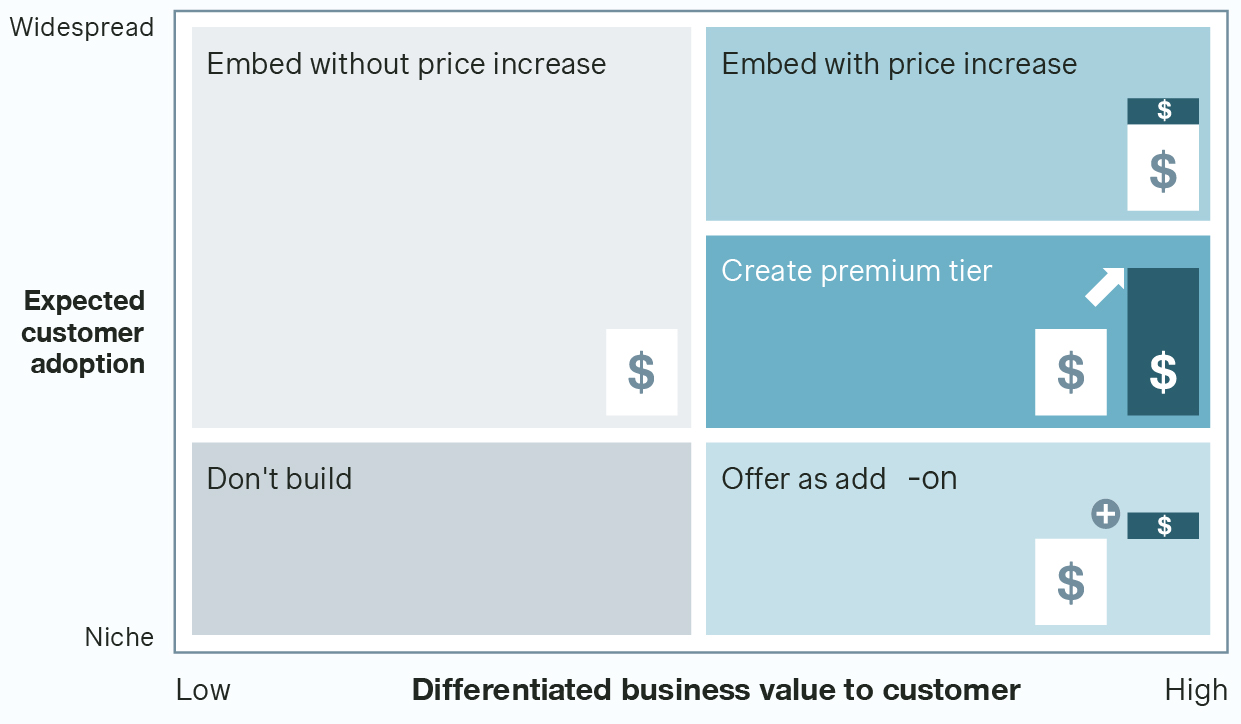
Consider a collaboration platform. Basic AI meeting summaries are useful to almost everyone, but they are becoming standard across competing products. Embedding them in the core offer, potentially without a separate charge, may be more effective than selling them individually. By comparison, an assistant that turns meeting decisions into CRM updates and follow-up workflows creates more distinctive value. If adoption is broad, it could support a higher core price; if demand is concentrated among power users, a premium tier may be better. A specialized sales coach that identifies patterns across customer calls could justify an add-on for a narrower segment. A novelty feature with limited adoption and differentiation may not be worth building at all.
The portfolio implications are clear. Embed the essentials to remain competitive and reinforce the core product. Premiumize differentiation through tiers or add-ons where customers see distinctive benefits, particularly in advanced automation and agentic AI. And continuously reassess the portfolio: today's premium AI capability may become tomorrow's expected feature. Product and monetization decisions must evolve together, rather than pricing being considered only after development.
2. Match the monetization model to value, autonomy, and cost
There is no universal AI pricing model. Three considerations should guide the choice.
First, indirect monetization potential: Can AI improve retention, adoption, or willingness to pay for the existing product? If so, embedding it may capture value without a separate fee. Second, AI autonomy: Is the capability assisting a person or independently taking ownership of work? More autonomy strengthens the case for direct monetization. Third, variable cost: does consumption materially increase the provider's cost to serve? If it does, pricing needs a way to reflect that exposure.
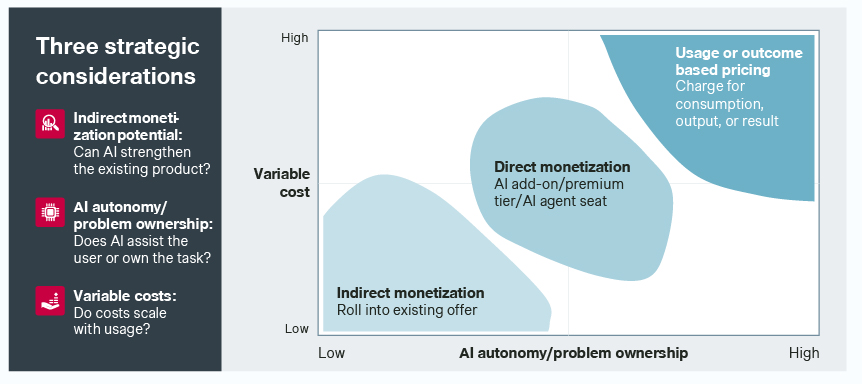
Low-autonomy, low-cost features may fit within the core subscription. Differentiated functionality can justify an AI add-on, premium tier, or dedicated agent license. Highly autonomous capabilities with meaningful usage-related costs may be better suited to usage-, output-, or outcome-based pricing. This does not mean abandoning seat-based pricing altogether. As AI performs more work and delivery costs rise with usage, the case for charging beyond user access becomes stronger.
Usage-based pricing itself covers several metrics. At the resource end, customers pay for compute, storage, or database capacity. Nordic cloud providers such as Finland's UpCloud and Aiven, and Sweden's Cleura, illustrate this approach: resource consumption is measurable and linked to delivery costs. Yet customers of business applications rarely care how many tokens were used to complete a task.
Activity-based models move closer to the user experience. Swedish AI development platform Lovable, for example, uses credits for AI-powered development activities. Credits translate technical consumption into a more understandable commercial unit. Sweden's Sinch similarly illustrates consumption-oriented charging through communications activities such as messages and calls.
Output-based metrics reflect work completed, such as invoices processed, accounting entries handled, or customer conversations managed. Swedish business software provider Fortnox provides an example of transaction- and volume-related charging, while Copenhagen-based Dixa has used AI conversation-based commercial units. These metrics are closer to what customers recognize as useful work, rather than what technology consumes.
Outcome-based pricing goes a step further. Intercom's Fin AI Agent offers a prominent example through charges linked to defined successful support resolutions. The customer pays for a result, not simply an interaction. But this only works when the outcome is clearly defined, reliably measurable and attributable to the software. A resolved support case can be relatively concrete; an AI contribution to a complex sales win is much harder to isolate.
The best metric, ultimately, balances customer value alignment, simplicity, predictability, and the provider's cost economics.
3. Transition gradually rather than switching overnight
Moving from seats to usage changes more than the price list. We observe three main challenges in Nordic software companies, which often lead to a transition being the better approach than a big bang.
- Customer predictability: Customers are accustomed to fixed subscriptions and predictable budgets, making variable charges harder to adopt.
- Metering readiness: Usage-based pricing requires reliable measurement capabilities, as companies cannot charge for what they cannot accurately track.
- Commercial transformation: Sales teams, billing systems, and customers must adapt to new pricing models, requiring changes in processes, capabilities, and customer education.
A practical transition allows providers to address these issues through three stages: crawl, walk, run.
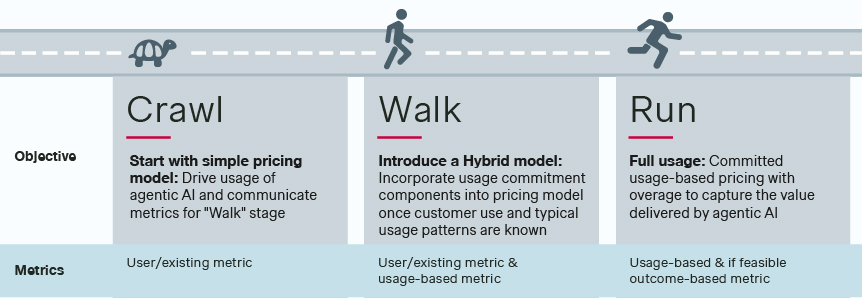
In the crawl stage, providers retain the familiar subscription model while measuring AI usage, costs, and customer behavior. Fair-use limits can protect against unusually high consumption. The priority is learning, not maximizing AI revenue immediately.
In the walk stage, companies preserve a predictable base while introducing usage allowances, included credits, or tiered packages. Enterprise customers might commit to a monthly or annual volume, with overage charges beyond that threshold. A model combining base subscription + included usage + commitment + overage connects revenue to consumption while keeping expenditure manageable.
Nordic software companies demonstrate different ways to make this middle stage work. Dixa's AI conversation packages show how a customer-service provider can add an AI consumption dimension without abandoning a predictable commercial foundation. Swedish CRM provider Lime Technologies illustrates a more package-led route, retaining familiar user-based elements while differentiating functionality and allowances across offers. Neither approach requires a sudden leap to pure pay-as-you-go. The appropriate balance depends on customer needs, purchasing behavior, and the value created by AI.
In the run stage, once usage patterns, metering, and commercial processes are mature, a greater share of revenue can follow actual consumption, completed work, or outcomes. But run is not a mandatory final destination for every provider: hybrid pricing may remain the best long-term answer for products where human access and AI work both create value.
Building a sustainable AI monetization strategy
For Nordic software leaders, the immediate priorities are therefore connected: identify where AI threatens seat revenue, focus development on meaningful customer problems, embed expected capabilities, charge a premium for differentiated ones, and build the metering and cost transparency needed for future models. The transition should protect existing customer relationships and the economics of the installed base.
AI is changing not only what software can do, but how it creates value. The companies that succeed will adapt their portfolios and pricing deliberately, rather than treating AI as another feature to bolt onto an old model.
The key question is: If software increasingly does the work, should vendors still charge only for the people using it?
Reach out to further discuss how we can help you develop an AI monetization strategy that captures new revenue opportunities.