
The future of AI pricing is often framed as a shift toward outcomes. Customers should pay for the value AI creates, not the resources it consumes. But as AI agents move from assisting users to executing work, this raises a fundamental question: when an AI agent resolves a customer issue, should customers pay for the actions it takes, the resolution it delivers, or the business value that follows?
Consider two AI agents that successfully resolve the same customer issue. One requires five actions; the other requires twenty. Should the customer pay more for the less efficient agent? At the other extreme, charging for incremental revenue or cost savings sounds attractive, but how much of that impact can realistically be attributed to AI?
This creates a key pricing challenge. For many enterprise AI applications, the answer may lie between activity- and outcome-based pricing: monetizing the work successfully delivered. Verified outputs can offer a more practical balance between customer value, measurability, and sustainable vendor economics.
AI is moving from access to execution
Traditional software pricing was built around access and seat-based licenses. AI infrastructure added tokens and compute, measuring the resources needed to produce intelligence.
Agentic AI changes the unit of value. Software increasingly executes work rather than just assisting people. It can also reconcile invoices, investigate exceptions, qualify prospects, or resolve customer requests.
This evolution creates five distinct pricing approaches: access, inputs, activities, outputs, and business outcomes. An AI agent handling a billing discrepancy could be priced by the number of users, tokens consumed, actions performed, cases successfully resolved, or dollars recovered.
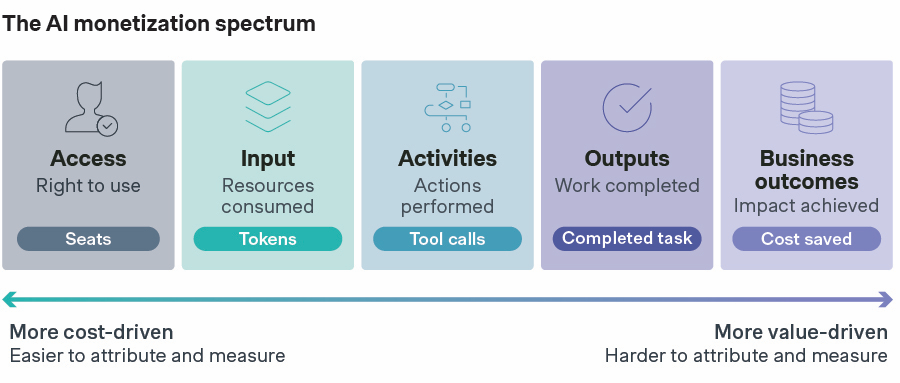
Moving across this spectrum generally brings pricing closer to customer value but also makes results harder to measure and attribute.
Each metric serves a purpose. Access pricing provides simplicity, input pricing suits infrastructure providers, and activity pricing can work when actions reliably reflect value. But as AI takes on more autonomous workflows, customer charges become harder to justify solely through technical consumption.
Why charging for activity becomes harder to defend
Under activity-based pricing, two agents completing the same task can generate different customer bills. One might resolve an issue in five actions. Another might require twenty because it selected a less efficient path, encountered errors, or needed retries. The customer receives the same result but potentially pays more for the less efficient execution.
The complexity increases as AI agents interact with enterprise software in different ways. The same task might be initiated through a product's user interface, an API, or a third-party AI agent using protocols such as MCP. Each pathway can involve different combinations of agents, tools, and workflows, creating two key challenges:
- Pricing complexity: Vendors must consistently meter and charge for different activities across multiple agents, tools, and access methods.
- Pricing inconsistency and arbitrage risk: Without harmonized charging rules, customers could pay different amounts for the same completed work depending on how their agents access the software.
As AI agents become more autonomous and interconnected, customers should not have to understand or pay for the technical complexity of how work gets done. Pricing should increasingly reflect what the agent accomplishes, rather than how many actions it takes, or how it accesses the software.
Why not go all the way to business outcomes?
Pure outcome-based pricing seems logical. If an AI sales agent helps close deals, why not charge a share of revenue? If an operations agent improves efficiency, why not charge a share of savings?
In some cases, this works. Stripe's Smart Disputes, for example, charges 30% of the disputed amount when a dispute is won, directly linking its AI service fee to a measurable financial result.
However, such clear attribution is not possible across most enterprise workflows.
Did the agent create a deal, or did the salesperson, product, and market determine the outcome? Did an operations agent prevent an outage that might never have happened? Attribution can be disputed, while payments may arrive long after delivery costs are incurred.
Intercom has publicly discussed this distinction in its AI sales pricing. It chose the qualified lead as a billable event rather than a share of eventual closed revenue, citing attribution and measurement challenges.
The key takeaway: A customer-valued output can be worth paying for, even when the ultimate business outcome is difficult to measure or attribute.
Output pricing: The missing middle
Output-based pricing monetizes a completed, customer-recognizable unit of work. It does not require the vendor to prove every downstream dollar of value, but it does require evidence that the agreed-on task was completed successfully.
In customer service, that might be a verified resolution. In finance, it could be a reconciled invoice or completed exception review. In sales, it might be a lead that meets the agreed qualification criteria.
The market is already experimenting with different approaches. A leading customer service software provider monetizes verified automated resolutions, while a leading CRM provider offers pricing options spanning actions, conversations, user licenses, and resolutions. These examples illustrate how enterprise AI monetization is shifting beyond traditional access and technical consumption metrics, although no single market standard has emerged.
Customers want to pay for value, but vendors need something they can reliably measure and monetize. Output pricing bridges that gap by connecting customer-recognizable value to a clear, verifiable billing metric.
Four principles for making output pricing work
Moving to output-based pricing requires more than changing the billing metric. The real challenge is developing a model that customers can trust, that scales across different workflows, and that remains profitable as AI adoption grows. Four principles can help guide this transition.
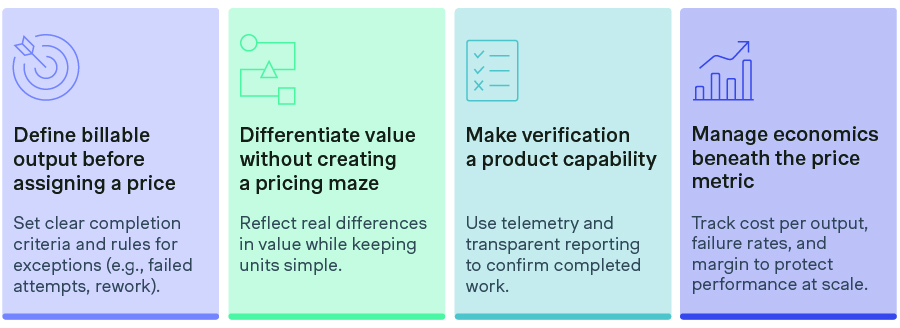
One important consideration is defining what qualifies as a billable output. Output-based pricing does not necessarily require a single charge upon final resolution. Depending on task complexity and where meaningful customer value is delivered, vendors can establish multiple charging points.
Consider two illustrative examples:
- Complex IT service incident: When a critical system goes down, an AI agent delivers value at several stages: impact assessment, recovery recommendation, and successful resolution. Each can represent a separately billable output if it delivers clear value to the customer.
- Simple customer service request: For a routine inquiry, such as updating account information, intermediate steps provide limited standalone value. The charge is triggered only upon successful resolution.
The principle is simple: charge for meaningful outputs, not every step an agent takes. This allows vendors to accommodate different levels of complexity while maintaining a consistent and scalable pricing approach.
Choosing the right AI pricing to drive adoption
The future of AI pricing will not be a binary choice between charging for activities and business outcomes. For many applications, vendors can charge for verified work completed, supported by upfront volume commitments and transparent rates for additional usage. This combines value-based monetization with greater spending predictability for customers and revenue visibility for vendors.
Importantly, output-based pricing could also accelerate AI adoption. According to the Simon-Kucher Global Software Study 2026, 66% of software buyers require quantified financial benefits or ROI to approve AI investments. While completed outputs do not prove ROI on their own, they provide a clearer foundation for connecting AI spending to value delivered. With AI becoming more affordable and its value easier to demonstrate, customers may be more willing to automate additional workflows and increase their investments.
AI pricing models that charge closest to a theoretical business outcome don’t automatically equate to success. The winning models make value easier to understand, spending easier to justify, and adoption easier to scale.
Turning output-based pricing into commercial strategy
Designing the right pricing model is only the beginning. Simon-Kucher has extensive experience helping companies bring value-based monetization models, including output-based pricing, to market. Our work spans defining billable outputs, designing pricing and packaging, and translating new models into contracting, sales enablement, and go-to-market execution.
If your organization is rethinking how to monetize AI agents, connect with our team to turn your pricing strategy into a scalable commercial model.