
Wholesalers and distributors are becoming increasingly sophisticated in how they segment customers and differentiate pricing. But differentiated GTM execution and customer development often lag, with many wholesalers and distributors relying on broadly similar coverage and activities across customers that have different needs and growth potential.
The commercial challenge across wholesale and distribution is increasingly one of execution. Simon-Kucher’s 2026 Global B2B Sales Study found that high-performing organizations achieve higher impact on conversion rate and margin, while spending similar or even less time (~40%) customer-facing. The differentiator is not more customer interaction: high performers are simply better at translating customer engagement into high-value commercial interactions.
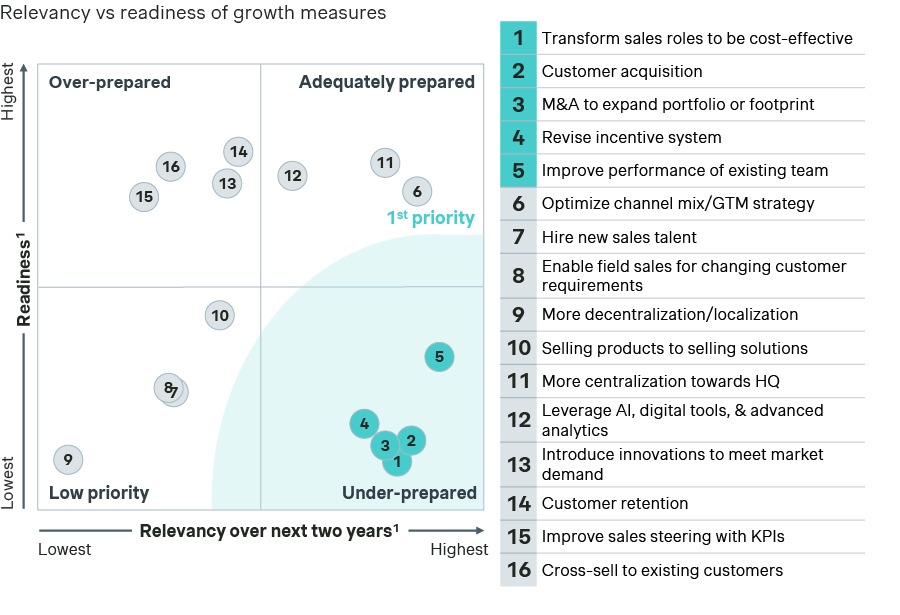
The study also shows that wholesalers remain underprepared on key commercial priorities, particularly around improving sales role cost effectiveness and improving performance of the existing team.
Figure 1: Relevance vs readiness of growth measures
Profitable growth depends on increasing share of wallet across a fragmented customer base without proportionally increasing commercial cost-to-serve. Thus, effective execution requires a differentiated customer development model: making deliberate choices about the type and level of coverage each customer receives, and which tools and capabilities enable the right interactions. In this article, we share Simon-Kucher’s perspective on how wholesalers and distributors can put this into practice across the customer base to drive profitable growth.
Customer segmentation is fundamental
Customer development differentiates sales, service, and other commercial activities against a robust customer segmentation to deliberately align cost-to-serve and customer potential. Most sales teams define customer potential or attractiveness based on:
Current value: revenue, gross margin, order frequency, category breadth
Future potential: share of wallet, under-penetrated categories, under-penetrated locations or geographies (often estimated by internal sales expertise)
Figure 2. Illustrative example of a customer segmentation based on future potential vs. current value
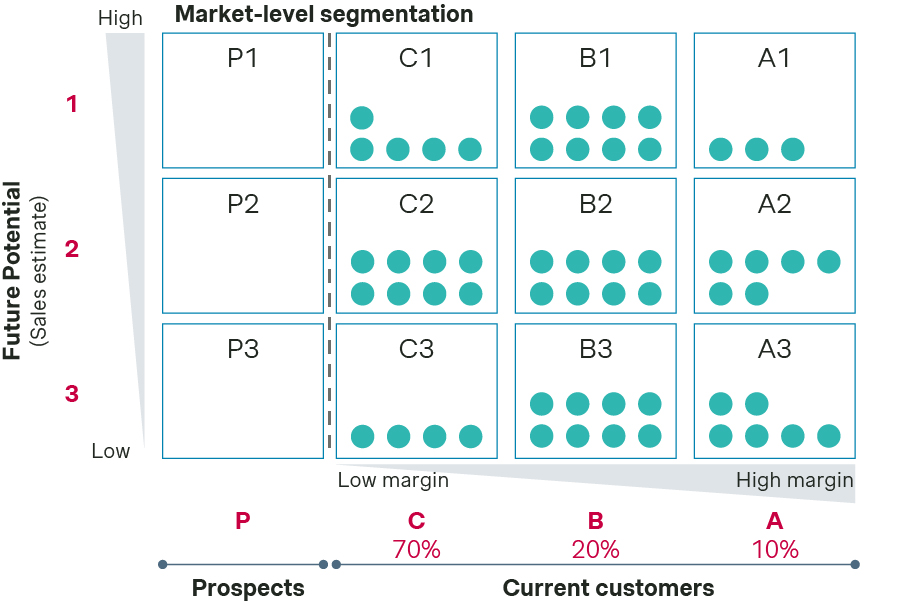
Other lenses may be considered given the specific market context. For example, a customer from a strategically important industry may be promoted to a higher segment, while a remotely located customer may be demoted to a lower segment. Both examples aim to align customer attractiveness and cost-to-serve.
Define activities and ownership per segment
Many commercial organizations are quick to assign accounts to roles without explicitly defining differentiated service levels per segment. This is the critical link between customer attractiveness and cost-to-serve. The simple example below suggests differences in role, meeting frequency, performance reviews, account planning, and other support. As organizational maturity evolves, or the market fluctuates, coverage and key activities and be added or adjusted.
Figure 3. Illustrative example of a differentiated coverage and service model
| Services and business rules | Prospects (P2, P3) | Lower priority (C2, C3) | Maintain (B3,A3) | Build (C1, P1) | Growth (A2, B1,B2) | Stars (A1) | |
|---|---|---|---|---|---|---|---|
Proposed intimacy / contact | First point of contact order mgmt. | n/a | n/a | Customer service | Customer service | Customer service | Customer service |
| Responsible role | Account Manager | Inside Sales / Digital | Account Manager | Account Manager | Account Manager | Key Account Manager | |
| Min. Frequency of F2F meetings | Only to close P2 opportunities | Not conducted | Minimum 2x/year | Minimum 2x/year | Minimum 2x/year | Minimum 4x/year | |
| Customer strategy and performance review/w customers | n/a | Not conducted | Minimum 1x/year | Minimum 1x/year | Minimum 1x/year | Minimum 2x/year | |
| Technical support | via AM | via Inside Sales / Self-service | Named product manager or expert | Named product manager or expert; involve supplier as needed | |||
Growth-focus and resources allocation | Key Account Planning (Customer growth plan) | n/a | Not conducted | Not conducted | Yes | Yes | Yes - detailed |
| Order optimisation | n/a | Not offered | Operational order review (Reactive) | Strategic quarterly or semi-annual review | |||
| Credit terms | n/a | Standard | Standard | Standard | Extended | Extended | |
A combined segmentation and differentiated service model has several operational implications. It helps to define the roles for hiring, informs team sizes and structures, and guides sales incentive plan design. It is recommended as a foundation for B2B sales organizations across the vast majority of industrial sales organisations, including wholesale and distribution.
Systemize the account planning process
Account planning is a critical activity that differentiates managed accounts from the long-tail of lower-value clients. Robust account planning integrates data across CRM, customer insights, and sales expertise, to form a holistic view on objectives, opportunities, challenges, and planned actions for an account.
Figure 4. Simon-Kucher’s 3P framework for account planning
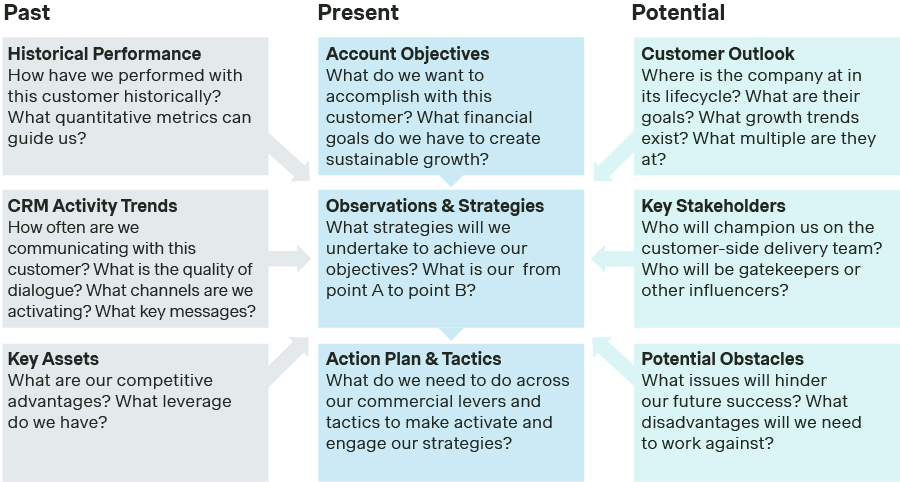
Inputs should be automatically populated from the CRM wherever possible. This is especially critical if account planning is new to the sales organization, since resistance will be high if many manual inputs are required. Algorithmic or AI-enabled “next best action” can also be leveraged, but should prompt or force the account manager for review, alignment, and validation, rather than taken at face-value.
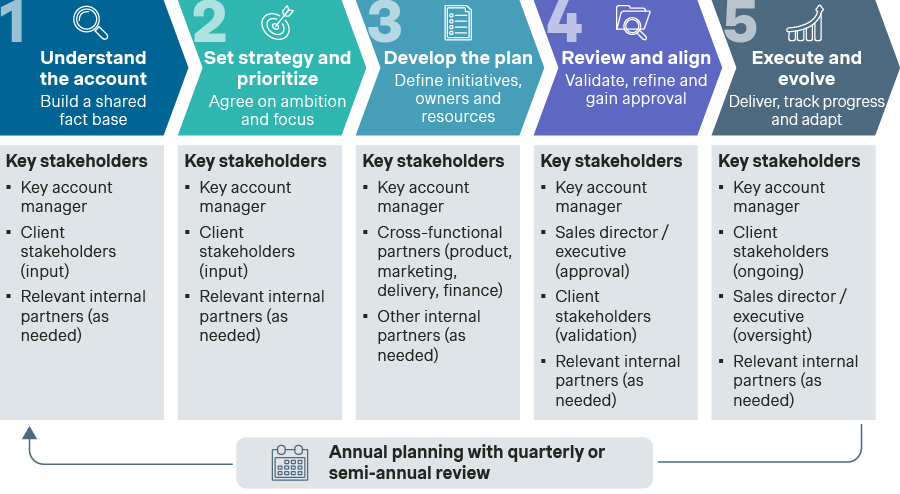
The real value of the account plan is not just in having the final document, but in the strategic thought, review, and alignment that goes into formulating and reviewing the plan. This is especially true for key and strategic accounts, which demand a human-led approach – even if supported by AI. Successful key account planning relies on input from key client stakeholders, alignment with internal support and delivery partners, structured reviews and monitoring, and executive oversight for the most important accounts. When account planning fails, it is typically a failure in the process, and not necessarily in the plan itself.
Figure 5. A robust and iterative key account planning process
Consider a digital journey for “low-touch” customers
The long-tail of our customers do not require a full account planning process. CRM capabilities allow us to automate decision-making and engagement with lower-value clients. Many B2B commercial organizations apply a trigger-based digital journey that automates commercial decision-making, significantly reducing sales resource requirements.
Figure 6. Illustrative example of digitally-driven customer journey
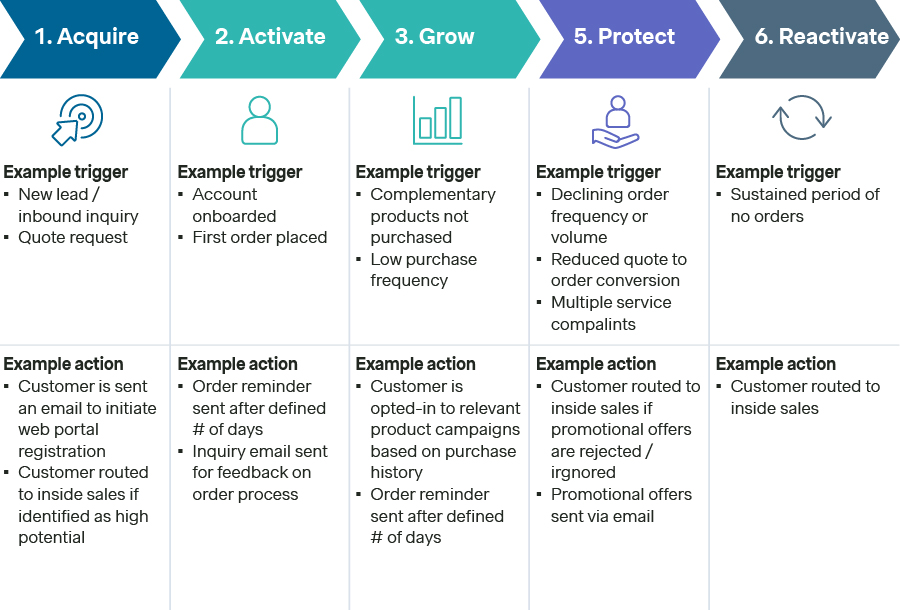
Digital sales journeys are typically led by the marketing function, but should be developed in conjunction with the sales team. Similar triggers can be used to aid inside sales or account management in their own workflows, such as consultative insights and “next best action” for client outreach. Digital journeys can also evolve over time, both to help drive near-term commercial objectives, or bigger changes over time to support a maturing commercial organization or fluctuating market.
Leverage AI to optimize efforts towards “high-value” activities
In addition to supporting decision-making and insights, AI also helps to digitize and automate low-value administrative activities. This frees up sales capacity to focus on preparation and execution of the higher-value customer interactions where human expertise provides the most value.
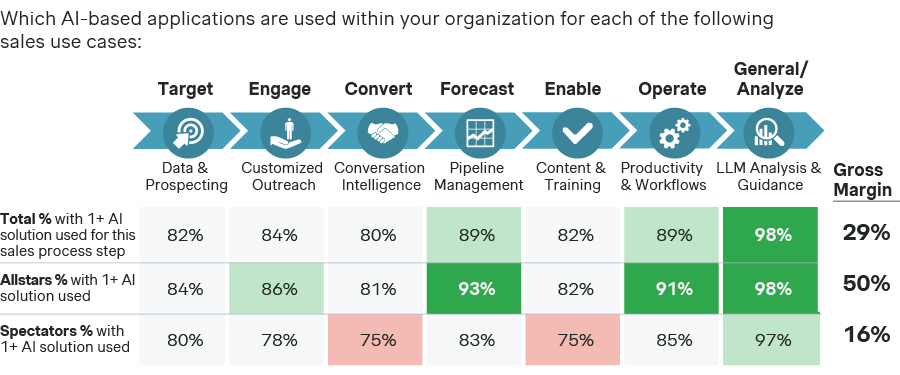
Many of the “All-stars” identified in Simon-Kucher’s Global B2B sales survey are already deploying AI more broadly across the revenue engine, particularly in sales operations, targeting, and engagement, and reporting materially higher gross margin than “Spectators”. The impact also appears to increase with breadth of adoption: wholesalers using AI across 3+ sales processes see stronger gross margin alongside revenue gains.
Figure 7: Usage AI-based applications across customer journey and commercial impact
Conclusion
Customer development works best when the commercial ecosystem is built on a robust foundation of customer segmentation and account planning, supported by digital engagement and outreach. These tools enable us to be more cost-effective while increasing team performance to drive profitable growth. If you want to increase the cost-effective performance of your sales team, or discuss any topics in this article or Global B2B sales study, please contact Simon-Kucher.