
B2B marketplace leaders are leaving money on the table when visibility products feel inconsistent or disconnected from results. Platforms need visibility products to turn paid exposure into a trusted performance lever that helps sellers compete more effectively.
Across marketplace models, visibility is one of the most powerful monetization levers because it directly influences the probability and speed of a transaction. For automotive platforms, more visibility helps dealers sell vehicles faster, reduce standing times, and improve inventory turnover. In real estate, higher exposure can create more buyer demand and competitive tension, potentially supporting stronger achieved prices. On job platforms, visibility is especially valuable for hard-to-fill roles, where reaching more relevant candidates materially increases the chance of a successful hire.
In other words, visibility is one of the most valuable commercial assets a platform controls: attention.
Transactional marketplaces have already proven how large this opportunity can become. In 2024, Amazon generated more than 56 billion US dollars in advertising revenue; eBay's Q4 advertising revenue of USD 445 million implies an annualized run-rate of roughly USD 1.8 billion; and Uber Ads exceeded a USD 1 billion annual revenue run-rate.
Classifieds are moving in the same direction, but many are still behind. Too often, visibility products are sold as hope: buy a boost, get more exposure, and “maybe” generate more leads.
AI is about to raise the stakes and make this asset even more strategic. As platforms move from keyword-based browsing to more personalized, intent-based discovery, visibility will no longer be defined only by fixed search positions. It will increasingly depend on which listings are shown, recommended, summarized, or prioritized in AI-supported user journeys. This raises a critical question for marketplaces: how should visibility be monetized when search itself becomes more dynamic and personalized?
Based on our work with marketplaces, three principles are critical.
1. Better positions must create better outcomes
The foundation of visibility monetization is simple: more visibility must generate more traffic and more leads. In many marketplaces, the first positions capture a disproportionate share of views and leads, creating a strong willingness to pay for better placement.
However, the design of the ranking system matters just as much as the position. Across marketplaces, visibility mechanics often become too complex over time: top listings, refreshes, bumps, badges, and premium placements overlap until sellers no longer understand which product creates real incremental visibility. If too many paid placements are allowed at the top, the “top listing” area can become so large that paid visibility no longer guarantees true top visibility.
Recency-based models create another challenge. Boosts can push listings up, but often only for a short period before they are displaced by newer or newly boosted listings. If booster intensity becomes too high, sellers may feel they need to constantly repurchase just to remain visible.
Finally, paid visibility must not be disconnected from relevance. If visibility is driven mainly by willingness to pay, boosted listings may generate more views but not more leads. That’s a signal that users are seeing listings that are not sufficiently relevant or attractive, which can hurt conversion, trust, and the overall user experience.
This is exactly where AI-supported search raises the bar. If platforms use AI to interpret buyer intent, personalize result pages, or recommend listings proactively, paid visibility needs to work with these relevance signals, not against them. In an AI-enabled marketplace, the winning model is unlikely to be “highest payer wins”. It is more likely to be a combination of commercial willingness to pay, predicted buyer relevance, and expected transaction outcome.
The implication: paid visibility should be scarce, easy to understand, and clearly linked to better seller outcomes, while still protecting relevance.
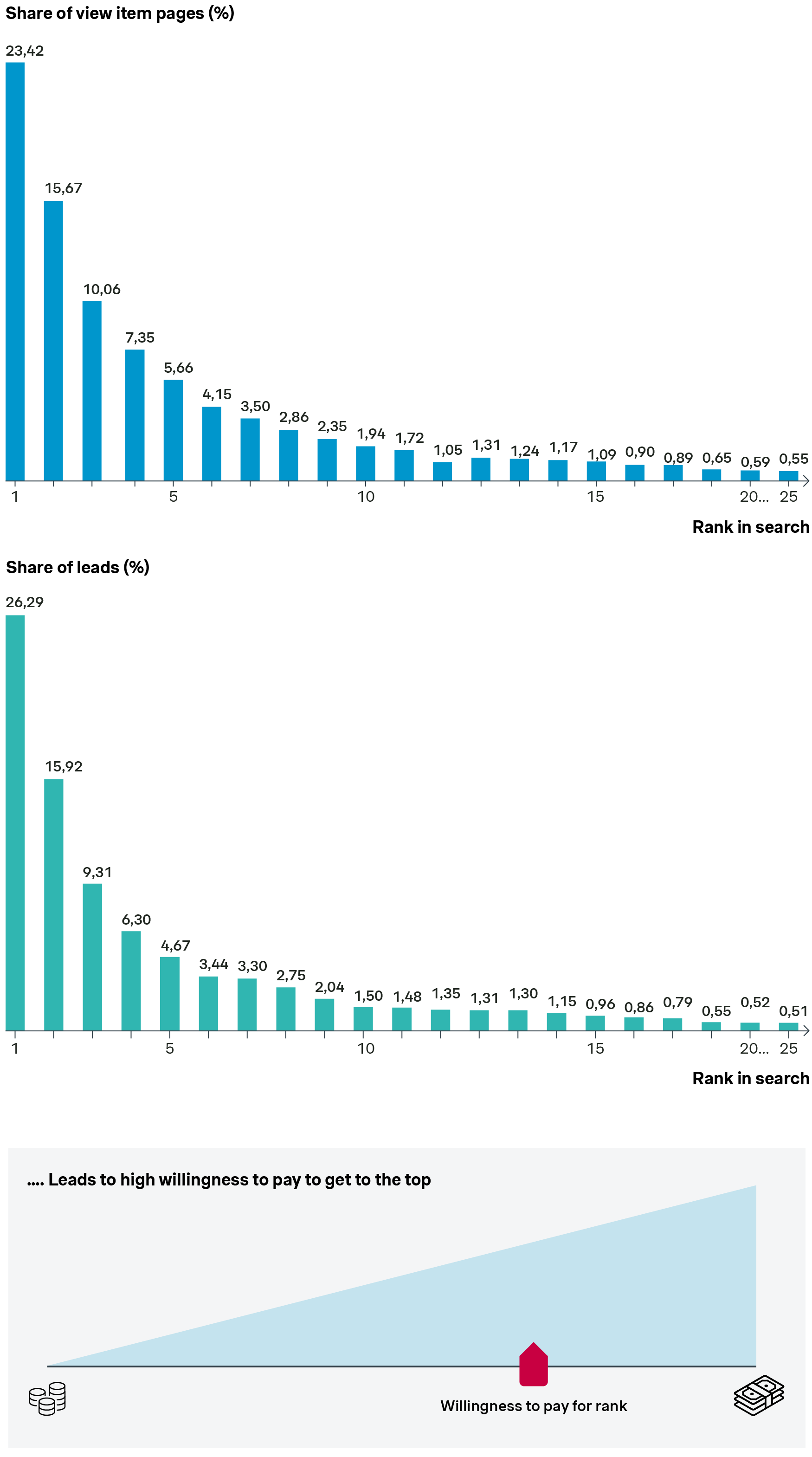
Benchmark example: view and lead share generated by respective rank in search at car classifieds with relevance/package based search
2. Visibility monetization needs competition
Visibility only becomes a strong revenue pool when many sellers compete for scarce positions. Search advertising is the classic example: sellers bid for keywords, and the price of top placement reflects competition, expected click-through, and commercial value.
Marketplaces often have the same potential but do not fully use it. In many cases, visibility spend is concentrated among a small group of heavy users, while the majority of sellers do not actively buy additional visibility. This has two consequences. First, the platform is under-monetizing a large part of the seller base. Second, heavy users may benefit from high discounts, even though they often have the strongest need for visibility and the highest willingness to pay for it.
Marketplaces should therefore rethink how they create competition for visibility. Potential levers include simplifying the offer, differentiating prices by listing value or demand intensity, creating stronger performance tiers, and moving toward more dynamic pricing over time.
A visibility boost for a high-value listing, a dense search category, or a high-margin region is worth more than a boost in a low-value or low-demand context. Price differentiation helps platforms capture this value while giving sellers more relevant options.
3. Sellers need to understand the value before they spend
Even a well-designed visibility product won’t sell if sellers can’t see what it’s worth. Many platforms show the product and the price, but not enough proof of expected impact. Sellers are asked to buy a “boost”, “refresh”, or “top placement” without knowing what it is likely to do for views, leads, or conversion.
This is where marketplaces can improve dramatically. Instead of selling booster mechanics, they should sell outcomes. A seller dashboard should not only show how many views a listing has received but translate that into a clear prompt: “Your listing is performing below similar listings in your region. A visibility boost could help restore traffic.”
The best platforms make additional spending easy to understand and easy to control. They link budget directly to expected outcomes, such as share of voice, ranking position, views, or leads.
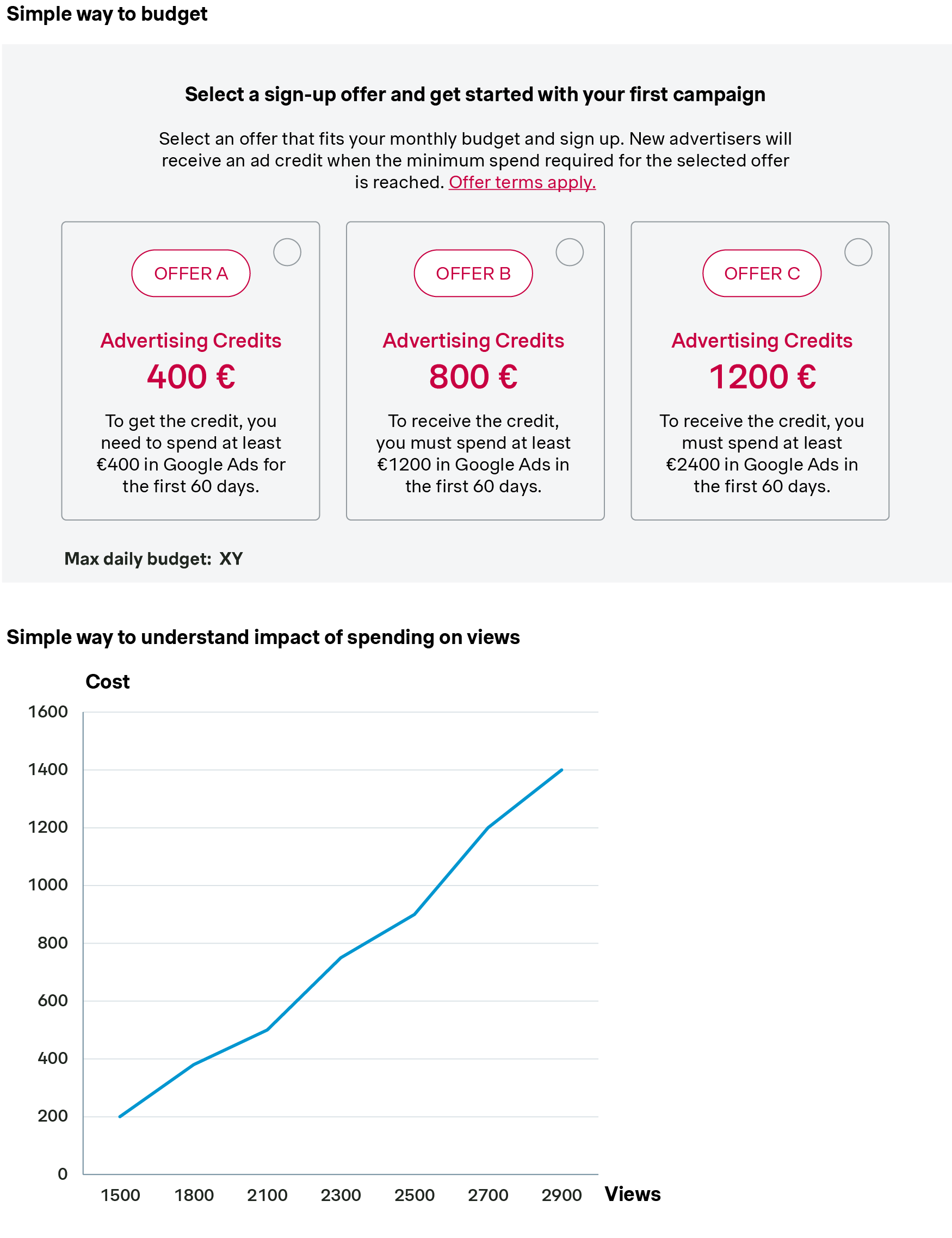
Example: Google Ads
Over time, this can evolve into an AI-supported “smart visibility manager”: sellers set a goal and a budget, while the platform automatically allocates spend across visibility actions. The system could decide when to refresh a listing, when to buy premium placement, when to increase exposure in a specific search context, and when not to spend because the expected uplift is too low. That changes the proposition from “buy this booster” to “tell us what you want to achieve, and we will help you get there.”
Practical change scenarios for marketplaces
For marketplace leaders, the path forward usually combines short-term commercial improvements with longer-term product evolution.
In the short term, platforms can improve value communication during listing creation, trigger visibility product nudges when performance declines, control excessive discounts, and differentiate prices based on listing or seller value.
In the medium term, they can redesign packages around performance, simplify overlapping visibility products, and make competitive performance insights more accessible.
In the long term, platforms can move toward AI-enabled visibility systems: dynamic or auction-based pricing, programmatic allocation of visibility inventory, and automated budget management where sellers define goals rather than manually selecting individual booster products.
The biggest opportunity lies in making paid visibility more accountable: stop selling hope and start selling measurable impact. When visibility is selective, valuable, measurable, and trusted, sellers are more willing to invest and buyers are more likely to stay engaged with relevant results. This gives the marketplace a monetization engine that scales with trust.
For more information or to speak to our team please contact us.