
Despite the mixed macro sentiment, M&A activity surged in 2025 and continues accelerating well into 2026. As portfolios expand and evolve, brand strategy is becoming crucial for maximizing deal value and overall value creation.
Yet, many organizations continue juggling a growing portfolio of brands without a concise blueprint for architecture rationale and positioning. Brands are often expanded, acquired, or reorganized resulting in mismatched positioning and missed opportunities to fully capitalize on advantages from a multi-brand strategy.
Why is strong brand strategy important?
Across markets, strong brand architecture strategy sits at the helm of all optimization efforts related to growing and winning. Revenue, margin, and brand growth are direct reflections of a brand’s positioning. Ultimately, success is derived from having a firm grasp on where brands operate, their core consumer segment, and their distinct value propositions.
When properly executed a robust portfolio enables:
Strategic clarity: Creating and aligning leadership on brand positioning and targeting ensures that all strategic decisions are made with architecture logic in mind. It also helps highlight white space in the market while preventing actions that do not strengthen the overall portfolio.
Sustainable competitive advantage: Differentiated brands create an advantage in both scale and target segment coverage, making it difficult for competitors to keep pace.
Optimized targeting: Intentional tiering allows parent companies to adjust positioning, offerings, and messaging to cater to a broader market segment without blurring brand identities or causing inter-brand conflict.
Growth through brand equity: Determining the right level of parent brand association can accelerate expansion and support go-to-market efforts by leaning on existing brand equity and reducing negative spillover effects.
Alignment of organizational culture & values: Shared understanding of brand roles reduces internal conflict and informs priorities across commercial functions.
What are the pillars of brand strategy?
Brand strategy isn’t a monolith, it’s a series of elements working in tandem to create, maintain, and sustainably grow brand equity.
Five pillars form the base for determining the optimal portfolio architecture and prompt a series of questions that companies should consider.
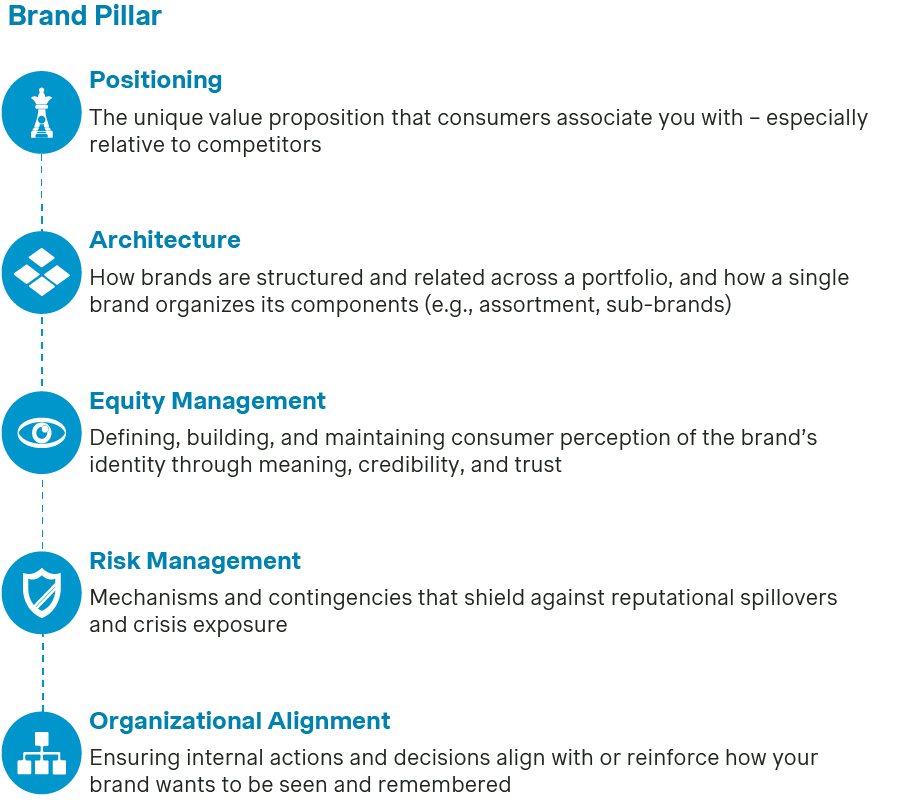
- Positioning: The unique value proposition that consumers associate you with, relative to competitors.
- What is the brand image of each brand today?
- What are the identifiable strengths and gaps?
- Who are the target consumer segments for each brand? Are they meaningfully differentiated?
- How are competitors positioned?
- What “white space” positioning opportunities exist?
- How should each brand be positioned alongside other companies in the portfolio? Are there any current overlaps?
Architecture: How brands are structured and related across a portfolio.
- What multi-brand architecture archetype works best for our portfolio?
- Is it a branded house, a house of brands, or something in between?
- How many brands should be supported and through what means? How should they work together?
- Are there any gaps in the current product portfolio, and how should they be addressed?
Equity management: Define, build, and maintain brand identity through meaning, credibility, and trust.
- How do consumers perceive your brand in the market? Does it align with the image you intended?
- What activities do you undertake to improve your brand equity, or ensure alignment with your vision?
- How does equity transfer across brands within the portfolio (e.g., parent brand to portfolio brands)?
Risk management: Implement mechanisms and contingencies to mitigate reputational spillovers and crisis exposure.
- What are the key reputational risks our portfolio is most exposed to?
- How exposed is the parent brand to potential spillovers from portfolio brands?
- What crisis response protocols and governance structures are in place to protect brand equity?
Organizational alignment: Ensure internal actions and decisions align with how you want your brand to be remembered.
- Is there clear ownership and governance for brand strategy across the organization?
- Does each brand understand how they relate to the overall portfolio?
- Do employees understand and consistently deliver on the brand promise?
- How are you presently ensuring that brand is considered throughout internal decision-making?
Answering the crucial questions surrounding each pillar will help your organization reset and develop a stronger understanding of your portfolio. Moreover, it may spark a discussion around the future and how to get there.
How does this all come to life?
The brand strategy pillars we outline underpin any architecture strategy, whether explicitly identified or not. Many of them are complex questions that may seem daunting at first glance.
To bring it all to life, we can break down the development process into three key steps: Where we are today, where we need to be, and how to get there.
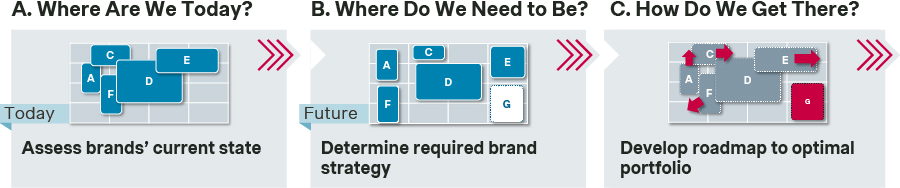
Where are we today?
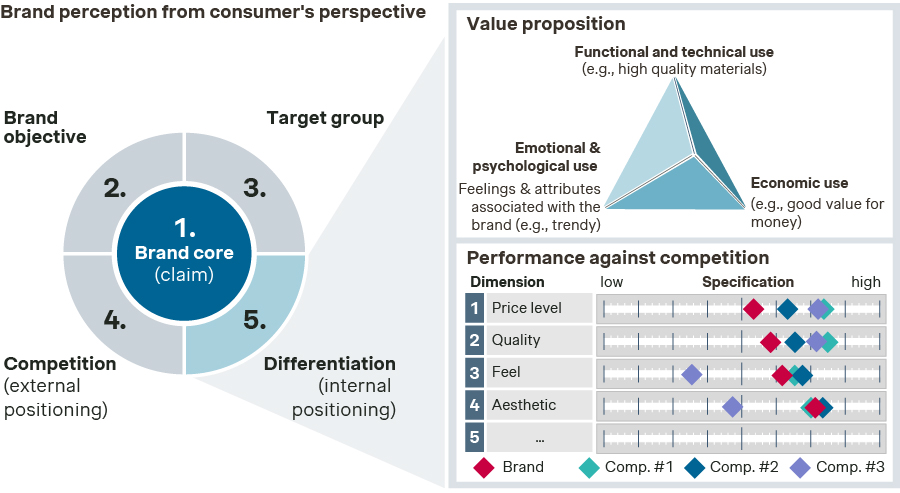
The first step is assessing your current portfolio. Before diving into strategy and design, it’s essential to fully understand where your organization stands in relation to its target audience. This step entails building an awareness of the current portfolio performance against consumer preferences and parent company expectations:
Develop brand profiles: Map out product categories to target consumer segments to benchmark brand performance and identify growth opportunities.
Conduct consumer perception and market research: Understand how consumers perceive your brand positioning compared to competitors in terms of brand association, strengths, and weaknesses.
Develop hypotheses-driven brand strategy alternatives: Based on internal and external insight, develop strategic alternatives to update, re-position, or transform each brand’s strategy.
Where do we need to be?
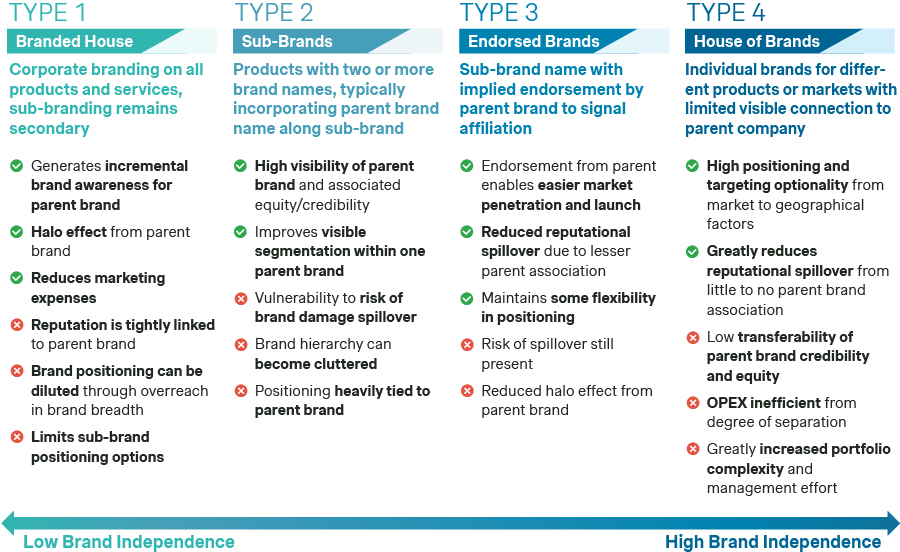
Next, define what your portfolio should look like. This is the ideal time for building the architecture. As an organization, ask what needs to be true for us to win in our target market? Where do we need to be with what we know?
Develop new positioning for each brand: Agree on how positioning should change (or not change) while keeping in mind other portfolio brands. Typically, this could look like a price vs. value map to create tiering between brands and prevent overlap. In addition, the map can expose whether brands are present in attractive segments and if there are price ranges that are not being captured.
Develop a clear internal positioning statement: Align each brand to a clear positioning statement to guide future decision-making and external implementation.
Define future state architecture: Evaluate architecture options and select the archetype that minimizes cannibalization and aligns with company strategy. It’s key to revisit the brand pillars outlined above and determine which trade-offs you are willing to make.
Create business cases and run simulations: Validate viability after confirming state positioning and architecture. By making changes, the analysis allows you to estimate the potential uplift from better alignment.
Final validation and enrichment: Consumer opinion matters most. Support your simulations through external validation (either qualitatively or quantitatively) process before restructuring.
How do we get there?
Lastly, with any good strategy, execution is critical. The journey matters as much as the desired destination. Applying a strong infrastructure suite is essential to achieve desired outcomes.
Document, document, document: All key stakeholders need to have a solid understanding of what is changing, why it’s changing, and how it’s changing. A brand handbook that describes the positioning of each brand portfolio ensures clarity in the goals each should achieve. A clear reference enables quicker uptake and reduces confusion.
Migration planning: A strong migration plan defines the WHO, WHAT, and HOW. Clearly outline brand movement, whether it’s a refresh, a reposition, or status quo, what changes the consumer will experience, and how to maintain or grow brand equity during the transformation. It’s also pragmatic to clearly identify risks and develop mitigation strategies in parallel.
Implementation roadmap: Build a clear, phased roadmap with objectives and activities that will enable portfolio restructuring. Key roadmap pieces include key initiatives, sequence, timelines, and ownership. Answer questions such as:
- What are the big milestones we are achieving?
- What activities are mission critical that require heavier support?
- Do we have the right resources in place?
- What are roadblocks we can anticipate and account for?
Governance and reporting: We all know that what gets measured gets managed. This is a guiding principle for large scale transformations that affect your entire consumer base. Establish clear governance structures, decision rights, KPIs, and ownership to reduce bottlenecks and track progress effectively. Best practice would include coordination mechanisms such as task forces and regular steering committees that are responsible for ensuring progress and proactively catching issues.
Multi-brand strategies are a timeless concept that have generated hundreds of billions in value from accelerating growth and leveraging economies of scale – just look at the top performing apparel conglomerates, marquee CPG brands, and automotive OEMs. Brand architecture isn’t a check-the-box exercise, it is a deep dive into who your consumers really are and how you can best capture their hearts and minds to create a sustainable competitive advantage.
The right question to ask isn’t ‘if’ optimizing portfolio architecture should be done, it’s a matter of when and how. Ready to leverage brand architecture towards better growth? Connect with our team to learn how resetting your portfolio can unlock value creation.
Contributing author: William Hou