
The Netherlands is steadily tightening its approach to sugar-related taxation. While the Consumption Tax on Non-Alcoholic Beverages (VBB) has existed for decades, the significant increase introduced in 2024 marked an important shift in direction. From 2027 onwards, the scope of the tax is expected to expand to additional beverage categories, including certain sweetened dairy and plant-based drinks, subject to parliamentary approval.
At the same time, the Dutch government continues to explore a differentiated sugar tax, where tax levels would depend on sugar content, similar to models already implemented in markets such as the UK.
This is more than a regulatory change. Sugar taxation has the potential to reshape pricing, portfolio strategy, and competitive positioning across categories. The key question is therefore not only how to comply, but whether to use this moment as a catalyst for broader commercial transformation.
International experience already demonstrates how significant the impact can be. In the UK, the announcement alone triggered large-scale portfolio redesign. Manufacturers reformulated products at scale to stay below tax thresholds, reducing sugar content in soft drinks by an average of ~46% between 2015 and 2020.
Evaluation of the category after the implementation of the 2018 UK sugar tax shows the impact on consumer behavior has been significant and the volume mix has been structurally redefined.
While total category volume remained broadly stable (around -0.5%), the value mix changed fundamentally: consumers reduced sugar intake by ~30%, and today 85–90% of volume sits in the lowest or zero-tax bracket.
Winning requires a deliberate commercial reset
Shifts in volume and mix directly reshape portfolio economics. Managing this requires clear, deliberate choices across pricing, portfolio strategy, and revenue growth management. We see four critical steps to move from reaction to advantage:
Step 1: Assess your exposure
Start by understanding where the sugar tax will impact your business—not just which products are taxed, but what this means for volume, margins, and portfolio role.
Products just above key tax thresholds are particularly critical, as mall changes can significantly alter both tax exposure and commercial performance.
Without this transparency, decisions risk being inefficient or unfocused and sometimes even value destructive.
Step 2: Define your ambition and anticipate competitive response
As we’ve seen in the UK, most players will respond, but not in the same way. Some will prioritize margin protection, others volume retention, and a few will use the moment to reposition their portfolio more fundamentally.
Understanding your own ambition informs how you respond to exposures you identified.
• Do you aim to outperform on market share?
• Protect profitability?
• Or structurally reshape your portfolio?
To compliment this, scenario analysis that identifies likely patterns of competitive responses is critical: which competitors are most exposed, who can adapt fastest, and where do we expect value and volume likely shift?
Your own ambition and likely competitive responses inform the direction of research in step 3.
Step 3: Decode market dynamics & product intrinsic opportunities
Build a fact-based view of how the category operates today and how it is likely to evolve. This includes researching price levels, promotion evaluations, consumer needs, key price thresholds, demand elasticities, and the role of different segments and channels. These dynamics determine where pricing power sits, where consumers are most sensitive, and where shifts in demand will occur.
Also, research what cost and effort possible reformulation would require to provide better tax positioning and, most importantly, whether the product still aligns to target consumer & customer needs and your brands positioning.
Step 4: Translate insights into commercial action
The final step is to turn insight into concrete, quantified scenarios. Combine different levers: pricing, pack-price architecture, mix management, promotions, trade investments, and reformulation (see Figure 2) and model their impact on volume, mix, and margin.
Figure 1: Framework Revenue Growth Management Levers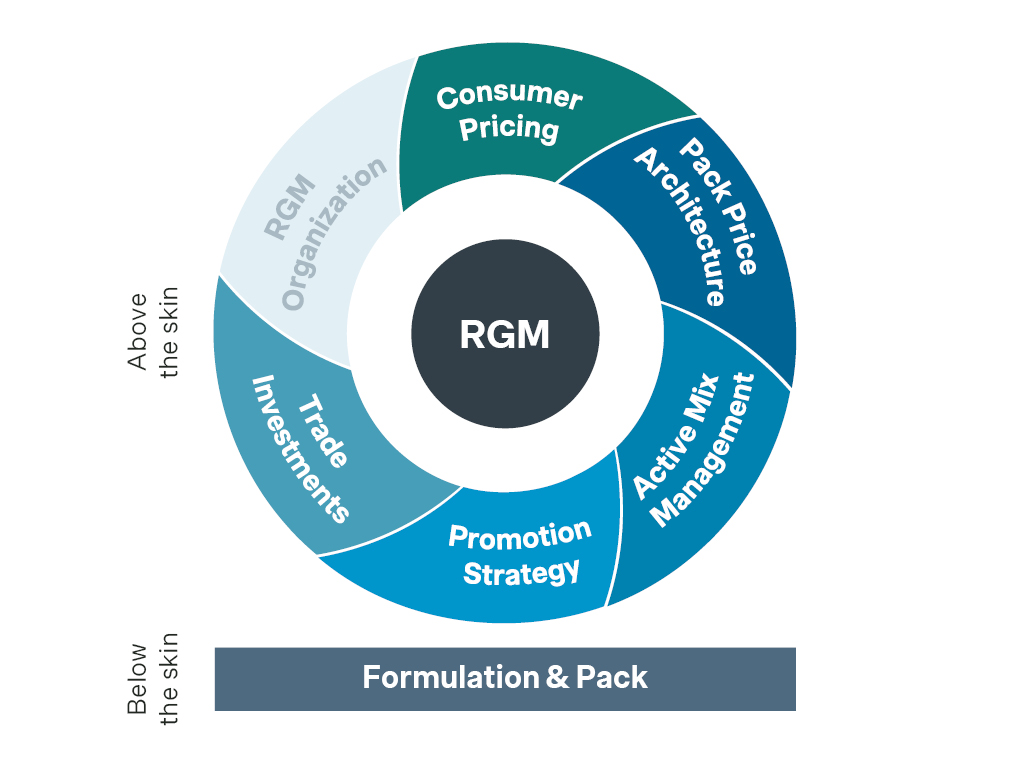
This is where difficult trade-offs should be solved for:
• Where do you pass on cost versus absorb it?
• Where do you drive premiumization versus protect volume?
• Where do you actively shift demand?
Clear choices, grounded in data and aligned with strategic ambition, determine whether you mitigate downside or capture upside.
Figure 2: Reformulation of questions across Revenue Growth Management levers
Example questions per lever
| Consumer pricing |
|
| Pack-price architecture |
|
| Active mix management |
|
| Promotion strategy |
|
| Trade investments |
|
| Formulation & Pack |
|
From policy change to commercial inflection point
The exact design of the sugar tax in the Netherlands remains uncertain. Different thresholds, exemptions, and category definitions will influence the magnitude and distribution of impact. But the strategic implication is already clear.
This is not an isolated regulatory measure, it is a structural shift in how value is created across the category.
Companies that treat this as a compliance exercise will manage the downside. Companies that treat this as a catalyst for commercial transformation will redefine their position in the market. This is not about managing a tax. It is about deciding how you compete in the next version of the category.
Please do reach out if you’d like support in translating these insights into concrete next steps for commercialization.