
The way AI supports sales is changing. As agents move from assisting sales representatives to executing parts of the workflow, commercial leaders face new questions about pipeline quality, pricing discipline, and reliability. Our Simon-Kucher Elevate experts uncover what it takes to make agents dependable, and what leaders should get right before scaling.
Sales teams gain little from isolated AI experiments. They need more qualified pipeline, faster deal cycles, and stronger margin discipline. That is the difference between treating AI as a productivity accessory and building it into the revenue operating model.
The first wave of AI solutions for sales was mostly assistive. These tools summarized calls, drafted emails, updated fields, and helped sales reps prepare. These tools were useful, but the sales representatives still had to know what to ask, when to act, and how to translate the output into commercial action.
Agentic sales changes that equation. An agent does not just produce another sales email. It can detect a trigger, prioritize an account, recommend the next action, draft the follow-up, check the pricing corridor, escalate an exception, and leave an audit trail. That is a different management question: no longer only, "Can AI support sales representatives?" but "Which parts of our commercial workflow should be assisted, guided, or fully run by agents within clear guardrails?"
Why now: the pressure is commercial, not technological
The pressure on sales organizations is not theoretical. Salesforce's State of Sales report found that sales reps spend 70 percent of their time on non-selling tasks. The same research also found that sales teams using AI were 1.3 times more likely to see revenue growth than teams without AI. The exact impact will differ by company, but the direction is clear: when sales representatives are buried in administration, internal coordination, and fragmented systems, the revenue system leaks time and focus.
This is why agentic sales is becoming relevant now. Models are improving, and the infrastructure around them has matured. Companies can now deploy agents in secure environments, trace and observe what they do, and keep humans in the loop through guardrails. But model access alone is not a differentiator. Most companies can reach similar foundation models. The advantage sits elsewhere: in the ability to embed agents into the workflows that move revenue.
That means connecting CRM, pricing, proposal, knowledge, and communication systems, along with external signal sources. It also means defining what "good" looks like commercially. A technically correct answer can still be commercially wrong if it recommends the wrong account, accepts the wrong discount, or gives the sales reps a generic value argument that weakens the deal.
What changes when AI becomes agentic
Agentic sales is best understood as a shift from assistance to execution. A chatbot waits for a prompt. A copilot helps with a task. An agent can execute a bounded workflow within clear guardrails, while the sales representative remains accountable for the commercial decision and outcome.
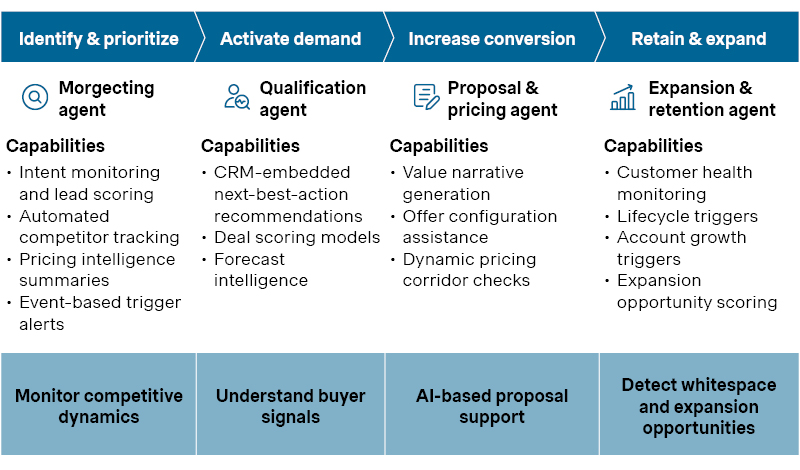
In prospecting, an agent might monitor intent signals, competitive triggers, and whitespace opportunities, then reprioritize target accounts. In qualification, it can surface next-best actions from CRM signals and deal risk. In proposals and pricing, it might generate a value narrative, check the pricing corridor, and suggest negotiation arguments before escalation. In renewal and expansion, it can track usage patterns and contract milestones to flag churn risk and cross-sell opportunities.
Source: Simon-Kucher
The value is not in any single use case, but in orchestration. Better prospecting improves pipeline quality, tighter qualification sharpens focus, and disciplined pricing protects margin. Faster follow-up shortens cycle time, and stronger renewal intelligence drives retention and expansion. When these pieces reinforce each other, value compounds. Here's how it works in action:

Source: Simon-Kucher
Extreme prototyping de-risks the buying decision
There is a challenge with agentic sales: decision-makers can struggle to commit to an agentic workflow they cannot yet see. Slides can describe a future workflow, but they rarely change the room. A clickable prototype does.
Extreme prototyping is valuable because it makes the future sales workflow tangible before committing to a full build. In a few days, leadership can see how an account intelligence agent might surface a priority account, how a pricing agent might flag a corridor breach, or how a meeting-to-follow-up agent might update CRM and draft the next action.
This matters because agentic sales requires cross-functional buy-in. Sales leadership cares about quota and adoption, pricing teams about margin and discount discipline. IT focuses on integration and security, legal and compliance on traceability and human oversight. A prototype gives these groups a concrete object to react to. It turns abstract alignment into a design conversation.
Reliable agents start with commercial judgment
Reliable agents are not built by engineers alone. They need domain expertise and technical discipline working together.
Commercial logic decides what the agent should optimize for: pipeline quality, win rate, margin, retention, expansion, policy adherence, or sales reps productivity. Sales workflow design places the agent in the daily reality of reps, deal desks, and account teams. Context engineering ensures the agent receives the relevant, current facts, customer signals, and commercial rules at each decision point - so it can make the right commercial decision on the right basis. Evaluation engineering defines how the output is judged. Observability shows what the agent did, step by step.
This is where many AI projects become fragile. Without commercial logic, agents follow instructions but may make poor business decisions. Problems become hard to diagnose without observability. And without business-aligned evaluation, quality can drift silently. Feedback loops tied to sales outcomes are what keep the system improving.
Morgan Stanley's work with OpenAI is a useful proof point here. OpenAI describes how Morgan Stanley used an evaluation framework to support adoption of AI tools in wealth management, with over 98 percent of advisor teams actively using the AI @ Morgan Stanley Assistant, the firm’s internal advisor chatbot. The lesson is not to copy the same solution, but that adoption at scale requires trust, and trust requires evaluation.
Production impact needs a different delivery model
The delivery model for agentic sales should not look like a traditional software project or an unstructured AI experiment. It needs both speed and control.
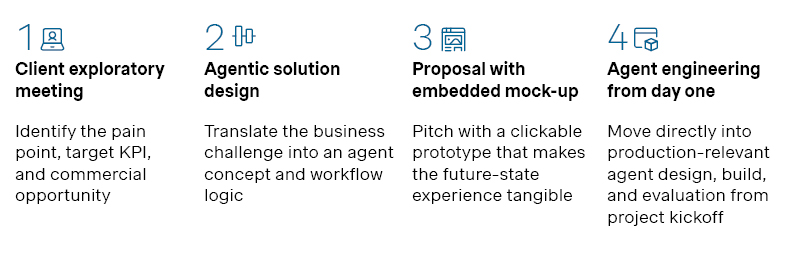
A rollout starts with agent design and commercial scoping. Which workflow will the agent support? Where does it deliver measurable P&L impact? What decisions can it suggest, execute, or escalate? What does "correct" mean in commercial terms?
The next step is to engineer the agent and its context, integrate the systems, and validate against curated commercial scenarios. Then comes pilot deployment with observability, tracing, dashboards, and a documented baseline. Only then can the team move into continuous improvement, comparing agent behavior and commercial outcomes against the baseline over time.
Source: Simon-Kucher
The operating rhythm matters: build, test, ship, observe, refine. That loop turns agentic sales from a one-off prototype into a managed revenue capability.
What leaders should do now
The starting point is not to ask which model to use, but where sales execution is weakest today.
Where do sales reps lose time to non-selling work? Where does pipeline quality break down? Where does discount leakage happen? And where do renewals become reactive rather than proactive?
Once those moments are clear, leaders can select the first agent use case based on value, feasibility, and risk. Some use cases are easier to start with: meeting-to-follow-up agents, account intelligence agents, expansion trigger agents, or discount governance support. Others require deeper integration and stronger guardrails.
The best first step is usually not the biggest agent. It is the agent that proves the management model: measurable commercial value, reps adoption, evaluation discipline, and a path to scale.
Agentic sales will not replace the commercial judgment of good sales teams. But it will change how that judgment is deployed. The companies that win will not simply give reps more AI tools. They will embed commercial logic into daily agentic execution, make the future workflow tangible fast, and build the discipline to improve it continuously.
To discuss what agentic sales could mean for your revenue execution, contact our Simon-Kucher Elevate experts.