
APIs have become the backbone of modern digital ecosystems, connecting platforms, automating workflows, and powering analytics, AI, and end-to-end business processes. As data volumes grow, AI use cases expand, and cloud-native architectures mature, API usage is accelerating rapidly. According to Postman’s 2025 State of the API report, 46% of organizations are increasing investment in APIs in the next year. This trend is reinforced by AI, where APIs act as gateways to high-value compute and models, combining significant infrastructure costs with outcome-based value, making pricing more complex and more critical.
Yet for many tech companies, software APIs remain a commercial blind spot. Usage and costs are rising, but the link to value capture is often unclear, leading to missed revenue and potential cannibalization. As APIs evolve into strategic assets, monetization requires deliberate design rather than ad-hoc decisions.
When to monetize your software APIs?
Not every API should be monetized; at least not immediately. The decision to introduce direct pricing should be a strategic one, grounded in value creation rather than technical capability.
A useful starting point is a simple but powerful question: who benefits from this API and how much?
The 2x2 decision lens
API monetization decisions can be structured along two dimensions:
• Benefits to the vendor (e.g., revenue growth through better value capture of API, ecosystem control, product enhancement)
• Benefits to the partner or customer (e.g., efficiency gains, new revenue streams, workflow automation, data access, competitive advantage)
Image 1: Decision matrix for API monetization
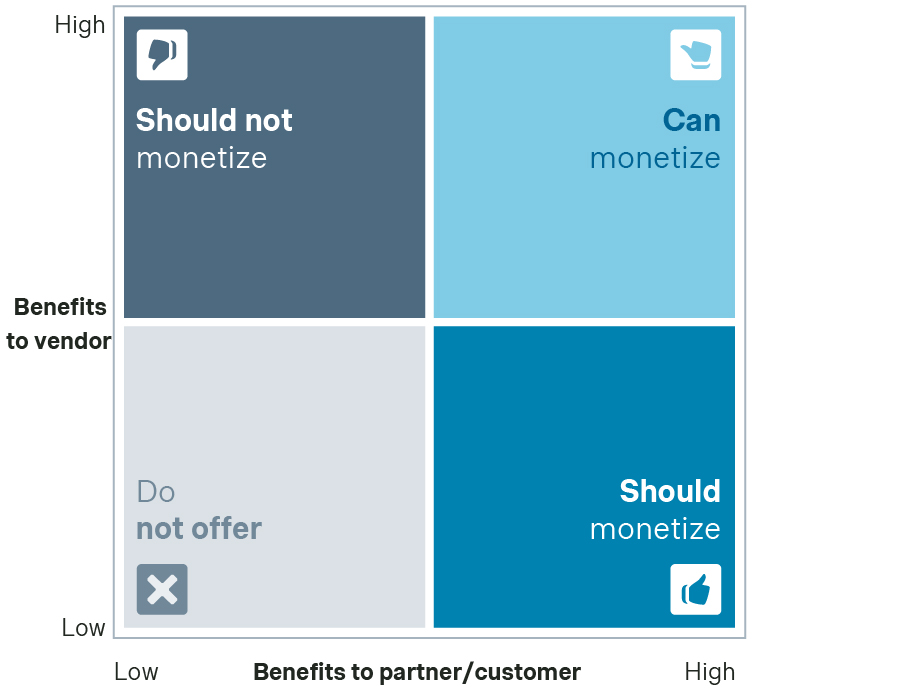
Plotting your APIs across these two axes creates four distinct strategic scenarios:
1. Do not offer (Low vendor benefit & Low partner/customer benefit)
If neither side derives meaningful incremental value, direct monetization is unlikely to succeed. Charging in this quadrant often creates friction without delivering tangible upside for the partner or customer. The better question is whether these APIs should exist at all.
2. Should monetize (Low vendor benefit & High partner/customer benefit)
Here, the API creates significant standalone value for customers or partners, for example by enabling automation, embedding data into mission-critical systems, or unlocking new revenue streams, while offering limited benefits to the vendor.
For example because the API is (very) valuable to a specific subset of customers or certain partners have built an additional revenue stream on the API that is not resulting in gains for the API provider. In this case direct monetization is typically appropriate: the API functions as a distinct value proposition and should be priced in line with the value it delivers.
3. Can monetize (High vendor benefit & High partner/customer benefit)
The API drives strong customer value but also significantly enhances the vendor’s core platform; for example by increasing stickiness, improving data quality, or expanding ecosystem reach. Immediate monetization may slow adoption and undermine long-term strategic goals. In such cases, companies often:
• Monetize selectively (e.g., advanced endpoints only)
• Bundle API access into higher tiers
• Introduce pricing gradually as the ecosystem matures
Timing becomes critical. Early-stage ecosystems may prioritize adoption; mature platforms with strong market positions can layer in monetization more assertively. ServiceNow shows how APIs can deepen platform integration and embed workflows across enterprise systems. In practice, API and integration capabilities are offered across the platform, while some advanced integration capabilities are commercialized through products such as IntegrationHub.
4. Should not monetize (High vendor benefit & Low partner/customer benefit)
If the API primarily benefits the vendor (for example by reducing internal support load, simplifying integrations or improving the ease of doing business with partners) but offers limited direct value to customers, monetization may face resistance.
In these cases, APIs often function as hygiene factors: necessary to remain competitive or do business together.
Timing in monetization decisions
Importantly, APIs can move between quadrants over time. What starts as a growth enabler in an early ecosystem phase may later become a revenue lever once usage stabilizes and value becomes clearer.
Image 2: Typical API monetization lifecycle
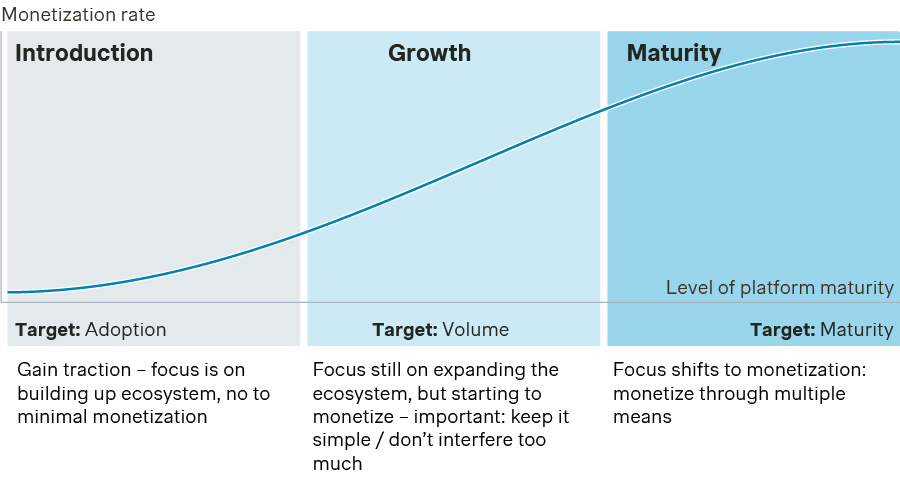
For this reason, the question is not simply “Should we monetize?” but rather:
- Is the API creating standalone value?
- Does monetization support or hinder our platform strategy?
- Is the ecosystem mature enough to absorb pricing without stalling adoption?
Companies that treat API monetization as a strategic timing decision rather than a reflex response to rising usage are far more likely to capture value without disrupting growth.
How to monetize your software APIs?
Once the decision to monetize has been made, API pricing should not be treated as a tactical adjustment, but as a deliberate commercial design exercise including role, metric, and model.
1. Define the role of the API in your platform
Before pricing an API, companies must answer a fundamental question: What role does this API play in our overall offering?
Across projects, we typically see APIs fall into one of three roles:
• API as a hygiene factor: Required to stay competitive and needs to be part of the core offering
• API as an upsell driver: Enhances platform value for a significant set of customers/partners and could be positioned as premium offering
• API as an add-on: Creates benefits for some customers/partners and needs to be an optional, stand-alone offering
Shopify illustrates APIs as ecosystem enablers: developer access to Shopify APIs primarily supports app and storefront development, while monetization in the ecosystem happens mainly through app subscriptions and Shopify’s revenue-share model.
2. Choose a value-aligned price metric
It is common practice to price APIs per call, and while this can be a useful starting point, effective API monetization requires a more nuanced perspective. While usage-based pricing can work well when value scales directly with volume and calls are relatively homogeneous, many APIs do not behave this way. Some calls trigger complex workflows, others access high-value datasets, and some are mission-critical while others are routine. In AI-driven APIs, where requests differ widely in complexity, resource intensity, and resulting impact, a flat per-call pricing approach is often a poor proxy for both underlying costs and delivered value.
Strong API price metrics share five characteristics:
• They correlate with customer value
• They scale with underlying cost drivers
• They are predictable and understandable
• They can be measured reliably
• They work across customer segments
For this reason, pricing design should move beyond counting calls alone. For example, combining call-based pricing with data-volume measures such as GB or TB processed can better reflect infrastructure costs in data-heavy APIs. In financial contexts, an outcome-based metric such as price per transaction may align more closely with the value delivered to customers.
In many cases, packaging and metrics must work together to approximate value rather than relying on metering alone. For example, for many of its model APIs, OpenAI prices usage primarily based on tokens processed rather than API calls, which aligns pricing more closely with both compute consumption and delivered value.
3. Select the right price model
Beyond the metric, the structure of the pricing model determines how risk and upside are shared. Pure pay-as-you-go models maximize flexibility but often create cost uncertainty and customer anxiety. Pure subscriptions offer predictability but can fail to capture upside.
Many successful API monetization strategies therefore use hybrid models, for example:
• base subscription + usage allowance
• tiered packages with fair-use limits
• differentiated pricing for heavy vs. light users
Hybrid models provide customers with cost visibility while allowing vendors to scale revenue alongside usage growth and manage infrastructure exposure. This is especially common in AI APIs, where providers combine base access fees with usage or token-based pricing to balance cost recovery and value capture.
When role, metric, and model are deliberately aligned, API pricing shifts from reactive cost recovery to a strategic tool that balances growth, margin, and ecosystem stability.
Image 3: Monetization models per API type
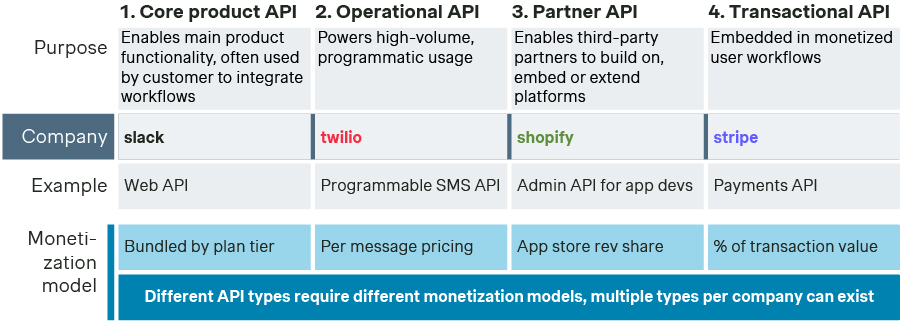
API pricing is a strategic growth lever
There is no single “right” way to monetize APIs. But companies that treat APIs as deliberate commercial products are far more likely to capture their full economic potential than those that treat them as technical afterthoughts.
Want to dive deeper into software API monetization? Reach out!
Tech Summit: For those eager to see best-in-class API pricing in practice, join our 10th anniversary Tech Summit in June: a standout opportunity to connect with top tech minds, share ideas, and shape the future of AI.
Interested in learning more about the implementation of API pricing? Stay tuned and keep an eye out for part 2 of our API pricing series!
The author thanks Amber van Ginkel (Senior Consultant) for her contribution to this article.