
The American Dream continues to shape how people think about success, yet the path to achieving it has becoming increasingly personal. Simon-Kucher's New American Dream Study 2026 shows how consumers are adjusting their spending decisions and financial priorities in response to today's economic realities, and how brands must adapt to remain relevant.
Explore the study here: New American Dream 2026
Ask some Americans what the American Dream means to them, and they will paint a traditional picture of what their grandparents aspired to: homeownership, raising a family, success through hard work, and financial stability. But dig deeper and ask which values are most important to them today, and the picture changes.
Simon-Kucher’s New American Dream Study 2026 reveals that Americans are driven by a different set of economic realities and ideals than those that were first coined by James Truslow Adams. Today, the traditional markers of success are being replaced by more flexible, individualized choices that prioritize greater stability, independence, and quality of life.
As a result, consumers are adapting goals to better align with their circumstances and priorities. They are making trade-offs by delaying major milestones, adjusting their spending, and seeking practical ways to gain more financial control in their everyday lives.
The Dream is still alive, but less uniform
Americans still believe in the American Dream, but Gen Z and Millennials are redefining it. A majority of Gen Z and Millennials say the Dream guides them “at least somewhat,” compared with less than half of Baby Boomers.
Older Americans are more closely connected to traditional security markers, such as retirement, financial stability, homeownership, freedom, and safety. Younger generations value these goals but place greater emphasis on lived experiences over visible achievements, prioritizing opportunity, flexibility, community, personal fulfillment, and individual progress. The shared goals remain recognizable, yet each person is finding their own way to pursue them.
The old roadmap has splintered
What stands out in this study of 5,000 US adults is that each generation is confident that is has the best chance of achieving the American Dream. Specifically, 57% of Baby Boomers, 38% of Gen X, 40% of Millennials, and 34% of Gen Z believe this to be true.
However, when respondents were asked which path offers the best chance of achieving the American Dream today, the leading answer was not college, entrepreneurship, technology, skilled trades, or even working one’s way up within a company. Strikingly, the most common answer was there is “no clear best path,” or “no specific route.”
High inflation and elevated costs have limited access to traditional milestones. Most Americans report that owning a home and becoming financially independent are more difficult than they were for previous generations.
For brands, this reflects a more complex view of success. Consumers still want to achieve their goals, but they are simply less convinced that there is a single path to getting there. Brands that recognize economic challenges, a wider range of aspirations, and different life stages will be better positioned to connect with today's consumers.
Money remains central, but consumers are using it differently
Money continues to sit at the center of the American Dream. The clearest status signal across all generations is financial wealth. About six in ten Americans say their financial situation strongly influences how secure or successful they feel. In other words, financial pressure is not only reshaping everyday decisions but also consumers’ confidence and peace of mind.
According to the study, inflation has changed how 90% of Americans shop. Grocery prices have increased, and half of consumers are putting off purchases and waiting for sales. Even more are looking for lower-cost alternatives, stocking up during promotions, and seeking cheaper places to shop, while about one-third are buying in smaller quantities or shopping less frequently.
Consumers are looking for value they can clearly recognize and justify, not necessarily the lowest price. Therefore, brands need to demonstrate a strong price-value relationship.
Spending is shifting toward quality of life
Across every generation, consumers value experiences over material possessions. Between 46% and 51% prioritize experiences, while just 8% to 13% prioritize possessions.
The leading discretionary categories include travel, dining out, entertainment, wellness, and social activities. Each contributes to making daily life more meaningful. Consumers will strongly defend those choices even when their budgets are tight.
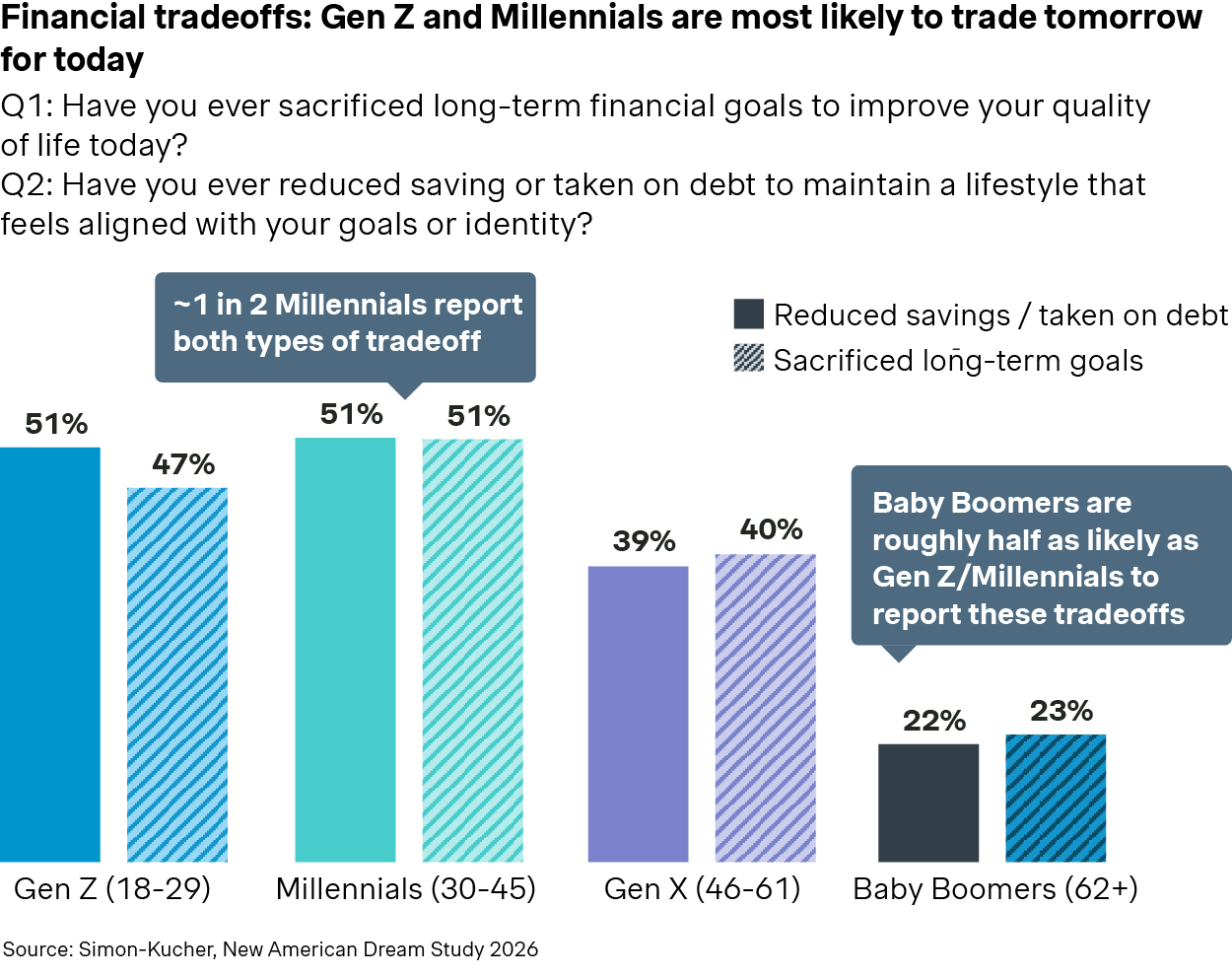
Trade-offs differ by generation. A majority of Gen Z say they have sacrificed long-term financial goals to improve their quality of life today. They are saving less, directing most of their income toward essentials, and renting rather than buying. Far fewer Baby Boomers are reducing savings or taking on debt to sustain their current lifestyle.
Younger generations are not building wealth in the same way their grandparents did. Rather, they are making deliberate trade-offs for a better quality of life today in exchange for less certainty later. Gen Z and Millennials concentrate on spending on education, training, self-improvement, health and wellness, personal hobbies, and technology. They are also deliberately taking on debt earlier than previous generations. For some, debt is seen as a long-term strategy to cover daily expenses, preserve experiences, and maintain a sense of normalcy. Debt does not necessarily signal failure; it can serve as a tool for making life work today.
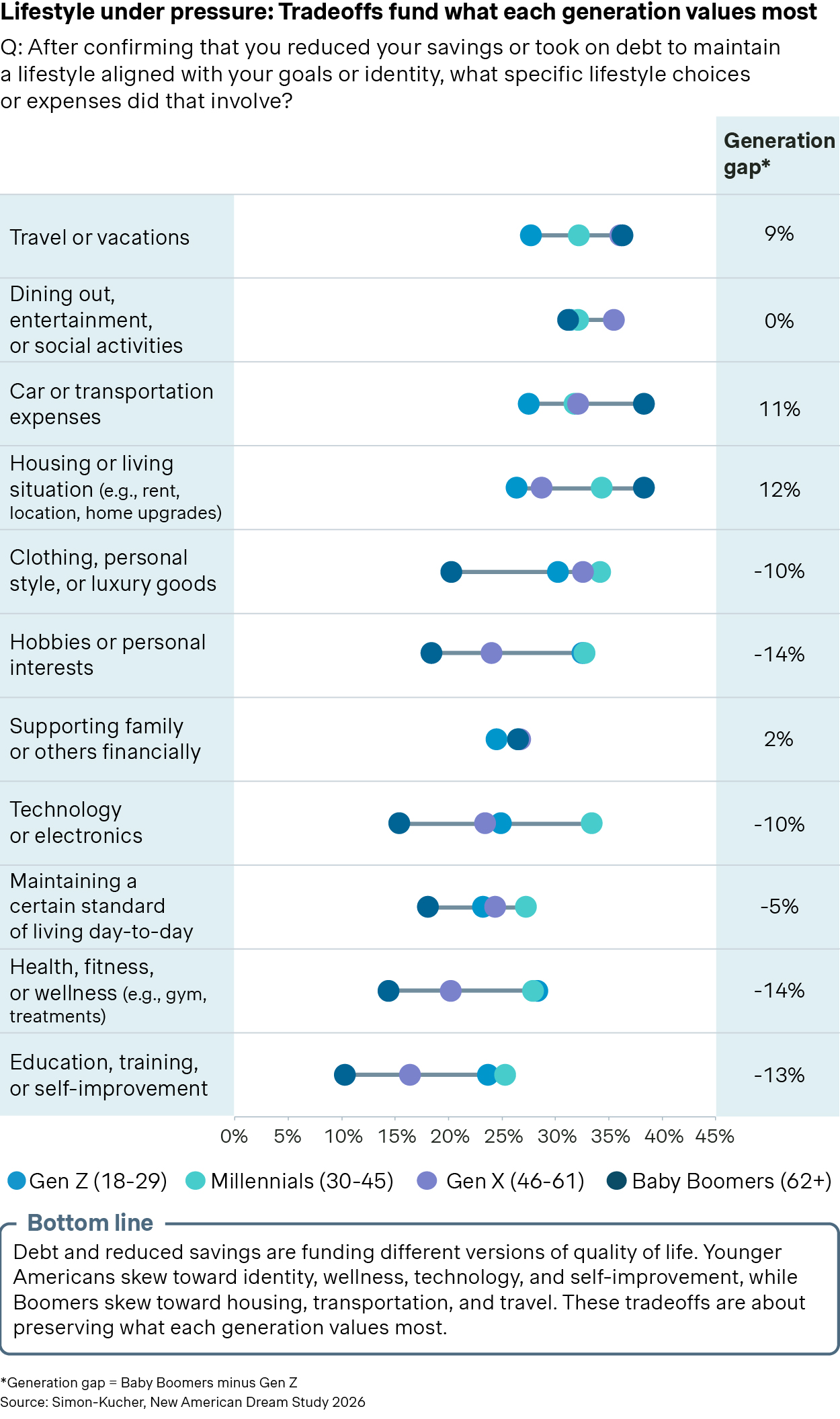
For brands, this creates both an opportunity and a responsibility. Consumers are willing to spend, even if they cut into savings, but every purchase faces more scrutiny. In a tight economy, products and experiences must justify their place by making life feel meaningful and valuable.
Housing and work reveal the new playbook
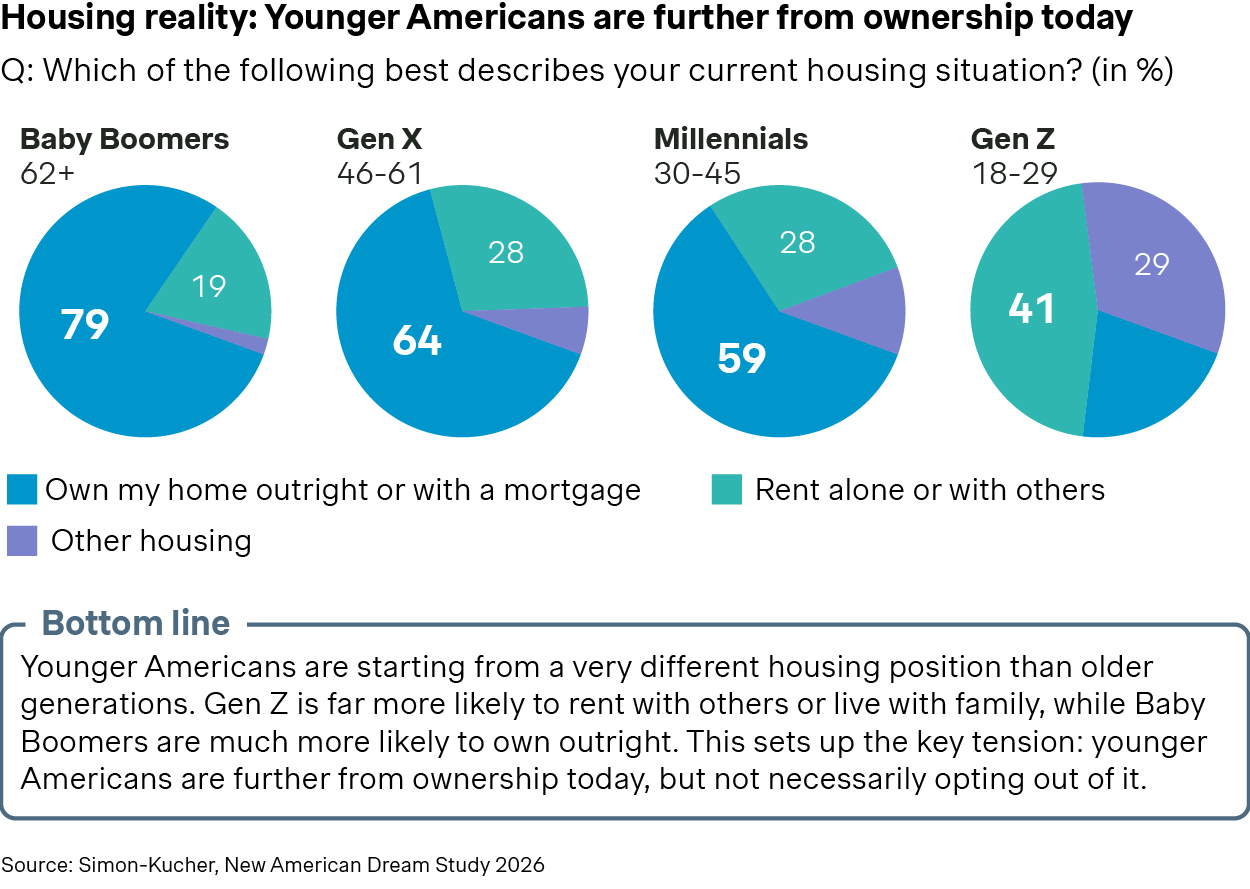
Housing offers one of the clearest examples of how the American Dream is changing shape. Young Americans highly desire homeownership, and many non-homeowners are “very interested” in purchasing a home in the future. Gen Z and Millennials are not lacking the desire; they are lacking access. Home prices, stagnant incomes, high student loans, insufficient savings, and job insecurity are barriers standing in their way.
As a result, renting has become a strategic tool. Younger Americans are split between viewing renting as a temporary phase before homeownership and seeing it as a long-term lifestyle choice. For them, renting can preserve flexibility, mobility, and financial control, while avoiding costs associated with homeownership. High inflation and economic instability also make renting a practical choice for many people in their twenties and thirties.
Work shows a similar pattern
Millennials and Gen Z prize flexibility over income more than Baby Boomers do, and that shift is reshaping where younger Americans choose to live. Here, flexibility means better agency over time, schedules, and balance, not simply the ability to work from home. Work is less of a ladder toward status and more of a source of resilience. Many younger Americans are building that resilience through multiple income streams, with Gen Z typically having two or more jobs and some even having three or more.
What brands should do next
The New American Dream is more personal and financially complex. Brands, retailers, and service providers should consider five priorities:
· Help consumers feel more in control.
Consumers are looking for greater reliability and assurance. Offer products, services, and messaging that reinforce a sense of self-determination.
· Make value easy to understand.
Inflation has raised expectations around value. Consumers need clear reasons to choose one product over another, whether that value comes from quality, durability, convenience, flexibility, or trust.
· Make it easier to balance tradeoffs.
Consumers are balancing today's needs against tomorrow’s goals. Offer product designs, pricing, subscriptions, payment options, and loyalty programs that can reduce that tension without feeling like a second choice.
· Segment by life context, not age alone.
Generational differences still matter, but so do meaningful life differences, including life stage, marital/relationship status, financial pressure, education, needs, and geography.
· Focus aspirations on valuable progress.
Today, consumers define success in personal terms. Brands should help people move toward greater stability, flexibility, independence, and quality of life.
The future of the American Dream: More adaptive, but still ambitious
The American Dream has not disappeared. People are pursuing it in different ways that reflect their circumstances, priorities, and opportunities. Americans still want stability, homeownership, financial progress, freedom, and security, but they are pursuing those goals through more flexible and individualized choices.
Consumers are defining success on their own terms, often without a clear path to achieve it. The brands best positioned to win understand how the American Dream is changing and what those changes mean for consumers. They will build stronger products, sharper value propositions, and customer experiences around a redefined definition of success.
Contributing author: Pace Billings.
For the complete findings among generations, housing, work, spending, debt, investing, and retirement, explore the full study here: New American Dream Study 2026.