
Rational exuberance was the theme of the week at SEMICON West this year. Where 2025’s edition was dedicated to the delirious climb toward the $1 trillion revenue milestone, this year’s was a celebratory look back - and a hopeful look forward to an uncertain future. Industry experts were right to believe that $1 trillion would be achieved far before 2030. But it is difficult to predict if the headwinds buffeting artificial intelligence as a viable, profitable end-user product will materially dampen semiconductor prospects. Are we near the top of the supercycle, or will the industry soar on toward $2 trillion and beyond by decade’s end?
The semiconductor boom is a pricing boom. Promised capacity ramps are still quarters, if not years, off. Highly-touted domestic U.S. capacity, such as Micron’s new Idaho fabs, will not see high-volume manufacturing (HVM) production until mid-late 2028. Average selling price (ASP) increases, especially on leading-edge memory and logic, are estimated to have resulted in as much as 90% of the uplift in revenue so far this year. Yet despite the immense capital expenditures and price uplifts across the value chain, the margin story remains mixed.
Designers and leading-edge fabricators continue to win on top and bottom lines, while others have yet to meet the commercial moment. Market caps rose through early 2026, but more recent results indicate that most of the semiconductor market is still looking wistfully at the windfall enjoyed by a few. We once again ask the question of whether the rising tide of AI will float all boats.
Below, we break down four themes that resonated at SEMICON West 2026 and share how we think players across the ecosystem can ensure a fair slice of the pie with a focus on commercial excellence in the year ahead.
Theme 1. The data enablement layer which forms the foundation of all AI can no longer be ignored
SEMICON West 2026 was a dose of reality for AI implementation. Casual observers of artificial intelligence may be forgiven for believing that it is capable of working miracles. Global marketing campaigns this year promised AI models that will ingest any and all data, wherever it is, and produce actionable results in minutes. It is not completely untrue. Agents unleashed on internal systems can and will confidently state conclusions when prompted. Quality and traceability are sacrificed.
“Unchecked innovation inevitably collides with its own architecture,” noted SEMI President and CEO Ajit Manocha in his opener. Ecosystem players of all stripes, from Synopsys to Nvidia, listed some form of ‘data enablement’ as a key challenge in the full-scale implementation of AI Agents. Experts observed that data has the unwelcome tendency to expand into every gap in governance. Much of what is most critical lives in emails with sales, quarterly strategy review PowerPoints, and offline Excel spreadsheets created by former colleagues, while translation and transformation rely on decades of institutional knowledge. The data can take months or years to unspool and reconstitute. The unified structure that results is the enablement layer. It is the lifeblood of the agentic era.
Commercial opportunity: Despite its tendency to anthropomorphize itself, AI is not good at nuance. It craves context. Good context, that which can be acted upon without false or misleading conclusions, requires structure from users and systems. Structure demands investment. But getting it right - running an entire org on a single commercial engine - unlocks possibilities for intelligent margin and share management that go far beyond what AI alone can deliver. Our recommendation: Use this moment to build a robust data enablement architecture that evolves with innovation, not against it.
Theme 2. Advanced packaging is not the only system where the industry is discovering value in efficiency
Last year, we along with many SEMICON keynotes, extolled the virtues of advanced packaging for carrying the torch of Moore’s Law. 2.5D/3D structures would do their part to continue increasing compute density and computational proximity. This year, things went a step further. From transistors to fab-level systems, less is more. Less latency in interconnects, less horizontal span in the gate-all-around transistor, less time that a front opening unified pod (FOUP) spends idle between processes in the fab. Bottlenecks that used to be taken for granted are now too expensive. This is the whole-industry-optimization moment.
The opportunities for capturing value abound. The complementary ecosystem, especially those players outside of the primary designers and integrated device manufacturers (IDM), will carve out new niches. Experts anticipate that photonics may finally have its HVM moment, while memory and compute get even more interwoven. Suppliers of system-level simulation and heat-mitigation solutions stand to benefit as tighter integration creates new demands.
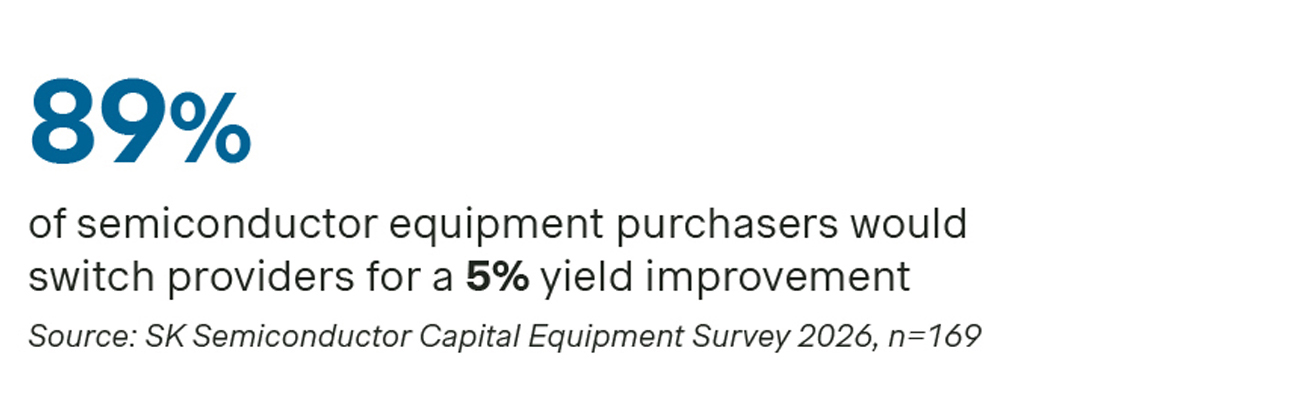
Commercial opportunity: Monetizing innovation is a commercial necessity. However, creating system level efficiencies and capturing their value may be two different challenges, particularly when improvements require collaboration across the ecosystem. Design toward what the market is willing to pay for. Leverage market research to evaluate the KPIs most applicable to your customers, whether they be yield, heat abatement, or wafer starts, and build proof points on the impact of your solution. For example, cutting even a percentage point of processing time due to better FOUP routing may be worth billions to the right customer. Realizing these gains may require co-innovation between equipment suppliers, automation providers, and fab operators, raising the question of how value should be shared. Our recommendation: Prioritize pricing while introducing products, or risk anchoring the market for a generation.
Theme 3. Monetizing AI effectively is a challenge while the Jevons paradox holds true
The Jevons paradox states that when a resource becomes more efficient to use, demand for the resource will increase (particularly for novel applications), resulting in higher overall usage of the resource. Clever readers may note two things about the Jevons paradox: it is not particularly paradoxical, and it is a useful model for the precipitous drop in per-token cost for AI. As prices have fallen, users have hoovered up every bit of available compute, proving that, for now, demand for compute is capped only by the speed of the data center buildout (and physics).
What does this mean for those attempting to productize AI capabilities, and particularly agents? As one CEO admitted on stage at SEMICON, the introduction of agentic features into the electronic design automation (EDA) workflow has only thus far resulted in a worrying compression of margins. If a typical informational query to an LLM chat interface has an indexed token cost of 1, a complex multi-stage agentic workflow may cost 1000. Costs balloon quickly when growth in agent usage greatly outpaces reductions in per-token costs. Ecosystem players are not yet passing those costs on to the end user at scale, but that time is not far off. The agentic workflow will only continue to expand, and with it the pressure on margins (and the pressure from shareholders).
Commercial opportunity: As agentic AI workflows grow more complex, providers risk seeing the cost of delivering value outpace their ability to monetize it. Traditional pricing models, such as seat-based subscriptions, were not designed for a single agent or small group of agents executing thousands of autonomous tasks. It’s time to rethink how value is measured and captured. Technical consumption, activities performed, outputs generated, and ultimately customer outcomes achieved offer a path to balance customer willingness-to-pay with the underlying cost to serve.
One deployment identified discrete workflows suitable for agentic AI. Customers could opt into assistance through two charges: one per workflow start and one per outcome. The outcome charge reflected the value of time saved compared with an equivalent human-only process. Our recommendation: Set up AI monetization models now, identifying where usage-, output-, or outcome-based models can unlock better value capture while ensuring guardrails are in place to protect against margin erosion.
Theme 4. Customers will pay for supply assurance
We called for a holistic monetization of national AI stacks after SEMICON last year. This year, we saw that idea in practice. Representatives from the nations in attendance presented their countries as one-stop shops for AI products and services. We were shown that buying the full stack of AI is as easy as navigating to a singular government portal (although the commercials are still murkier than the representatives would care to admit). In a polarized world, however, a single shop introduces many points of failure. At the same time, onshoring and nearshoring continue around the globe. As one panelist noted, exuberant investors once imagined that simply onshoring manufacturing capacity would draw demand. The cost profile of said onshoring quickly sobered perspectives.
More interesting to the modern value chain is securing the supply of critical inputs. Gallium, helium, gold - look closer at any area of the periodic table and you will find a shortage or an export ban. Several presentations used metrology (one of our 2025 themes) to identify every element present or used in the production of a semiconductor wafer. Each element was then traced back to its source, recording the nation of origin, private or public control, rarity, substitutes, processing locations, and more. The litany of restrictions was eye-opening.
The pace of government spending around the world on securing critical elements demonstrates that national leaders are doing the same calculations. Multiple times we heard “Rare-Earth Free” as a value proposition for magnet performance and supply resilience both. Risk-reduction is the real value play.
Respondents to our in-person survey at SEMICON agreed (see Fig. 1, below): Over a third of commercial leaders are thinking about capacity guarantees for supply assurance in 2027.
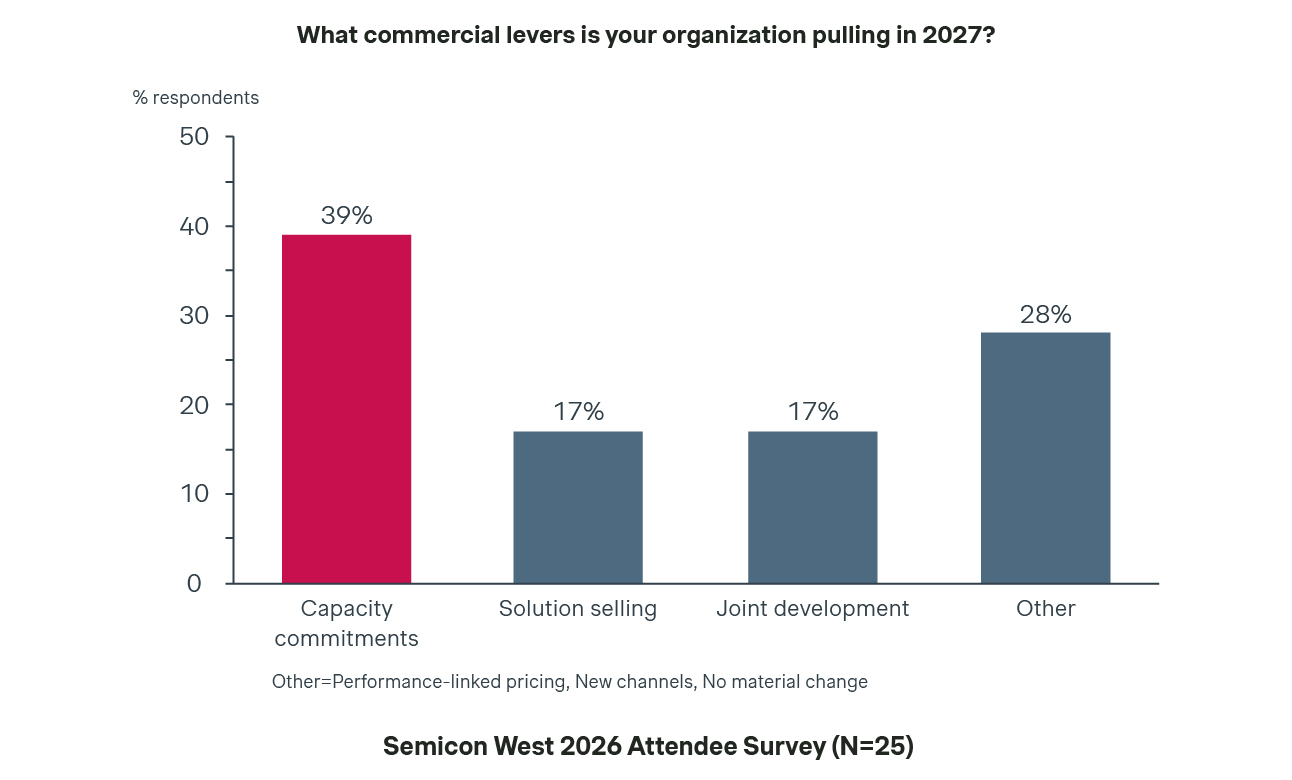
(Fig. 1)
Commercial opportunity: Monetizing the value of supply assurance does not stop with raw materials. For years, we have been coaching our clients to trade in capacity guarantees through contract excellence. Customers are willing to pay to reduce and eliminate risks. Sometimes they have no choice. As the world’s dominant supply chains grow increasingly isolated from each other, value will be created in what resources can be assured, and which resources can be innovated away. Our recommendation: Consider the holistic value of your solution, from the elemental level. If there is an opportunity to secure production or nearshore, leverage that as a differentiator.
The year ahead may be even more lucrative and challenging
We walked away from SEMICON West 2026 debating the promise of the year ahead. Will it be one of steadily climbing ASPs and consistent appetite for compute, or will investors begin to demand a path to profitability in AI? Will all of the purchase orders for 2028 and beyond withstand the threat of a downturn?
There are a few “sure things.” It is certain that packaging and systems technology will advance, AI Agents will consume more tokens, and data architectures will become even more challenging. For those prepared to seize the moment, uplift to the top and bottom line awaits:
- Build the AI-enabling data architecture of the future with structured and unified data across product, sales, commercial, and eventually operations, paired with strict governance protocols to guide the development and sharing of outputs.
- Innovate and price for efficiency in all systems through a deep understanding of current pain points and optimization areas, a clear roadmap to solve them, and a real-time understanding of the market value for each solution.
- Monetize agentic AI by identifying current workflows where AI can add value, and quantify the value ($) from AI implementation along with an estimation of one-time and recurring costs to unlock identified value.
- Understand how customers value BOM-level risk reduction to jointly develop risk mitigation plans, conduct accurate cost-benefit analyses and maximize the value capture of reduced risk.
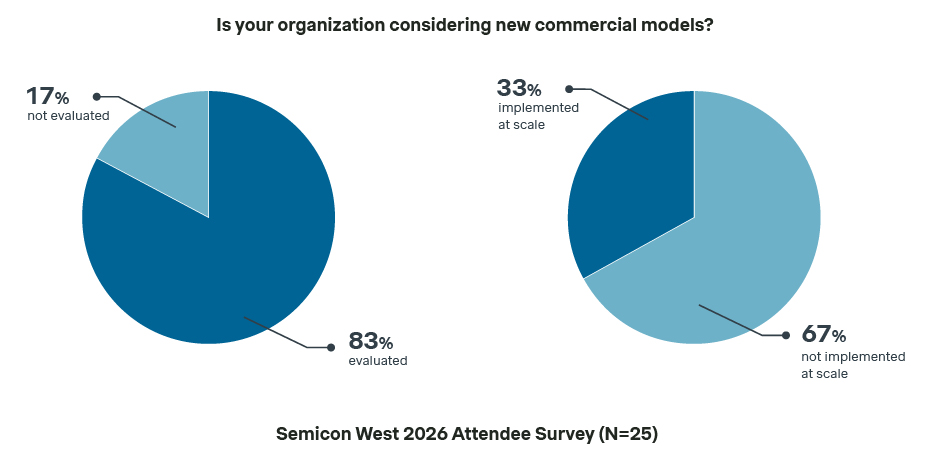
(Fig. 2)
We heard at SEMICON that a majority of organizations had evaluated new commercial models, but only a third had implemented anything at scale (see Fig. 2, above). At Simon-Kucher, we help semiconductor leaders turn industry shifts into measurable commercial outcomes. If you’re setting commercial priorities for 2027, we can help you assess the value of data readiness, agentic AI, system efficiency, and supply assurance. Talk with our semiconductor team about where to start.
Contributing authors: Jeremy Phillips and Emery Engling
Form placeholder. This will only show within the editor