
The way consumers discover hotels is changing. As AI becomes part of the consumer journey, hospitality providers face new questions about visibility, customer acquisition, transactions, and where value will ultimately be created.
Key takeaways:
- AI is influencing hotel discovery faster than booking.
- Conversational search changes how travelers express intent and how AI systems interpret hotel content.
- Direct hotel channels could benefit from AI-led discovery, but visibility varies across LLMs and hotel brands.
- Booking still depends on payments, fraud control, compliance, customer support, and integrated technology.
- Future value will depend on who controls discovery, checkout, and customer relationships.
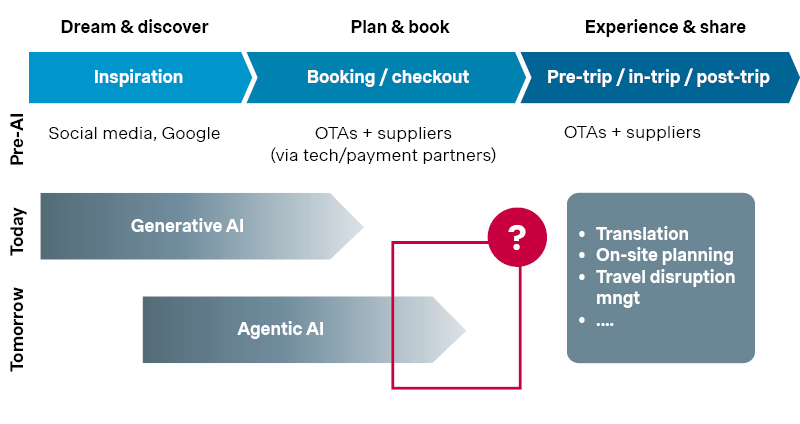
AI adoption is currently concentrated in the early stages of the consumer journey, where it is already changing how consumers discover and compare hospitality providers. This gives AI platforms greater influence over which brands are considered, even when the final transaction takes place through an established booking channel.
Understanding how travelers are using AI provides the starting point for assessing how hospitality distribution could evolve.
How consumers are using AI in hospitality today
AI adoption is not uniform, with consumer interest varying considerably across markets or consumer groups. Younger and higher-income travelers report the strongest interest.
Travelers willingness to use AI for travel inspiration is highest in China at 81%, followed by Saudi Arabia at 76% and India at 71%. By comparison, the figure is 48% in the US and ranges from 24% to 37% across the European markets surveyed.
Interest also rises with income. Among consumers earning more than €100,000, 73% expect to use AI for travel inspiration, compared with 50% of those earning between €50,000 and €100,000.
Millennials and Gen Z report comparable levels of interest at 63% and 62%, respectively.
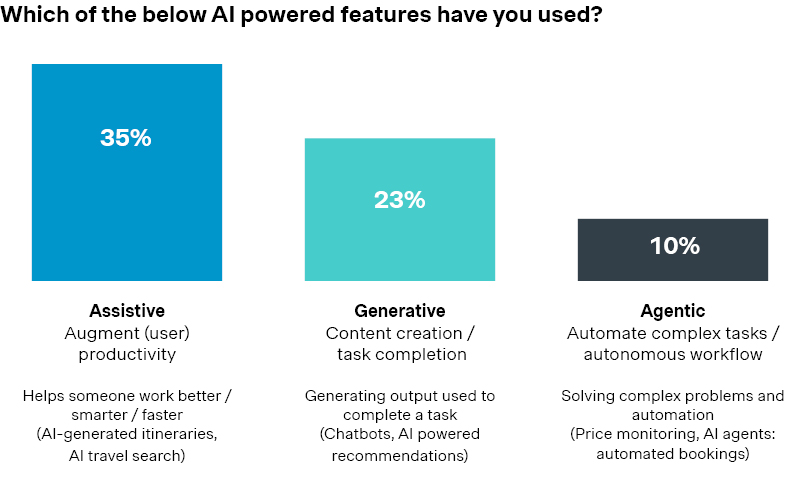
Current AI users most commonly rely on it for inspiration, itinerary generation, travel search, and translation. Satisfaction with these use cases is high because AI provides immediate responses, shortens planning time, and recommends experiences travelers may not have otherwise considered.
AI-powered features consumers already use
Source: Simon-Kucher Travel Trends Survey 2026 | n = 10,179
Concerns about trust, privacy, and confidence in AI-generated outcomes continue to limit wider adoption for more complex tasks, including autonomous booking.
As a result, AI's influence on the consumer journey is currently concentrated in discovery, while its role in transactions remains limited.
For hospitality providers, this matters because discovery is the first step in the distribution journey. As consumers increasingly turn to conversational AI to explore destinations, compare accommodation, and refine their options, the way hotels compete for attention begins to change.
How conversational AI changes hotel search
Consumers have traditionally discovered hotels by searching online, comparing multiple options, and making their own booking decisions. AI introduces a different experience. Rather than navigating pages of results, consumers can ask detailed questions, refine requests through dialogue, and receive recommendations tailored to their specific needs.
From Google's "messy middle" to conversational AI
This changes how hospitality providers need to think about visibility.
Content still needs to inform prospective guests, but it also needs to be structured so AI systems can interpret, compare, and recommend it. Rich, current, and trusted content becomes increasingly important, alongside an understanding of the prompts consumers are likely to use when searching for accommodation.
Travelers are no longer limited to short keyword searches. They can describe the purpose of a trip, preferences, budgets, locations, and amenities in natural language, allowing AI systems to generate more tailored recommendations. Hospitality providers need to ensure their content reflects the information consumers are seeking, rather than relying solely on traditional search optimization.
AI-generated visibility is not distributed evenly. Direct hotel websites currently appear to perform well relative to online travel agencies, although results vary considerably across LLMs and between hotel brands.
Discovery is changing faster than transactions
Extending AI from hotel discovery into booking is more complex because booking accommodation extends beyond generating recommendations. Payments, fraud management, compliance, after-sales support, and fragmented technology ecosystems all contribute to the complexity of completing transactions through AI. Consumer trust is another constraint, particularly for higher-value purchases.
These challenges help explain why AI's role in hospitality distribution is developing differently across the consumer journey. Discovery is evolving rapidly, while transactions still rely on established booking infrastructure.
AI currently has its greatest impact in discovery, before the transaction
Source: Simon-Kucher Travel Trends Survey 2026 | n = 10,179
Recent attempts to extend AI beyond discovery and into the booking process illustrate this point. Rather than owning the entire booking journey, current approaches continue to rely on established merchant ecosystems and technology partners to complete transactions.
Several AI-enabled hospitality distribution models are therefore possible.
- Online travel agencies retain ownership of transactions while AI platforms influence demand.
- AI-powered discovery directs more travelers to suppliers' own booking channels.
- AI platforms play a larger role throughout the booking process if today's barriers around trust, payments, technology, and compliance are resolved.
What hospitality providers should do now
Hospitality companies do not need to wait for the market to settle before taking action. Regardless of which distribution model ultimately emerges, organizations can strengthen the capabilities that improve their visibility, customer acquisition, and ability to respond as AI reshapes how consumers discover and engage with brands.
- Define the business priorities. Successful AI initiatives begin with clearly defined commercial objectives. This helps ensure technology investments support specific business goals instead of becoming a collection of isolated projects.
- Focus on the highest-value opportunities. Once priorities are clear, organizations can select a limited number of initiatives based on their potential commercial impact and feasibility. Targeted quick wins can demonstrate early value and help build momentum for further investment.
- Embed AI across the organization. Technology is only one part of the equation in achieving sustained impact. Operating models, governance, and change management all play an important role in ensuring AI capabilities are adopted across the organization and integrated into day-to-day operations.
What comes next for AI in hospitality
Hospitality providers should prepare for multiple outcomes rather than waiting for a single model to emerge. Strengthening trusted content, understanding how consumers engage with AI, and aligning AI initiatives with clear business priorities will help organizations respond effectively as the market continues to evolve.
Future distribution scenarios
As AI reshapes how demand is created and influenced, the next phase will determine where value is ultimately captured – whether by AI platforms, intermediaries, or hospitality providers themselves.
In the near term, online travel agencies, search engines, and AI assistants may coexist: AI captures more of the discovery journey while established intermediaries continue to handle booking. In a more advanced model, AI could become the primary gatekeeper. Scenarios could include OTAs repositioning as B2B infrastructure providers, supplying inventory and booking capabilities to AI platforms while retaining control of checkout.
To discuss what these changes could mean for your distribution strategy, contact one of our hospitality experts.