
The EU-India FTA is expected to reduce import costs for qualifying European medical devices, creating new scope to compete in India. Passing those savings straight into lower prices risks giving away margin without winning more business. The stronger opportunity lies in choosing where to protect price, where affordability can unlock demand, and where local manufacturing still earns its place.
What has changed: The EU-India FTA and lower import tariffs
The EU-India Free Trade Agreement (FTA) gives European medtech companies a reason to reconsider how aggressively they compete in India. Under the agreed terms, zero duties are planned for 90% of products in the optical, medical, and surgical equipment category, where tariffs currently reach 27.5%. Most reductions are scheduled for entry into force or after five or seven years, with some phased over ten.
The potential value is substantial. EU exports in this category were worth about $3.68 billion in 2024. An illustrative saving of just 5% of that value represents around $184 million a year; at 7.5%, the figure reaches $276 million. These are gross scenarios before product eligibility, phased implementation, and competition determine what suppliers actually keep.
For European medtech, lower duties improve the position of qualifying EU products and weaken the tariff protection that has supported local production. The opportunity is attractive, but it arrives at different times across the portfolio. Product eligibility, manufacturing origin, and the relevant tariff schedule determine when the new economics become available.
Status of the EU-India FTA
Negotiations concluded in January 2026, and the agreement is progressing through the formal approval and ratification process. Tariff reductions begin once it enters into force, according to the relevant product schedule.
What does this mean for European medtech?
India's import gap points to where European suppliers have an opening. Companies need to identify products where tariff relief materially strengthens the offer from those where technology, channel costs, or competing prices still dominate.
India's localization push has not closed the import gap
Over the past decade, India's import bill has continued to grow faster than its exports even as domestic manufacturing has developed. A DGCIS series published in rupees shows compound annual import growth of 9.8% from FY2014-15 to FY2024-25, against 7.6% for exports. The trade deficit grew at an annual rate of 10.9%.
Exhibit 1: India's medical-device imports have grown faster than exports
Index: FY2014-15 = 100. The lines and growth rates use the published INR series. Dollar endpoint labels come from separate category data; they are not conversions of the plotted series.
Medical-device imports reached $8.82 billion in FY2024-25 against $4.01 billion of exports, leaving a $4.81 billion deficit. Electro-medical equipment accounted for about $3.80 billion, or 79%, while consumables and disposables recorded a small surplus. Import dependence alone, however, says little about which supplier will win the business.
Exhibit 2: India's medical-device trade deficit by category
Net imports, FY2024-25, USD bn. Source: DGCIS / Department of Pharmaceuticals; authors' calculations from category imports and exports.
A modest saving can change a product's competitive position
Even single-digit savings can influence which products warrant further investment. Lower import costs can make European medical devices more competitive in India, improve tender economics, or make them affordable to a new customer group. Exhibit 3 shows the range of values implied by different savings assumptions across the broad EU export base.
Exhibit 3: The potential annual value of tariff savings
Illustrative savings applied to the $3.68bn export-value base. The percentages are assumptions, not measured reductions in full landed cost. The 15% case is a sensitivity, not a forecast.
The potential savings will depend on the qualifying product, source plant, and implementation date. Recoverable import taxes are excluded where input-tax credit applies. Freight, foreign exchange, inventory, and channel costs complete the comparison. These costs determine whether tariff relief merely narrows a price gap or supports a different commercial strategy.
Pricing and market access: When do lower prices create more value?
Where affordability constrains adoption, lower import costs invite a familiar response: cut prices and chase volume. That can be expensive if customers take the discount and buy no more. Whether manufacturers should pass tariff savings on to customers or retain them depends on the potential profitability of additional sales, which customers are likely to change their purchasing behavior, and how much of the benefit the manufacturer controls.
Lower prices must earn back the margin given up
More sales do not automatically mean more profit. For a product sold at 100 with variable costs of 65, 35 is left to cover fixed costs and profit. If tariff relief cuts costs by 7.5, that amount rises to 42.5 while the selling price stays unchanged. In this illustration, the saving equals 7.5% of the original selling price.
Passing half the saving to customers requires 9.7% more volume to match the contribution from keeping the full saving. Passing it all through requires 21.4% more volume. A supplier therefore needs a credible case for those additional orders before a price cut improves the result. The calculation assumes unchanged unit costs and baseline volume; extra selling and service costs, or sales lost by holding price, would change the comparison.
Exhibit 4: Price pass-through and required volume growth
Starting contribution margin: 35%. Savings are measured against the original selling price; volume is compared with full retention. These are break-even thresholds, not demand forecasts.
The case for a discount is strongest when acquisition cost is holding back a purchase. Financing or pay-per-use can address a funding constraint; lower prices are less likely to stimulate demand where staffing or patient volumes are the main barriers to investment. Revenue from service and consumables also belongs in the comparison where additional equipment sales create recurring business. The relevant measure is the money earned from the relationship, beyond the initial equipment sale.
Discount requests do not necessarily signal additional demand
Customers seeking the largest discounts may generate little additional sales volume. A purchasing group might negotiate aggressively without buying more; a smaller provider might invest only once equipment becomes affordable. Treating both accounts the same risks giving away tariff savings to reward bargaining power while overlooking the customers whose buying decisions can actually change.
Clinical performance and service can support existing prices in one premium private account, while funding determines whether another provider buys at all. Hospital and diagnostic groups must consider utilization, purchasing leverage, and multi-site requirements. Public tenders add specifications and local-content preferences that affect access even when import costs fall. These differences explain why selective price changes may be more effective than applying price reductions across the entire Indian market.
Distributors may capture the saving before suppliers benefit
A tariff cut can improve a distributor's margin while leaving the manufacturer's profitability unchanged. When a distributor imports at a fixed manufacturer selling price, the immediate cost saving benefits the distributor. How that saving is shared depends on transfer prices, agreed margins, customer pricing, and contract negotiations. The headline duty reduction is therefore a poor guide to the amount the manufacturer can spend on growth.
Where the manufacturer imports and sets the customer price or tender bid, it has greater control over how the savings are used. In distributor-led channels, lower duties can stimulate demand only if the benefit reaches customers or funds a better offer and stronger coverage. Channel economics establish whether the manufacturer has room to retain margin, finance customer growth, or renegotiate how the benefit is shared.
Exhibit 5: Commercial priorities by customer segment
| Customer segment | Affordability / value | Competition / access / channel | Options to assess |
|---|---|---|---|
| Premium private |
|
|
|
| Hospital / diagnostic groups |
|
|
|
| Mid-market |
|
|
|
| Public procurement |
|
|
|
Local manufacturing: Where does production in India still make sense?
Lower EU duties also challenge the assumption that expanding in India requires more production in India. Existing European plants become relatively more attractive as tariff protection falls. Local production still has to be assessed based on production costs, responsiveness to customer needs, and market access. The right choice is the one that supports profitable sales in the segments the company intends to serve.
Tariff avoidance is not a strong reason to manufacture in India
Companies now need to rethink plans for local manufacturing that were established mainly to avoid import duties. Preferential EU treatment erodes that benefit, while the investment and operating costs of local production remain. The comparison should account for European factory costs, freight, duties, and inventory, alongside Indian costs, imported components, scale, and capital investment. Local assembly is another option where selected activities in India add commercial or operating value.
Incentives need to be viewed over the same period as the investment. The medical-device Production Linked Incentive scheme offers eligible manufacturers 5% of incremental qualifying sales, with an incentive period from FY2022-23 to FY2026-27. Its value depends on actual eligibility and remaining entitlement. A plant expected to compete through a longer tariff phase-down needs economics that remain attractive beyond that incentive period, including any export business served from India.
European scale and tariff preference can favor imports; local economics and customer access can support Indian production. Hybrid models that offer value depending on product portfolio and customer needs may be appropriate in many cases.
Cheaper imports do not mean better market access
Importing from Europe may be more cost-effective, but it can be the wrong commercial choice if it weakens access to valuable tenders. Local manufacturing can improve access to public demand when products meet procurement and local-content requirements. Its value lies in the business that can realistically be won and the contribution it earns. An assembly operation needs that evidence just as much as a full manufacturing plant.
Manufacturing origin also affects FTA eligibility, making source-plant choice part of commercial strategy. Moving production carries regulatory consequences: India's CDSCO identifies changes to the actual overseas manufacturing site among circumstances requiring a fresh import license, while additional sites can be endorsed subject to documentation and fees. Validation, timing, and potential sales disruption can materially affect the attraction of an otherwise cheaper source.
Exhibit 7: Manufacturing origin affects cost and market access

Tariff preference and procurement eligibility are separate requirements.
Exhibit 8: European supply, Indian production, and local assembly
| Measure | EU supply | India production | Local assembly |
|---|---|---|---|
| Costs |
|
|
|
| Investment |
|
|
|
| Access |
|
|
|
| Sales |
|
|
|
| Returns |
|
|
|
Competition and policy: How could the market respond?
The tariff saving starts on the cost side of the business. Competitor pricing and India's policy response determine how much reaches the bottom line. Both can overturn a supplier's preferred strategy.
Exhibit 9: How different market responses could affect medtech companies
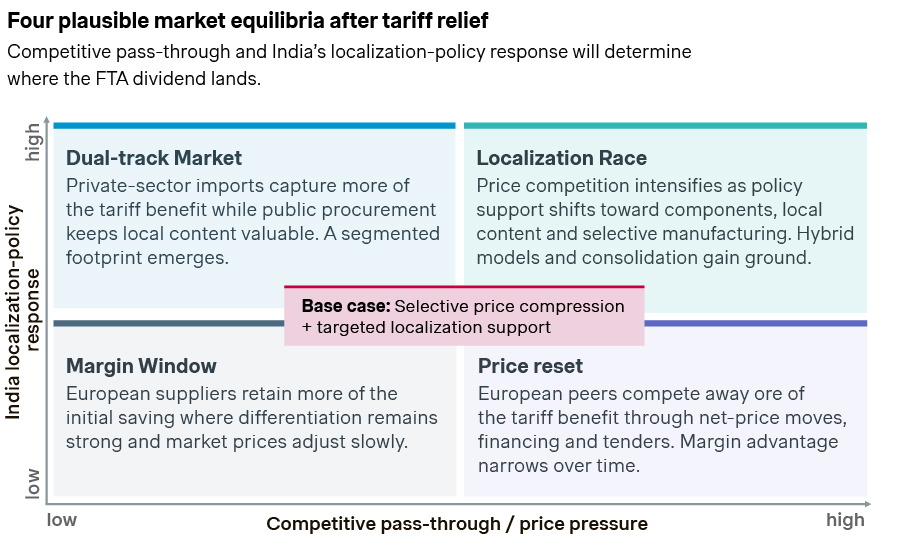
Authors' scenarios; the base case is an analytical assumption.
Competitor price cuts can erode the margin opportunity
Retaining the saving becomes harder when a rival uses the same benefit to cut prices. European suppliers might reprice early, customers and distributors negotiate at renewal, and Indian or Chinese competitors respond through price, features, or service. These are scenarios for an agreement awaiting entry into force.
Differentiation offers some protection. Closely matched products face greater pressure to follow rival discounts, even before extra demand justifies them. Local manufacturers might also pursue partnerships, investment, or consolidation under sustained pressure.
India can support local production even as tariffs fall
India retains procurement preferences and manufacturing incentives. Its June 2026 call under the Strengthening of Medical Device Industry scheme included support to reduce import dependence. Further tightening of local-content requirements remains a scenario unless adopted.
The FTA also preserves trade remedies and provides a bilateral safeguard for increased preferential imports causing or threatening serious injury to domestic industry. These conditional measures are separate from routine procurement policy. Exhibit 10 illustrates possible combinations of pricing pressure and localization support, without assigning probabilities.
Conclusion: Building a profitable growth strategy for India
The EU-India FTA gives European medtech companies a reason to revisit their ambitions in India. Automatic price cuts risk giving away margin; retaining every saving could leave commercially attractive customers out of reach. Verified product savings, customer response, and channel economics provide the basis for choosing between them.
Companies also need to assess how tariff reductions affect their portfolios, distribution channels, and manufacturing strategies. As the agreement takes effect, understanding which products and customer segments offer the greatest potential will be essential to prioritizing opportunities.
Simon-Kucher help medtech companies assess these opportunities, drawing on decades of expertise in pricing, market access, customer segmentation, and tender strategy. The objective is to identify where tariff savings can deliver stronger margins or generate profitable growth.
To discuss what this could mean for your business, please get in touch with our medtech experts Feras Mahdi, Jan Bordon, and Salil Kumar.
Calculation and exhibit notes
Price-volume calculation: Exhibit 4 assumes original revenue of 100 and variable costs of 65 per unit. For a saving of 7.5, contribution is 42.5 with full retention, 38.75 with half pass-through and 35 with full pass-through. Required volume uplift is contribution under full retention divided by contribution after pass-through, less one. Unchanged unit costs and baseline volume are assumed.