
This article marks the first in a two-part series exploring how medtech and diagnostics companies can succeed in an increasingly hybrid commercial landscape. Here, we examine why omnichannel engagement has become a strategic priority and what end-to-end omnichannel truly looks like in practice - from customer journey design to the capabilities required to deliver a seamless experience across channels.
Medtech and diagnostics commercial models are at a critical inflection point. Customers increasingly expect digital engagement, self-service, and personalized interactions. At the same time, many companies still rely heavily on traditional door-to-door sales models. This growing disconnect between evolving customer expectations and legacy commercial approaches is forcing organizations to rethink how they interact with customers.
The question now is no longer whether omnichannel matters, but how to build a model that improves customer experience while delivering measurable commercial outcomes.
A shift away from traditional go-to-market models
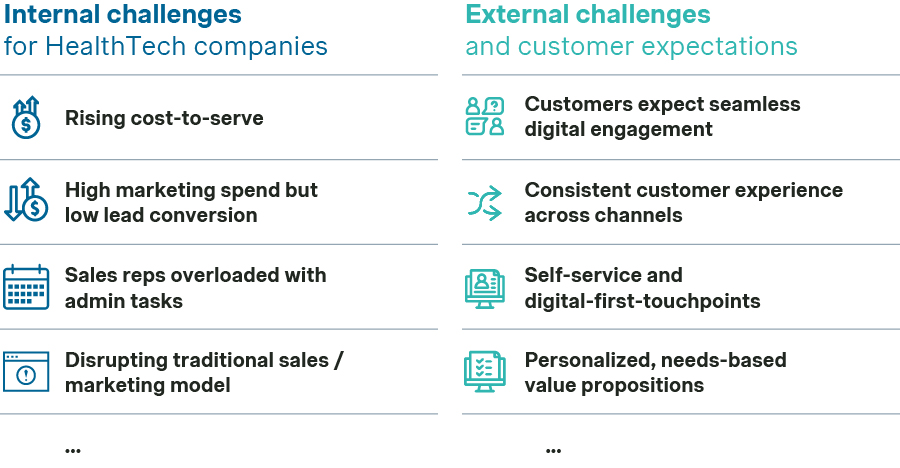
The pressure on traditional commercial models is not happening in isolation. It reflects broader structural shifts across the market that are redefining how medtech and diagnostics companies engage with customers.
Several forces are accelerating this transition:
Source: Simon-Kucher insights
These shifts are pushing companies toward hybrid commercial models that combine field sales, digital engagement, inside sales, and self-service channels. To be successful, medtech and diagnostic companies need to master …
- New routes to market: There’s a rising demand for e-commerce, expected to grow at 10% CAGR in the next ten years, and self-service platforms.
- Alternative engagement models: Simon-Kucher experts find that companies are reassessing traditional field-heavy sales structures, with 40%+ companies planning a reduction of field sales.
- Closer sales and marketing integration: Marketing investment is increasing and commercial coordination is more important than ever.
- AI enabled commercial effectiveness: Companies are adopting AI-enabled tools and analytics to improve targeting, prioritize opportunities, personalize customer engagement, and increase sales-force productivity across hybrid channels.
Taken together, these developments highlight a clear trend: commercial success is no longer driven by individual channels, but by how effectively companies orchestrate them into a seamless customer experience, through omnichannel approach.
Business value at stake
Omnichannel is a strategic priority with clear financial upside. Companies that execute well can create value across the P&L, improving growth, profitability, and commercial efficiency at the same time. The impact typically comes from three levers:
- Topline growth: e.g., expanding reach into the long tail of customers, optimizing engagement with priority accounts, etc.
- Gross margin improvement: e.g., optimizing commercial policies by channel, driving up- and down-selling pathways/ NBA per defined channel, etc.
- Sales and marketing efficiency: e.g., increasing touchpoints and customer base per FTE, improving productivity of commercial teams, etc.
Simon-Kucher research shows that these levers, when brought together, can generate 8–16% EBIT uplift from digital commercial transformation.
Moving from multichannel activity to end-to-end omnichannel engagement
Many organizations already operate across several channels, from direct sales and distributors to digital & e-commerce. However, true omnichannel engagement is fundamentally different from simply operating multiple channels.
Instead of managing channels independently, optimal omnichannel organizations coordinate them around the customer journey. This requires alignment across three key dimensions:
1. Where to play
Companies must first determine where to focus their commercial efforts. This involves prioritizing:
- Countries and markets
- Customer segments
- Product portfolio and value propositions
- Sales channels such as direct sales, distributors, and digital platforms
2. How to win
Organizations must define how these channels work together across the customer journey, end to end.
This means coordinating activities across:
- Marketing
- Sales
- Service
The objective is to deliver consistent customer experience regardless of how customers interact with the company.
3. Capabilities and systems
Finally, companies must build the capabilities required to execute omnichannel engagement, including:
- Processes and governance
- Data and analytics capabilities
- Organizational structures and skills
- Technology architecture
Only when these elements work together can organizations deliver an optimal omnichannel engagement approach.
How to start an omnichannel transformation
A successful omnichannel transformation starts with understanding the full customer journey.
Medtech and diagnostics companies must begin by mapping how customers interact with them today. This involves analyzing the journey from two complementary perspectives: the customer’s experience and the internal marketing, sales, and service perspective.
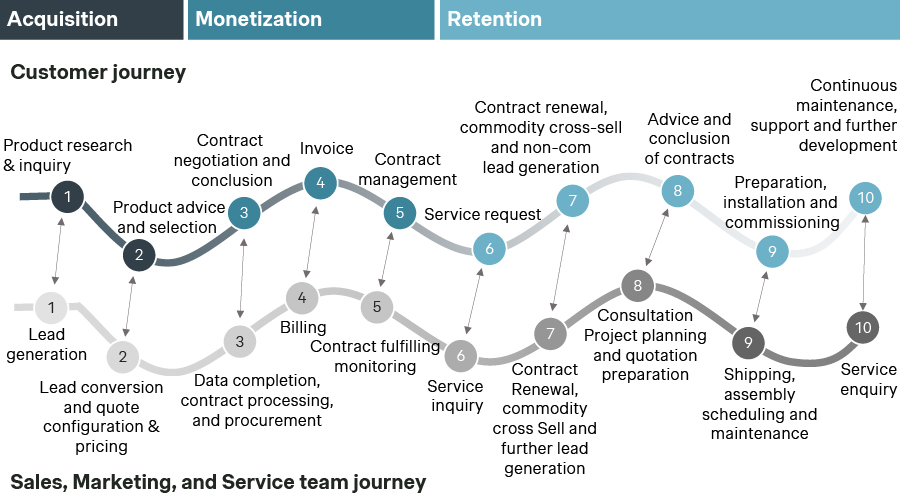
Source: Simon-Kucher insights
By mapping these stages in detail, companies can identify where friction occurs. For example, the analysis can provide insights into where customers experience delays, inconsistent messaging, or fragmented interactions. At the same time, the internal journey mapping highlights operational inefficiencies, unclear responsibilities, or missing capabilities within the organization.
This exercise allows the translation of pain points into clear requirements and capabilities needed, often revealing that the biggest barriers to omnichannel engagement are not technology-related but rather gaps in processes and organizational capabilities.
Common challenges in omnichannel transformation
Currently, despite strong momentum, many medtech and diagnostics companies struggle to implement omnichannel effectively. In practice, organizations tend to face a similar set of recurring challenges:
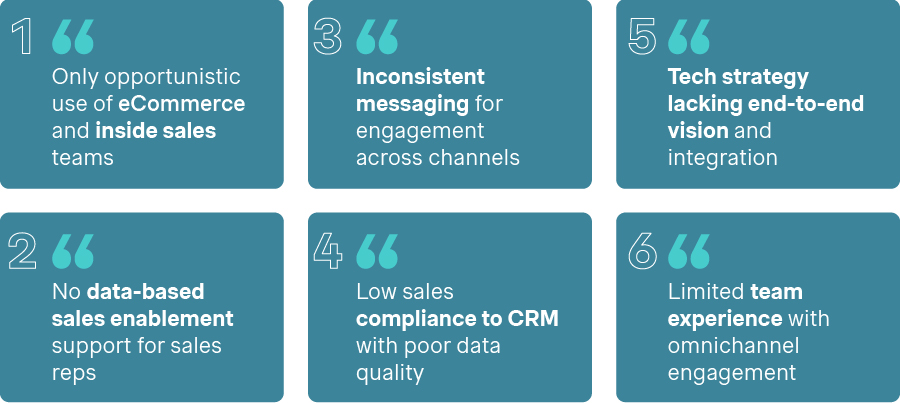
Source: Simon-Kucher insights
These challenges illustrate that omnichannel transformation is not simply about technology. Instead, it requires coordinated changes across strategy, processes, capabilities, and organization.
In the second article of this series, we will build on these challenges and explore how medtech and diagnostics companies can address them through practical initiatives: from channel design to CRM and sales enablement, content management, and technology architecture. Stay tuned.
In the meantime, let’s connect to discuss how your organization can unlock competitive advantage through omnichannel strategies.