
Better patient care depends on more than creating demand. It requires knowing where patient intent stalls, which channels build lasting value, and how each handoff supports continuous care.
A provider group increases marketing spend significantly. Lead volume rises. Call center traffic goes up. Yet capacity remains underfilled, revenue barely moves, and leadership still cannot explain which activities created value.
This is rarely a marketing failure. Many providers are effective at generating patient interest through marketing, referrals, digital channels, and community engagement. The challenge is too little of that interest translates into booked appointments, utilized capacity, appropriate treatment uptake, and lasting patient relationships. The result is a commercial performance gap between demand created and value realized.
In many elective provider markets, pricing is constrained by regulation, reimbursement structures, competitive transparency, or patient willingness to pay. That makes volume, capacity utilization, treatment mix, conversion, and retention the primary growth levers. Despite continued investment in demand generation, providers often struggle to convert interest into profitable growth. Patients inquire but never book. Referrals fail to become treatments. Available capacity remains underutilized. Existing patients disengage before realizing their full lifetime value. Demand generation is not the issue. It is converting demand into commercial and clinical value.
We call this the leakage cycle, and it shows up in three places across the patient journey: Attract, Convert, and Retain. Each is a point where demand enters the system and, too often, quietly leaves it again. For healthcare providers, closing these leaks must become a commercial capability: one that attracts the right patients, converts demand into treatment, and compounds patient value building continuity of care over time.
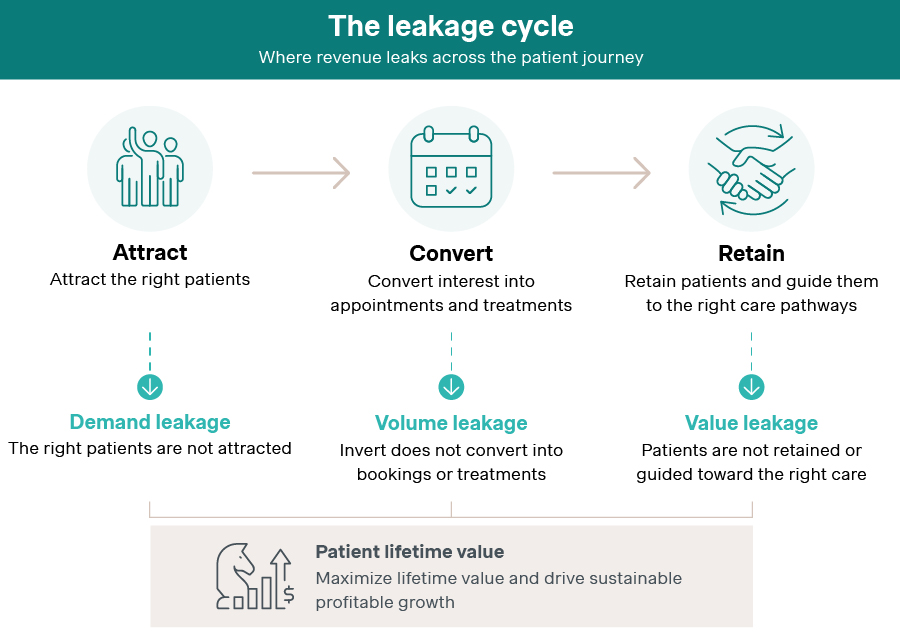
Source: Simon-Kucher insights
Attract: Are you filling capacity, or just filling a funnel?
Most providers measure acquisition success in lead volume, website traffic, or appointment requests. But more demand does not automatically mean more value. A full funnel can still be a leaking one.
The leak here is a mismatch: marketing fills the top of the funnel with patients who never convert, don't fit available capacity, or generate limited long-term value. The investment drives activity, not revenue.
Best-in-class providers go one level deeper. They track not only leads, but booked appointments by source, attendance rates, treatment mix, capacity fill by site, and patient value by acquisition cohort.
This looks different by segment. An aesthetics clinic may generate hundreds of campaign-related leads while most are price-sensitive shoppers comparing providers, not candidates for premium treatment plans. A dental group may attract steady routine check-up traffic while leaving higher-value implant and orthodontic demand on the table. A specialty care provider may receive a healthy referral flow that is, on inspection, mostly low-complexity cases consuming scarce capacity without proportional clinical or commercial return.
The signs are usually visible before the revenue impact is. There is limited visibility into which channels produce high-value patients, spend concentrated in broad awareness with no clear commercial link, weak differentiation in search and referral generation, and no consistent way to trace acquisition spend through to treatment mix and retention.
It is thus important for leadership to identify if the demand generated is filling capacity with the right patients. Providers that get this right through tighter channel mix, patient targeting, and spend allocation have reduced acquisition costs by up to 25% while holding volumes steady.
Convert: Where does patient intent leak before care begins?
Generating demand is the easy part. For most providers, the single largest pool of lost revenue sits in the gap between a patient's first moment of interest and their first appointment.
A patient responds to a campaign, visits a website, calls in, and receives a referral. And then, nothing. Every patient lost here is a double loss: the revenue itself, and the acquisition spend and capacity already used to generate interest in the first place.
Leading providers design this handoff deliberately: clear next steps, fast response times, visible appointment availability, prioritized handling of high-intent leads, and proactive follow-up if patients do not book.
In fertility care, prospective patients frequently disengage within days if appointment availability, pricing transparency, or initial support are slow or inconsistent. In dental care, prospective implant or orthodontic patients abandon the journey before treatment planning simply because the next step isn't clear. In specialty care, referred patients often never book at all, not because they declined, but because nobody owned the handoff.
Watch for complex or clunky online booking journeys, slow response to inbound inquiries, referral patients who are directed but never followed up, high cancellation and no-show rates, and most tellingly, no visibility into exactly where in the funnel patients are dropping out.
Here, the leadership must find out how much existing demand they are losing before treatment even starts. This is also the leak with the fastest payback. Targeted fixes such as automated follow-up, simplified scheduling, and proactive reminders can reduce no-show rates by up to two points, often within a single quarter, without spending another euro on acquisition.
Retain: Are you building continuity, or reacquiring the same demand?
There’s an asymmetry at the center of most provider economics. Organizations invest heavily in getting a patient through the door once, and far less in making sure they receive continuous care.
Picture a patient who completes one successful treatment, books no follow-up, and quietly becomes someone else's patient eighteen months later, not because the care was poor, but because nobody asked them to return. Multiply that across a patient base, and the result is a slow, largely invisible erosion of lifetime value that never shows up as a single bad month, only as a ceiling on growth that never gets explained.
This shows up most where the economics depend on long-term relationships. An aesthetics provider delivers a first treatment well but never brings the patient back for maintenance or complementary services. A veterinary group converts a one-off visit into a transaction instead of a wellness plan, vaccination schedule, or chronic-condition program. A dental provider loses a patient after a single hygiene visit despite an obvious opening for recall and preventive care.
The tell-tale signs: no structured recall or re-engagement program for inactive patients, patient data that isn't used to flag follow-up or cross-service opportunities, inconsistent communication between visits, and no real tracking of lifetime value by location, specialty, or channel.
It thus becomes less about whether the patient had a good visit, but if the organization is actively managing this relationship after the visit. And the return on fixing it is the strongest of the three. Providers using structured recall and personalized follow-up have seen lifetime value rise 15–30%, improving patient care continuity and satisfaction.
Where to start
Three leaks, one underlying issue: demand generation is still managed as a set of disconnected marketing activities rather than a connected commercial system, one that links investment directly to patient volume, capacity utilization, and long-term value.
Before your next planning cycle, a useful exercise is to ask three questions in sequence: Which channels are filling capacity with the right patients, not just the most patients? Where exactly, and at what cost, is interested demand failing to become a booked appointment? And which patient segments are we acquiring well but retaining poorly? Most leadership teams can answer the first question. Few can answer all three. The gap between those answers is usually where the revenue is.
A focused demand generation diagnostic can put numbers behind each of these questions: quantifying the leakage, sizing the opportunity, and prioritizing which leak to close first. The providers that treat demand as a managed system and not a marketing line item are the ones who grow without having to spend their way there. Connect with our experts today to discuss your next best steps.