
Identifying future growth opportunities is only the beginning. Commercial strategy translates long-term growth ambition into a practical commercial plan, helping organizations focus investment, align commercial priorities, and turn opportunities into measurable business results.
From growth ambition to commercial execution
Knowing where future growth exists is an essential first step. The bigger challenge is deciding what to do next. Once the most attractive growth opportunities have been identified, leadership teams face a new set of decisions to convert these insights into focused commercial action.
Several key questions quickly emerge.
What has worked in the past year? What is the ROI of past investment? How profitable are my customers, channels, and categories? Which customer segments should receive the greatest investment? Which partners should be prioritized? How should resources be allocated across sales, marketing, and retail activation? And just as importantly, which opportunities should be deprioritized?
Without clear answers, organizations risk spreading investment too thinly across competing priorities. Commercial teams and marketing teams pursue different objectives, resources become fragmented, and promising growth opportunities fail to translate into measurable business performance.
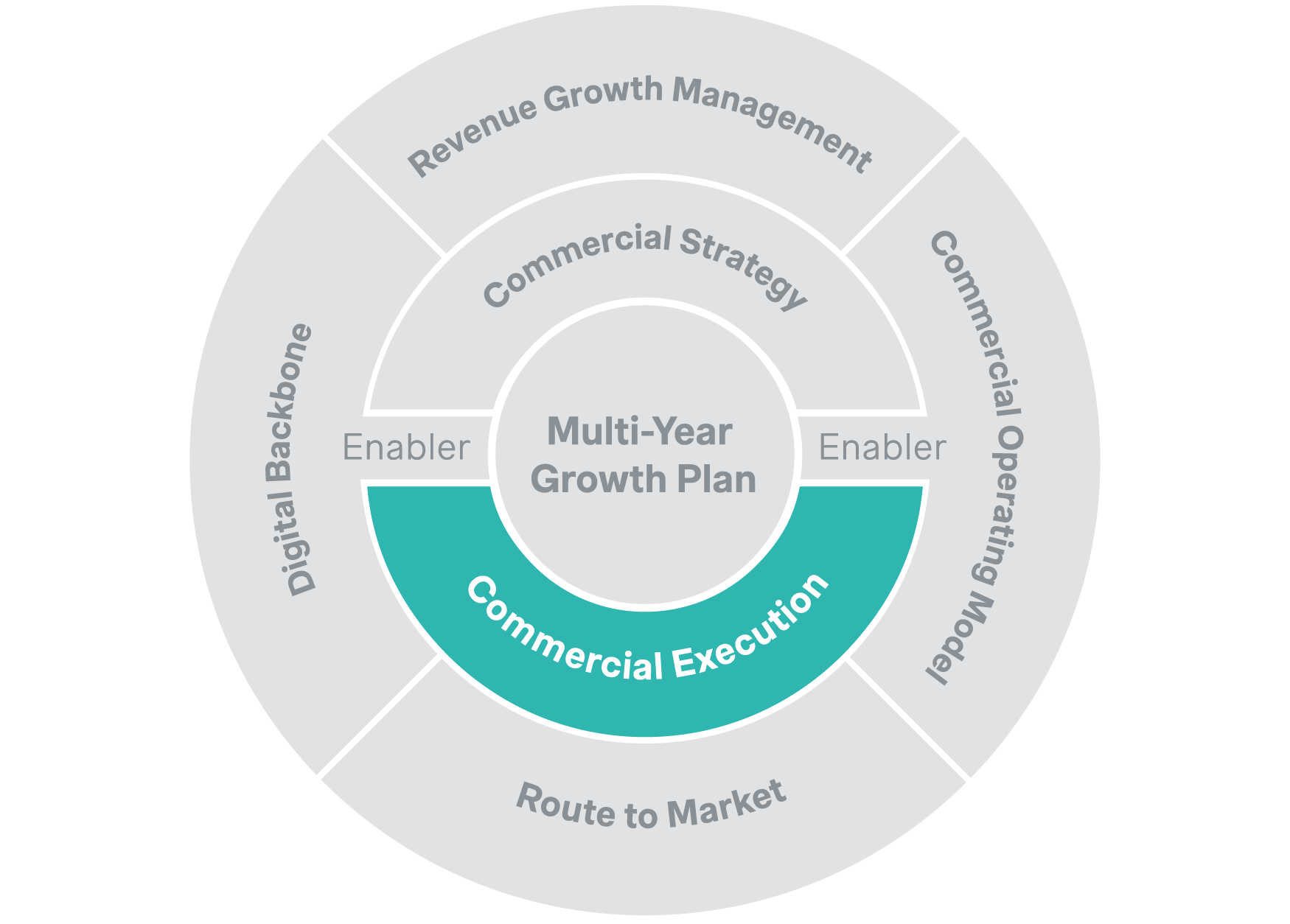
As the second pillar of the End-to-End Commercial Excellence framework, commercial strategy bridges the gap between long-term growth planning and commercial execution.
The 7 levers of End-to-End Commercial Excellence
Source: Simon Kucher
How to build an effective commercial strategy
Growth opportunities rarely exist within broad markets alone. They differ by category, consumer segment, channel, customer, and even individual account.
A robust commercial strategy evaluates opportunities at a much deeper level, identifying where commercial effort is most likely to generate profitable growth. Rather than treating all opportunities equally, decision-makers can make informed trade-offs about where to invest, where to accelerate, and where to reduce focus.
Knowing where to grow is only valuable if organizations understand how to reach those opportunities effectively.
By analyzing the customers, channels, current performance, profitability, and categories with the greatest growth potential, businesses can focus commercial effort on where it will have the greatest impact. This creates a more focused commercial approach, rather than investments being spread across competing priorities.
Successful execution depends on more than choosing the right opportunities. Organizations also need the capabilities, resources, and operating models to deliver against them.
Leadership teams gain clarity on where additional commercial capabilities are needed, how resources should be allocated, and whether existing operating models can support future growth ambitions. By aligning investment with organizational capabilities, businesses improve execution while avoiding unnecessary complexity and duplicated effort.
The final step is turning strategic decisions into an actionable commercial plan for the next 12-18 months.
It establishes clear priorities, aligns teams around shared objectives, and provides practical direction for execution. With a clear roadmap in place, organizations can move from strategic intent to confident commercial action.
The Simon-Kucher advantage
Every organization develops commercial plans. The difference lies in how effectively those plans guide the commercial decisions that matter most.
At Simon-Kucher, we help organizations turn growth ambitions into actionable commercial strategies. Combining deep commercial expertise, proven methodologies, and rigorous analysis, we take a 360-degree view of the business to provide clear direction on how growth opportunities should be pursued. This enables leadership teams to make confident decisions about where to focus commercial effort, where to invest, and where to be more selective.
Our analytical precision, including a clear P&L view and rigorous assessment of profitability, enables leadership teams to prioritize investment towards the highest-value opportunities while identifying lower-priority activities that can be reduced or eliminated.
Equally, we recognize that an effective commercial strategy must connect growth ambition with organizational reality. By breaking down silos across sales, marketing, and finance, we bring together the perspectives needed to shape recommendations around market attractiveness, organizational capabilities, competitive position, and ability to execute successfully. This ensures commercial plans remain practical, achievable, and commercially sustainable.
The result is a focused commercial roadmap that gives leaders the confidence to translate growth opportunities into coordinated commercial action, align investment behind strategic priorities, and accelerate profitable growth.
This creates a consistent foundation for pricing, promotions, route-to-market, account management, and commercial execution, ensuring every commercial lever supports the same growth agenda.
Ready to turn strategy into commercial action?
Transform your growth ambitions into a focused commercial plan. Discover how commercial strategy can help you prioritize investments, align your organization, and build a practical roadmap for profitable growth.
If you're interested in further discussion, reach out to us today: Contact us