Private equity sponsors are entering a new phase in pharma services as 2020–2022 CDMO and CRO acquisitions move toward exit windows. This raises two questions: which value creation levers can still be proven under current ownership, and which should remain for the next investor.
The market backdrop for pharma services has shifted since the 2020–2022 acquisition boom. Higher interest rates have raised financing costs for capital-intensive CDMOs. Tighter venture capital funding has constrained biotech spending, weighing on demand for CROs with biotech exposure. High-profile biotech failures and tighter pharma budgets have added further pressure.
For sponsors, these changes have made the path to realizing the original investment case more challenging.
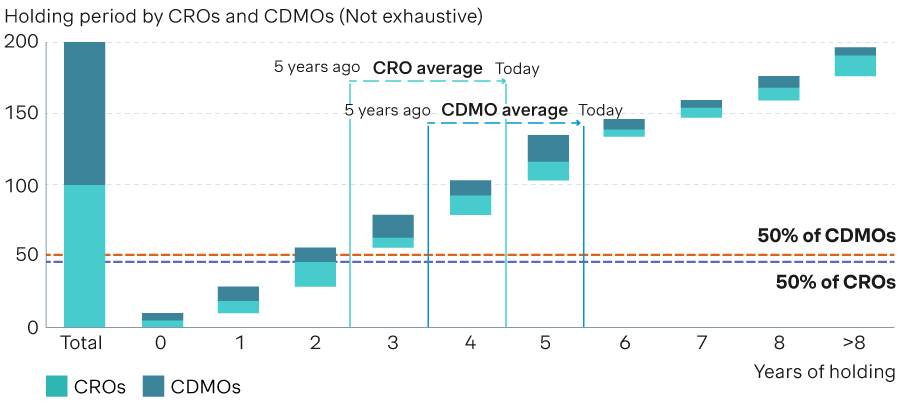
Many sponsor-owned CDMOs and CROs are now four to six years into ownership. While holding periods have lengthened, a sizeable cohort is approaching the exit window.
For sponsors, demonstrating progress since acquisition is only part of the exit case. They also need a clear view of the asset’s commercial maturity, the opportunities still untapped, and the value a future owner can realistically unlock.
That assessment should shape the value creation agenda before a sale process begins. It should prioritize what can be delivered under current ownership and define what remains for the next investor.
The acquisition wave is reaching the exit window
Our analysis of CDMO and CRO transactions between 2010 and 2026 shows a clear acceleration in acquisition activity around the 2020-2022 vintages.
Those assets are now reaching the point where sponsors would traditionally start evaluating exit options. Not every company will or should come to market. Some still have investments to complete; others may need more time to improve performance or wait for a more attractive transaction environment.
But the size of these acquisition cohorts matters. A growing share of sponsor portfolios is entering a period where the decision is no longer simply whether to hold or sell. The more important question is what can still be done during the remaining ownership period to strengthen the assets and the next investment case.
Holding periods reinforce this point. Our analysis of approximately 200 sponsor-owned CDMOs and CROs shows that average holding periods increased by around 38% for CDMOs and 67% for CROs between 2021 and 2026.
Source: Simon-Kucher insights
Longer ownership is not necessarily a drawback. It can give sponsors time to complete investments and build capabilities. It can also help capture opportunities that were not mature by the original expected exit date.
But additional time should come with an aligned value creation plan where tangible results can be established well before a sales process.
CDMOs and CROs are entering the exit window differently
The data also suggest that the ownership cycle is developing differently across CDMOs and CROs.
For CDMOs, value creation can require significant time and investment. New facilities, added capacity, technology platforms, and expansion into new modalities may take several years to move from investment decision to generating meaningful revenue and earnings.
The commercial model can also slow the realization of some value creation levers. In parts of the CDMO market, capacity and commercial commitments are agreed well ahead of manufacturing. Existing demand backlogs provide visibility, but they can also limit how quickly price increases flow through the P&L. Pricing actions on new business may take time to become visible as contracted volumes are delivered and older agreements roll off.
That makes the timing of value creation particularly important. A CDMO may have pricing headroom, attractive new capacity, or a stronger service portfolio. But the exit case depends on when those improvements translate into financial performance, so action needs to start well in advance.
CROs are typically less capital intensive but face a different set of questions. Growth can depend on customer funding, the number and complexity of initiated clinical trials, backlog conversion, therapeutic area exposure, and the balance between large pharma and biotech customers. Commercial maturity may depend more heavily on customer penetration, service differentiation, sales effectiveness, and the ability to translate market growth into sustained share gains.
There is therefore no single optimal holding period for pharma services. What matters is whether the asset is commercially ready for its next ownership phase, and whether the remaining opportunities are sufficiently clear, material, and executable.
The four-year-plus cohort needs a fresh value creation assessment
For assets already four years or more into ownership, the original investment thesis is no longer the right starting point.
The key questions include what the business looks like today, what the optimal size and shape should be at exit, and how to bridge the gap.
That requires assessing both market maturity and commercial maturity. Is the company exposed to the right customer segments, therapeutic areas, and modalities? How attractive is the underlying demand outlook? Has competition changed? Is the service portfolio differentiated enough to sustain growth?
The same assessment needs to look inside the commercial engine. Is pricing disciplined? Are customer relationships fully penetrated? Is cross sell happening across the portfolio? Are the sales model, account ownership, and incentives aligned with the opportunity? Is the company monetizing its most differentiated services? For CDMOs, are capacity and contract structures supporting the right mix of utilization, price, and customer quality? For CROs, is backlog translating into attractive, repeatable growth?
The objective is to identify what remains to be created, not just document what has already been achieved.
Some opportunities may be delivered within months. Pricing governance, discount discipline, customer segmentation, or sharper account management can often move relatively quickly. Others take longer. Building a new capability, changing customer mix, or materially shifting portfolio positioning may require a broader transformation.
That distinction matters when an asset is approaching exit. Sponsors need to know which opportunities can improve performance before a process, and which can strengthen the equity story even if the full financial impact comes later. Other opportunities may be better positioned as part of the next owner’s value creation plan.
This is the same discipline we highlighted in our previous article on value creation due diligence. Commercial opportunities only become meaningful when investors understand their size, timing, confidence level, and execution requirements.
Across more than 50 pharma services value creation and due diligence assignments, our team has seen the same exit-readiness questions appear: what can still be captured under current ownership, and what credible upside should remain for the next investor? Sponsors should ideally address these questions 18–24 months ahead of a planned exit to allow sufficient time for implementation and proof of impact.
Prepare for the exit before the process starts
Sponsors with CDMO and CRO assets already four to six years into ownership should assess that question now, rather than waiting until sell-side diligence begins.
The starting point is addressing simple questions. How commercially mature is the business today? Where are the remaining gaps? Which value creation levers can realistically be captured over the next 12 to 24 months? Which opportunities can form a credible growth plan for the next owner?
Depending on the asset, the answer may involve improving pricing and contract structures, increasing customer penetration, sharpening the service portfolio, improving sales execution, optimizing customer and end-market mix, or accelerating the commercial impact of investments already made.
A recent project identified quick wins with the potential to deliver >2% sales uplift and >5% EBITDA improvement over 18 months ahead of exit, while the measurable long-term order entry uptake impact strengthens the sell-side equity story supporting a long-term value creation roadmap.
The 2020-2022 acquisition wave has created a sizeable CDMO and CRO exit cohort. Longer holding periods may spread those exits over time, but they also give sponsors a window to strengthen the businesses before they come to market.
It is important to use the remaining ownership period to make the next value creation story stronger. Exit preparation should reflect that work instead of substituting it.