
AI adoption in sales is table stakes now. End-to-end integration in commercial workflows remains a challenge for most B2B organizations. So how are leaders raising the bar? Commercial leaders are connecting AI to measurable commercial outcomes: better targeting, higher conversion, stronger retention, more disciplined pricing, more productive sellers, and happier customers.
Sales AI usage vs. Sales AI integration to strategy
Sales AI is moving beyond drafting sales messages and summarizing discovery calls towards predictive account research, more precise lead qualification, and continuous client follow-up with tailored value. Large language models are now pervasive, and specialized AI tools have appeared across the sales process as point solutions.
Simon-Kucher’s 2026 Global B2B Sales Study findings show LLM usage is nearly universal at 98% and sales-specific AI use has tripled in the past 12 months to ~80%. The best performing companies are using AI in at least eight different commercial processes.
Usage continues to shift from isolated AI applications towards agentic workflows that can execute commercial processes. No single sales AI vendor owns the workflow yet. That matters because sales leaders should ideally focus less on selecting a single platform and more on building a connected workflow: a combination of native tools and specialist applications that deliver a connected sales strategy. Read more on how Simon-Kucher’s Elevate team views AI’s move from assisting to executing through Agentic Sales.
At our 2026 New York Commercial Leadership Roundtable CRO and private equity participants echoed this conclusion: AI is an accelerator, not a strategy. AI is most effective when the underlying data, CRM discipline, and commercial processes are sound. In other words, AI does not fix a weak GTM system. It amplifies the system you already have. And many of those processes have been either boilerplate or patchwork for years. The 2026 B2B Sales Study respondents agreed that leveraging AI is going to become more relevant over the next two years, but they are not prepared for this shift.
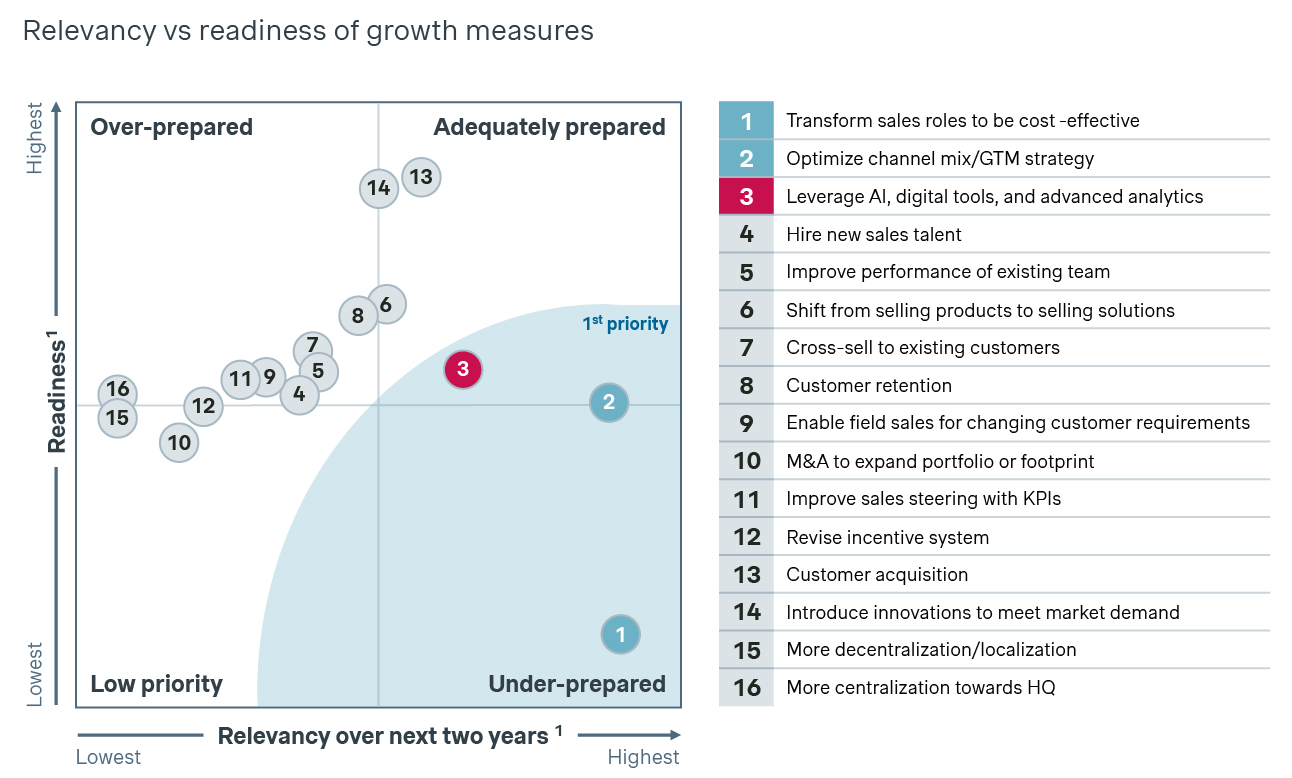
1) Data was transformed and scaled | Source: Simon-Kucher B2B global sales study conducted in May 2026
How can sales leaders measure the commercial value of AI?
Many companies started AI with the goal of cost-reduction. This meant fewer administrative tasks, faster research, better call preparation, quicker content generation, and automated follow-up. However, time-saving applications only strengthen financial investment when they reduce actual expense or contribute to growth. Growth fuel can be sharper opportunity prioritization, more precise qualification, improved sales velocity, higher price realization, better account retention, or more relevant expansion plays.
To show the ROI from AI in sales, sales leaders should focus strategically and measure AI across four value levers.
- Revenue growth: Does AI improve pipeline quality, conversion, average contract value, cross-sell, upsell, retention, or new logo acquisition? This is where AI moves from seller assistance to growth engine.
- Profitability and margin: Does AI improve price realization, reduce unnecessary discounting, increase attach rates, improve cost-to-serve, or shift capacity toward higher-margin opportunities? This is where AI earns credibility with finance.
- Productivity: Does AI reduce administrative work, speed up call preparation, shorten proposal creation, improve content quality, or free selling capacity? This helps fund the business case, but productivity needs to be converted into redeployed capacity, higher coverage, or reduced cost for a stronger business case.
- Capability building: Is AI integrated into CRM, pipeline reviews, coaching, content management, account planning, and performance management? Adoption alone is a weak metric. Workflow integration is the real benefit. This is critical for sales managers, who are getting squeezed by their sellers and leadership to meet performance goals.
What works for another company may not work for yours. Start with strategy.
Use case selection is one of the most important AI decisions. Your AI roadmap should depend on the commercial bottleneck you are trying to solve. A few examples we’ve helped clients diagnose and solve:
- If the problem is poor targeting, prioritize ideal customer profile scoring, account prioritization, and prospect data.
- If the issue is inconsistent qualification, deploy AI to improve discovery, call coaching, and deal scoring.
- If the challenge is forecast quality, focus on pipeline inspection and opportunity risk signals.
- If sellers are defaulting to discounts, use AI to equip value messaging, deal guardrails, and pricing guidance.
- If account expansion is underdeveloped, focus AI on cross-sell, usage signals, retention risk, and next-best-action plays.
How to get started
Here are three actions sales leaders can take to move from AI experimentation to proven ROI value:
- Prioritize use cases by commercial value and implementation feasibility. Focus where the measurable prize is large enough to justify change management and sufficient data exists for accurate guidance.
- Select a commercially meaningful pilot with a baseline and an invested sales leader. Focus where there is opportunity and impact potential. Measure whether the tool changes conversion, cycle time, price realization, retention, customer-facing capacity, or manager coaching quality.
- Scale promising use cases with a clear business case and continuous monitoring.
Sales leaders should make conservative assumptions and work with finance to establish a ROI threshold (e.g., 5x in 1 year), recognizing that not every experiment will clear that bar immediately.
Final thoughts
The highest-performing organizations will not be the ones with the broadest AI sales stack. They will be the ones that connect AI to a modern commercial engine, with clear measures showing how it improves growth, margin, and seller productivity.
AI should streamline the selling process and improve the customer experience, but the investment case must go further. It must show how better workflows deliver more value, create meaningful customer conversations, open a path for revenue expansion, and accelerate more profitable growth.
Read more on how Simon-Kucher’s Elevate team views AI’s move from assisting to executing through Agentic Sales.
Download Simon-Kucher’s 2026 Global B2B Sales Study