
The field service industry is entering a new phase of growth where service quality is being paired with commercial excellence. In both installments of our 2025 Commercial Excellence Benchmarking Study, developed in collaboration with Future of Field Service, we dove into the state of the industry and established the building blocks required to set growth potential in motion. This includes sharper segmentation, better structured offers, stronger value-based pricing, and digital enablement.
Success with this framework unlocks growth and raises new questions. For many of our clients, one such question is “How do we ensure our teams are designed to capitalize on the building blocks we’ve put in place and deliver sustained growth?”
The problem is not access. Customer access across industries has never been greater, especially among field service organizations. Technicians are on-site regularly, trusted by operators, and closer to customers than any other function. They see recurring failures, usage shifts, and unmet needs that no sales team ever will. Rather, we find the problem that most often hurts organic growth is conversion.
When growth stalls, the instinctive response is to add sales resources, push technicians harder, or launch new enablement initiatives. These actions offer temporary relief but rarely address the real issue. The difference between companies that capture that value and those that don't comes down to whether the organization is structured to convert those observations into revenue.
Commercial design is a growth bottleneck
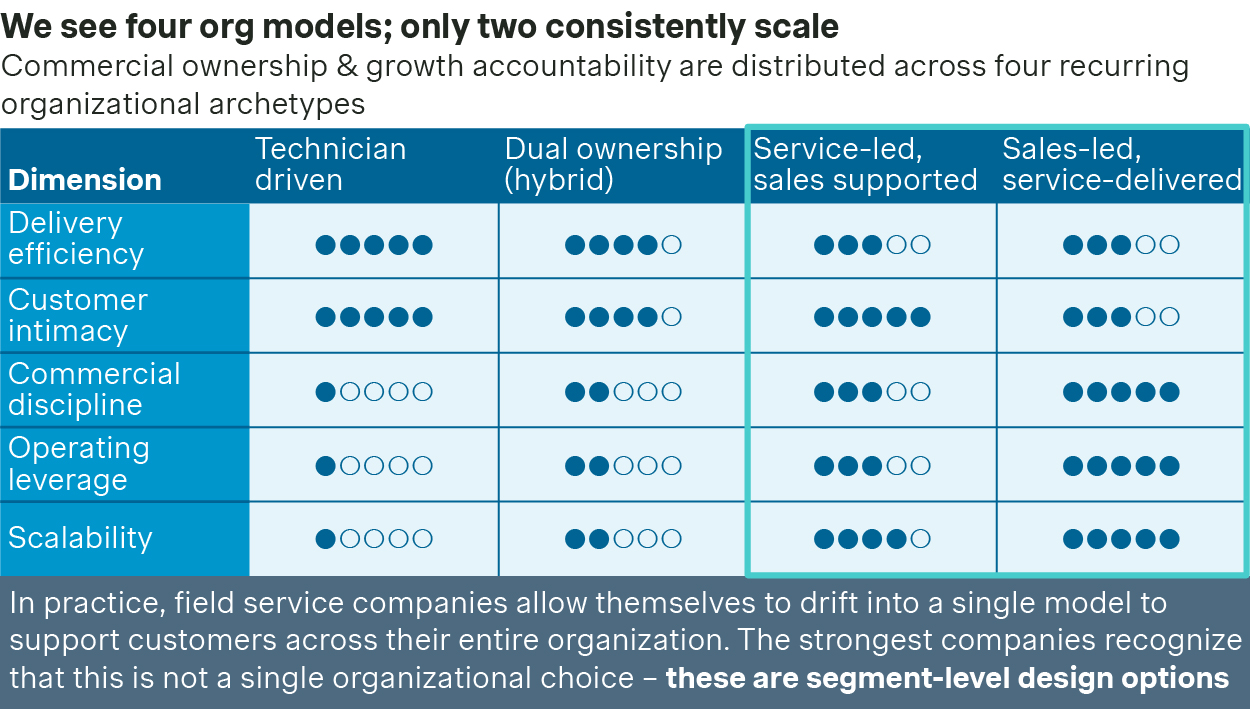
Many field service organizations we work with fail to review and redesign their commercial organizations as they grow and serve new segments. Their commercial models most often crystallize into one of four organization models:
Technician-driven model: The frontline ultimately identifies and shapes commercial opportunities. Customer intimacy is high, but this model rarely scales. It runs on individual initiative rather than repeatable discipline. Organizations often see pockets of strong performance alongside large parts of the customer base that are never developed.
Hybrid model: Sales and service share ownership. In theory, this pairing is balanced, but ambiguous in practice. Without explicit hand-offs and decision rights, shared ownership becomes murky, and opportunities ultimately slip through the cracks.
Service-led, sales-supported model: Service retains the primary customer relationship and identifies expansion potential, while sales teams provide structured account support. This model performs well in fragmented customer environments where consistent technician relationships drive trust. Without clear triggers and hand-off discipline, service teams absorb expectations that were never properly resourced.
Sales-led, service-delivered model: Sales run point on commercial orchestration while service reinforces delivery and proof of value. This model fits large, concentrated accounts with complex buying behaviors, diversified relationships, and outcome-based structures. It breaks down when both functions operate with separate incentives and no coordination.
The mistake many organizations make is believing that one model should serve every customer. However, the best organizations intentionally deploy different models tailored for specific customer segments. Without assessing how each model serves different customer segments, organizations risk losing revenue they are already positioned to capture.
Good models follow the customer, not internal inertia
The right commercial model should be determined by how customers buy, how services are delivered, and where value is created. A practical way to choose is to pressure-test each customer segment against three questions:
How concentrated is the customer base?
Large, concentrated accounts typically require more deliberate commercial orchestration. Fragmented accounts often rely more on frequent service interactions and local trust.
How complex is the service or offer?
Multi-site, engineered, bundled, or outcome-based services usually require sales-led coordination. Standardized or recurring services can often scale through a service-led motion.
Where does the expansion signal appear first?
If growth opportunities surface in executive buying discussions, sales should lead. If they surface during inspections, repairs, maintenance visits, or recurring technician interactions, service needs a defined role in the growth model.
This test prevents organizations from assigning commercial ownership based on internal inertia. Instead of asking “Do we want sales or service to own growth?”, organizations should consider “Where do customers need commercial guidance, and which role is best positioned to provide it?”
For many field service organizations, the answer will vary by segment. The same segmentation logic that determines what customers are offered, how they are served, and how they are priced should also denote where growth is owned. When the model follows the customer sales and service start playing distinct roles in the same growth system.
Strategic considerations
Design around where value is created: Anchor the commercial model in how customers buy, where expansion signals appear, and which role is best positioned to act. The goal is not to force sales-led or service-led coverage everywhere, but to match the model to the customer context.
Separate insight from ownership: Do not default ownership to either sales or technicians. Define who identifies, translates, owns, and converts the opportunity based on where the customer signal originates and who is best positioned to act.
Create a path from field signal to revenue: Recurring issues, usage shifts, aging assets, and modernization needs should not remain isolated field observations. They need a defined route into qualification, customer follow-up, and pipeline ownership.
Reinforce the model through incentives: Sales, service, and frontline metrics should support the behaviors each role is expected to drive. Incentives must reduce ownership conflict, protect customer trust, and make the intended growth motion easier to execute.
Field services as your growth engine
Scalable field service growth is not created by choosing sales over service or asking technicians to sell harder. When executed, the frontline becomes part of a broader commercial system. This is not a substitute for sales, but a source of performance insight that helps the organization convert customer access into sustained growth.
Every field service organization we work with is trying to grow. Most are facing the same labor, cost, and competitive pressures. Those outgrowing their peers have intentionally designed their commercial organization around the customers and segments they serve.
In our next article, we’ll discuss a key to unlock your commercial organization’s success – technician compensation.