
Technology creates differentiation. Commercialization determines whether you capture its value.
Within the payments industry there is one growing consensus: technology alone is no longer enough to protect margins. Most providers are seeing a decline in take rates or volumes, if not both. New entrants, lower barriers to entry, and growing feature parity have made providers appear interchangeable, shifting commercial conversations toward price rather than value.
This creates a structural challenge. Processing costs are largely outside providers' control, with interchange and scheme fees consuming a significant share of economics. Pricing pressure quickly translates into margin pressure and a hit to valuation.
While payment providers may appear increasingly similar from the outside, the value merchants receive is not. Higher authorization rates, better checkout performance, lower fraud losses, optimized routing, integrated software, and value-added services all create measurable commercial outcomes for both small and large customers.
A one-percentage-point improvement in authorization rate can add millions of dollars of incremental revenue for enterprise customers. Inclusion of local payment methods can increase conversions by double digits. Card on file and account updater capabilities reduce churn significantly for subscription businesses, boosting their valuations.
Despite the clear benefits from technological advancements, why are margins still under pressure?
Commercialization trumps technology alone
Across our work with more than 100 payment processors, acquirers, schemes, embedded payment providers, and software platforms, we consistently see the same pattern: technology creates differentiation, but commercialization determines whether providers capture its value. Strong technology alone does not guarantee margin protection or profitable growth.
We find that payment providers typically fall into one of four strategic positions.
The Commercialization Matrix
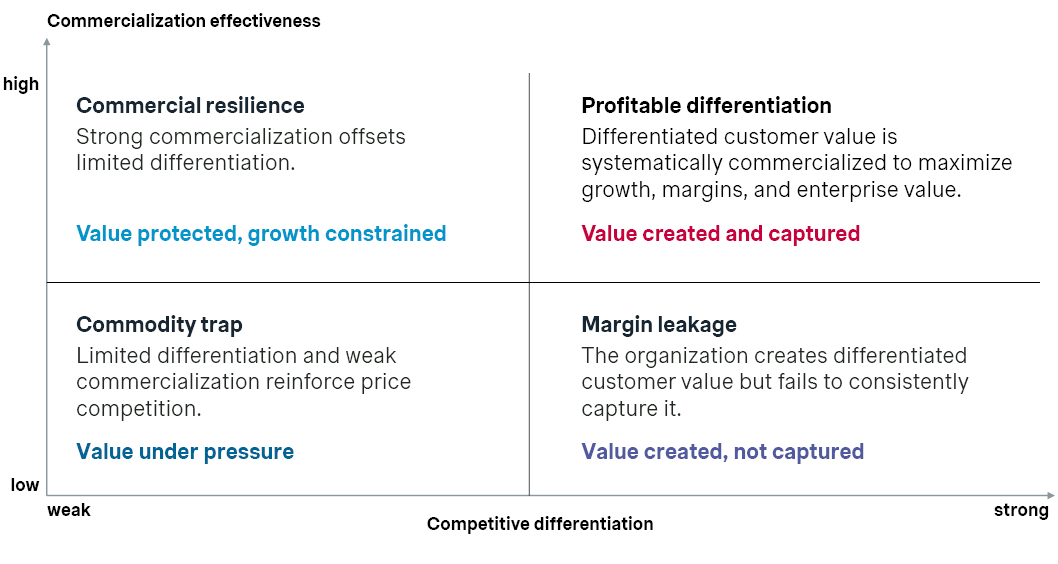
The objective is clear: move toward the Profitable Differentiation state rather than relying only on better technology.
Our analysis shows that providers that make this shift consistently outperform their peers in five commercial capabilities that turn differentiated technology into better financial performance.
1. Commercialize business outcomes
Too many payment discussions collapse into a comparison of transaction fees. Procurement teams, finance controllers, and business owners understandably push for a lower price. This is where providers lose value.
Payment providers need to shift conversations from price to value, where the focus is on outcomes that matter to merchants. That means moving from “we have state-of-the-art tech” or “we have 99.9999% uptime” to “we help you generate x% more revenue and reduce losses by y%, thereby lowering total cost of running payments by z%.”
Best-in-class providers follow a structured playbook. They create a streamlined value story, customized for each needs-based customer segment. They understand what each customer segment cares about, prove the differentiated impact of their capabilities, and translate technical performance into financial terms that buyers can justify internally.
The goal is not to avoid price discussions. It is to enter them prepared, with clear and quantified outcomes that shift the focus away from pricing.
2. Monetize differentiated value
Margin leakage often starts before negotiation even begins – when differentiated capabilities are presented too broadly, discounted too quickly, or included without a clear monetization logic.
Our research across regions and verticals consistently shows that merchants, even within the same vertical and size group, do not all want the same outcomes or have the same needs.
Some merchants are heavily focused on maximizing conversions while others want “good enough” performance at low prices. Then, there are differences in how they treat each geography and channel, how they think about their workflows, what kind of customer support they want, and how many payment providers they want to work with. These are just a few dimensions on which needs vary.
Reaching out to all merchants with a single undifferentiated offer makes it harder to show the value and orients the conversation to price. But offering multiple modules creates a paradox of choice that makes adoption harder for both customers and sales reps.
From working with companies across the payments value chain, we find that the strongest providers adopt needs-based offer structures to make the differentiation visible. They separate core functionality from premium capabilities to drive a clear link between outcomes and price. Furthermore, they align their pricing – metrics, fee structures, price points – with the offer structure.
These providers do not let high-impact capabilities become free add-ons. They continuously ask themselves: Are we monetizing the value we create, or just using it to win volume without margin uplift?
Capital markets increasingly reward providers that consistently monetize differentiated outcomes.
3. Build commercial discipline
Too often, we see providers with great strategies undone by sales and account management teams that were never equipped to execute them.
Margin erosion often happens deal by deal. A merchant threatens to churn. A competitor prices aggressively. A sales team that lacks tools, confidence, or incentives to focus on value can still win a deal, but what should have been an exception becomes the rule, weakening the business over time.
Top providers give sales teams the tools, training, and commercial discipline to sell and negotiate on value, not just explain features or talk price. Sales should be able to connect value from performance to merchant economics and outcomes to create buy-in on the provider’s proposition and pricing.
These providers pair that tooling with structured coaching and compensation plans built to reward the right business objectives.
They also set up robust internal governance in place – clear pricing authority, discount rules, escalation paths, concession frameworks, and deal review processes – that gives sales controlled flexibility without sacrificing discipline.
4. Optimize route-to-market
Channel strategy determines how efficiently value reaches the market.
Direct sales can be the right answer when the proposition is complex, the merchant relationship is strategic, or the value case requires consultative selling. It gives providers more control over the relationship, better access to decision-makers, and more opportunity to defend premium pricing. But it also increases acquisition costs and can slow growth if used too broadly.
Partner-led and embedded models solve a different problem. They extend reach, improve scalability, and serve fragmented merchant segments more efficiently. The trade-off is lower control, weaker direct ownership of the merchant relationship, and potential pressure on unit economics.
Leading providers realize that the right channel strategy is about selecting the route to market that best fits each target segment’s economics, the complexity of the solution, and how much value merchants are willing to pay for.
Providers that get this right do not just distribute more effectively. They grow their business sustainably.
5. Continuously evolve the proposition
Innovation across payments is accelerating, from software layers to value-added services built around payments. Invoicing, billing, reporting, loyalty, AI support, reconciliation, chargeback automation, fraud management, and financing solutions can make the provider more relevant to day-to-day customer operations.
Even Adyen has departed from its long-standing position of building technology completely in-house to acquire Talon.One and Orb in quick succession – underscoring the importance of creating value at pace in a competitive environment.
Providers continue to invest heavily in new capabilities, yet the commercial return on those investments often falls short.
Leading providers know that when their core proposition becomes truly easier to compare and the market players can move faster with AI, their own proposition needs to evolve to become a bigger differentiator.
Successful providers do not add features or products for the sake of it. They take a deliberate approach, first identifying what the customer pain points are in payments and beyond, where their product and feature gaps are relative to the market, and where natural adjacencies exist.
These providers also know that the best innovations and products fail not because there is no need, but because willingness to pay is limited. As a result, they carefully consider the monetization potential of new developments.
By doing so, the best-in-class players open additional revenue streams and increase stickiness by embedding themselves deeper into customer’s business.
From technology to enterprise value
Payments and technology will continue to become easier to build, distribute, and replicate. Commercial advantage will not.
The providers that outperform over the next decade will be the ones that most effectively identify, communicate, monetize, and continually expand the value they create for merchants.
Converting that differentiated value into profitable growth can help organizations sustain margins, improve valuation, and build long-term competitive advantage.
The winners aren't those who create the most value but the ones who consistently capture it.
Where are you creating differentiated value, and where is it leaking?
Most providers misdiagnose their commercialization gap as a technology problem. Finding out where that gap actually sits is the real starting point.
We developed the Commercialization Diagnostic to help payment leaders do exactly that.
In just 10 minutes, the diagnostic will show where your organization sits in the Commercialization Matrix, which commercial capabilities are strongest, and where the greatest opportunities exist to improve value capture, margins, and growth.
You’ll receive:
- Your position in the Commercialization Matrix
- A maturity assessment across five commercialization capabilities
- An indication of where margin leakage may be occurring
- Practical priorities to strengthen profitable growth.
Take the Commercialization Diagnostic to assess your organization's maturity level
Complete the 10-minute assessment to evaluate your organization and receive tailored recommendations.