
This is the third article in our series on structured differentiation in retail. In the first article, we introduced three dimensions of commercial optimization: where to tailor strategies by store, how to manage categories according to their commercial role, and when promotional investments create value. The second article explored the where dimension through Store Clustering. This article turns to the category dimension: what role should each category play in the broader retail proposition?
Too often, categories are managed based on sales volume, historic planning routines, supplier input or margin targets, rather than on the role they should play. That creates value leakage. A category that should build traffic may not receive sufficient price investment. A basket-building category may be underused in placement and cross-sell. A margin-driving category may be over-promoted. A category that supports a specific customer segment may receive too much space relative to its strategic value.
The opportunity is to move from category management based on standalone performance to category management based on commercial role. This enables retailers to fully potentialize each category: not by treating every category as equally important, but by defining the role it should play and managing it accordingly.
From category performance to category purpose
The key question is not only how a category performs today. The key question is what role that category should perform for the retailer.
Category Role helps retailers answer that question. It classifies categories into clear role groups based on how they contribute to the customer journey, basket composition, price image and commercial strategy. These roles then become the basis for differentiated decisions on assortment, pricing, promotions, shelf space and activation.
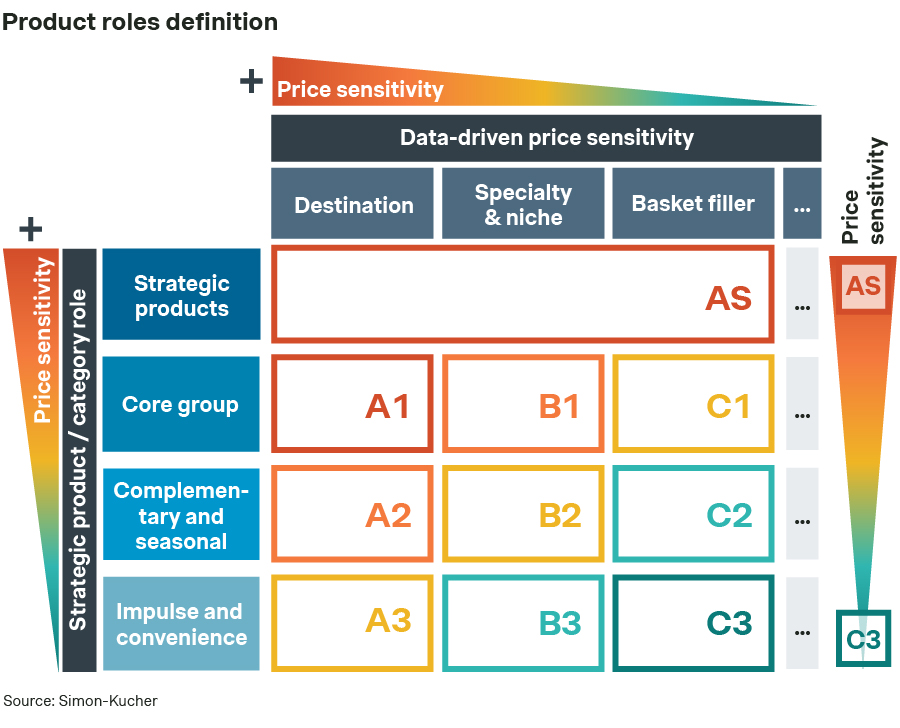
A practical Category Role framework typically distinguishes between a limited number of intuitive roles. The exact labels can differ by retailer and sector, but four common roles are:
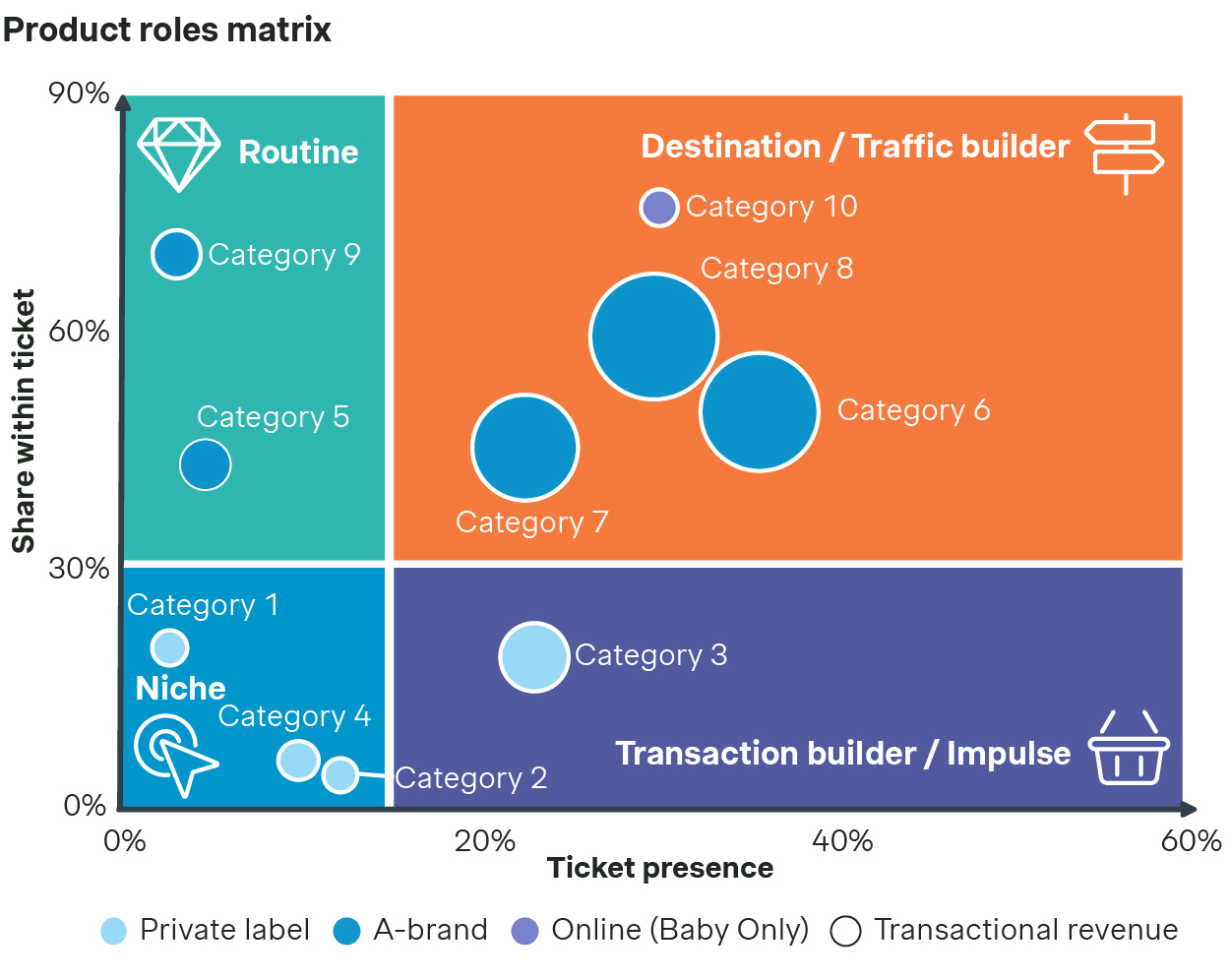
Destination categories attract customers and strongly influence where they choose to shop. They are often planned purchases that shape store preference and price image. Depending on the retailer and customer mission, examples could include baby formula in a drugstore, fresh bread in a supermarket or running shoes in a sporting goods retailer. These categories often justify sufficient assortment depth, strong availability, visible shelf space and selective price investment.
Routine categories are part of the regular shopping mission. Customers expect them to be available, easy to find and competitively priced. These categories may not always differentiate the retailer, but poor execution can damage convenience and trust. The focus is typically on reliable availability, clear price architecture and efficient range management.
Impulse categories increase basket value because they are often added during the shopping trip rather than planned in advance. Examples can include confectionery near checkout, travel-size products, accessories or small add-on items. These categories usually depend less on deep price investment and more on visibility, placement, bundling and cross-sell logic.
Niche categories serve more specific customer needs and often have lower price sensitivity. They may not drive high traffic or volume, but they can strengthen relevance for specific segments and contribute attractive margins. The key is to protect profitability and avoid overextending the range: enough choice to serve the target need, but not so much complexity that space, stock and working capital are tied up unnecessarily.
The purpose of the framework is not to label categories for the sake of it. The purpose is to unlock the full potential of each category by managing it according to its commercial role. Each role should lead to a different answer on where to invest, where to simplify, where to protect margin and where to strengthen the customer proposition.
What Category Role delivers
Category Role translates category purpose into concrete commercial decision rules.
For each role, retailers can define guidelines across:
- assortment breadth and depth;
- national brand versus private label balance;
- entry, mid-tier and premium price points;
- promotion frequency and mechanics;
- shelf space and facings;
- merchandising and activation priorities.
This creates a more coherent category strategy. Instead of asking whether each category should simply grow revenue or margin, retailers define how each category should contribute to the total proposition.
That distinction matters. A Destination category may justify sharper price investment because it influences traffic and price image. An Impulse category may create more value through placement and bundling than through discounting. A Niche category may deserve margin protection rather than promotional pressure. A Routine category may require operational excellence: availability, simplicity and a competitive value perception.
Category Role therefore helps retailers avoid two common mistakes: treating all categories as if they have the same commercial objective, and optimizing categories without considering their role in the broader customer journey.
Which data is needed?
Category Role requires a fact-based view of how customers shop across categories. The critical step is not only calculating category KPIs, but interpreting what they imply for commercial strategy.
The foundation is usually transactional data. Relevant indicators include ticket presence, share of basket, purchase frequency, first-purchase presence and the extent to which a category acts as the main reason for a shopping trip.
This can be combined with assortment and product attributes, price sensitivity insights, competitive intelligence, shopper research and category expertise. These inputs help distinguish between categories that may look similar on sales but play very different roles in the customer journey.
The output must be practical. Commercial teams need role definitions that guide concrete decisions, not a complex classification that only explains historical performance.
Potential impact
The impact comes from aligning commercial choices with category purpose.
For Destination categories, retailers may decide to protect price image, broaden the range, strengthen visibility and invest selectively in traffic-building promotions. This helps the category fulfil its role as a reason to visit the store and as an anchor of the retailer’s broader proposition.
For Impulse categories, the better decision may be to improve placement, build cross-sell combinations and use simple basket-building mechanics. Here, the opportunity is not necessarily to discount more, but to increase attachment and basket value at the right moments in the shopping journey.
This is where Category Role becomes more than a segmentation exercise. It creates a decision framework for allocating commercial investment across categories and making sharper trade-offs between revenue, margin, customer relevance and operational complexity.
Our project experience shows that defining category roles and role-specific guidelines can contribute to 4–8% return-on-sales improvement. Targeted pricing actions by category or product group can also generate substantial topline and margin improvements while limiting unnecessary volume erosion.
The organizational benefit is also important. Category Role gives merchandising, pricing, marketing and store teams a shared language. It helps teams understand why one category deserves price investment, another deserves promotional support and another should be simplified or managed for margin.
What comes next
Category Role addresses the second dimension of structured differentiation: how to differentiate and what role should each category play in the overall retail proposition?
It also builds directly on Store Clustering. Once retailers understand which store types require different commercial strategies, Category Role helps determine how categories should be managed within those strategies. A Destination category in one store cluster may warrant more space, broader assortment depth, and sharper price investment, while the same category may play a more limited role in another. This is where structured differentiation becomes more precise: store strategy and category strategy reinforce one another.
In the next article, we turn to the third dimension: when do promotional investments genuinely create value? We will explore how Promotion Excellence helps retailers identify which promotional moments deliver true incremental impact and how promotions can be managed as disciplined growth investments.
Want to unlock the full potential of your categories? Get in touch with our retail experts.