This is the fourth and final article in our series on structured differentiation in retail. In the first article, we introduced three dimensions of commercial optimization: where to tailor strategies by store, how to manage categories according to their commercial role, and when promotional investments create value. The second article explored the where dimension through Store Clustering, while the third focused on the category dimension through Category Role. This final article turns to the last question: when do promotional investments genuinely create incremental value?
Promotions are one of the most visible commercial tools in retail. They drive traffic, influence customer perception, support suppliers, activate categories and create short-term sales momentum. But do they create incremental value?
Many retailers still evaluate promotions mainly on sales uplift during the campaign period. That view is incomplete. A promotion can generate strong sales without creating much incremental value. Some customers would have bought the product anyway. Some volume may be shifted from another week, another product or another category. Some promotions increase volume but dilute margin. Others may look modest in revenue terms but create attractive profitability or valuable basket effects.
The opportunity is to move from running promotions to managing promotional investment: understanding which promotions create incremental value, which need to be redesigned and which should be reduced or stopped.
From promotional sales to incremental value
The key question is not whether a promotion generated sales. The key question is whether it generated sales and profit that would not have happened otherwise.
Promotion Excellence helps retailers answer that question. It distinguishes between sales genuinely created by the promotion and sales that would likely have happened anyway, using baseline modelling. It then evaluates promotions based on incrementality, profitability, cannibalization, supplier funding and basket effects.
This matters because promotions often serve different strategic purposes. Some promotions are designed to build traffic. Others defend market share, support a category role, increase basket value, activate a supplier partnership or clear inventory. A strong promotion strategy does not treat all promotional events alike. It defines what each type of promotion is expected to achieve and evaluates performance accordingly.
The objective is not to promote less by default. The objective is to promote better: with clearer targets, stronger economics and better alignment with store and category strategy.
What Promotion Excellence delivers
Promotion Excellence translates promotional performance into clear commercial decision rules.
A typical output is a classification of promotions based on true volume uplift and true ROI. These metrics go beyond campaign-period sales. They reflect the broader economics of the promotion, including incrementality, margin impact, cannibalization, supplier funding and basket effects.
This creates a simple decision view without oversimplifying the economics behind it. Retailers can distinguish between different types of promotional outcomes:
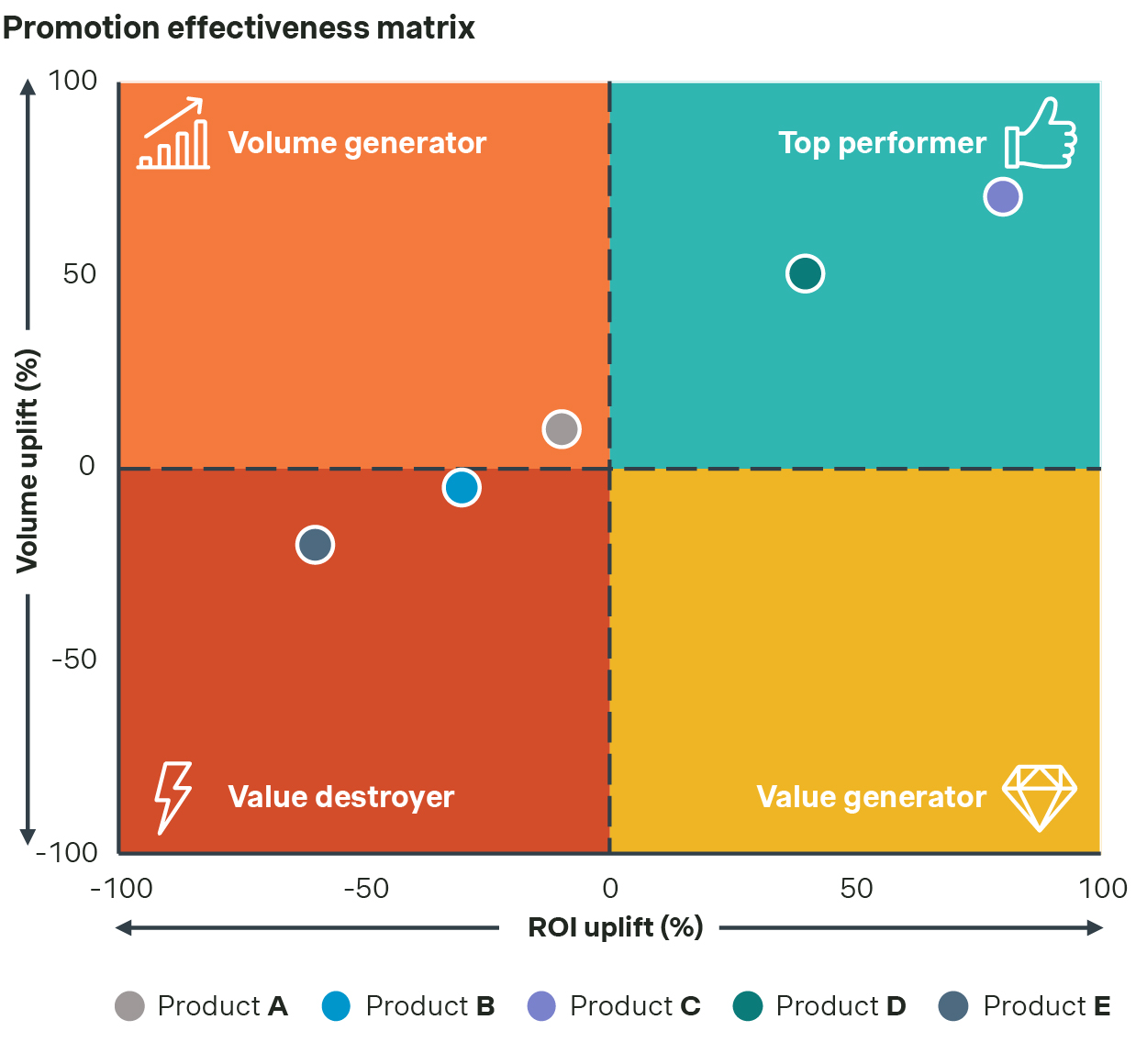
Top performers generate both meaningful volume uplift and attractive ROI. These promotions are useful benchmarks for future campaign design and may deserve more investment.
Value generators improve ROI even if volume impact is limited or negative. These promotions can be attractive when profitability, margin protection or supplier economics are the priority.
Volume generators create significant volume uplift but weak or negative ROI. These may still be relevant for specific strategic objectives, such as traffic building, market share defense or brand activation, but should not be treated as automatically successful.
Value destroyers underperform on both volume and ROI. These promotions should be redesigned, reduced or discontinued unless there is a clear strategic reason to keep them.
This classification helps retailers move beyond post-campaign reporting. It creates a practical basis for better promotion calendars, clearer investment choices, more disciplined supplier discussions and repeatable governance.
What data is needed?
Promotion Excellence requires a fact-based view of promotional performance and the underlying sales baseline. The critical step is not only collecting campaign data, but interpreting which effects are truly incremental and which are caused by timing shifts, cannibalization or margin dilution.
The foundation is usually transactional data, pricing and promotion history, discount depth, promotion mechanics, promotion calendar, product attributes and margin information. Customer data, supplier funding and basket-level information can further enrich the view.
Baseline modelling is used to estimate what sales would likely have been without the promotion. This creates a reference point for measuring true uplift. From there, promotions can be assessed on incremental revenue, gross profit, ROI, volume effects and broader basket impact.
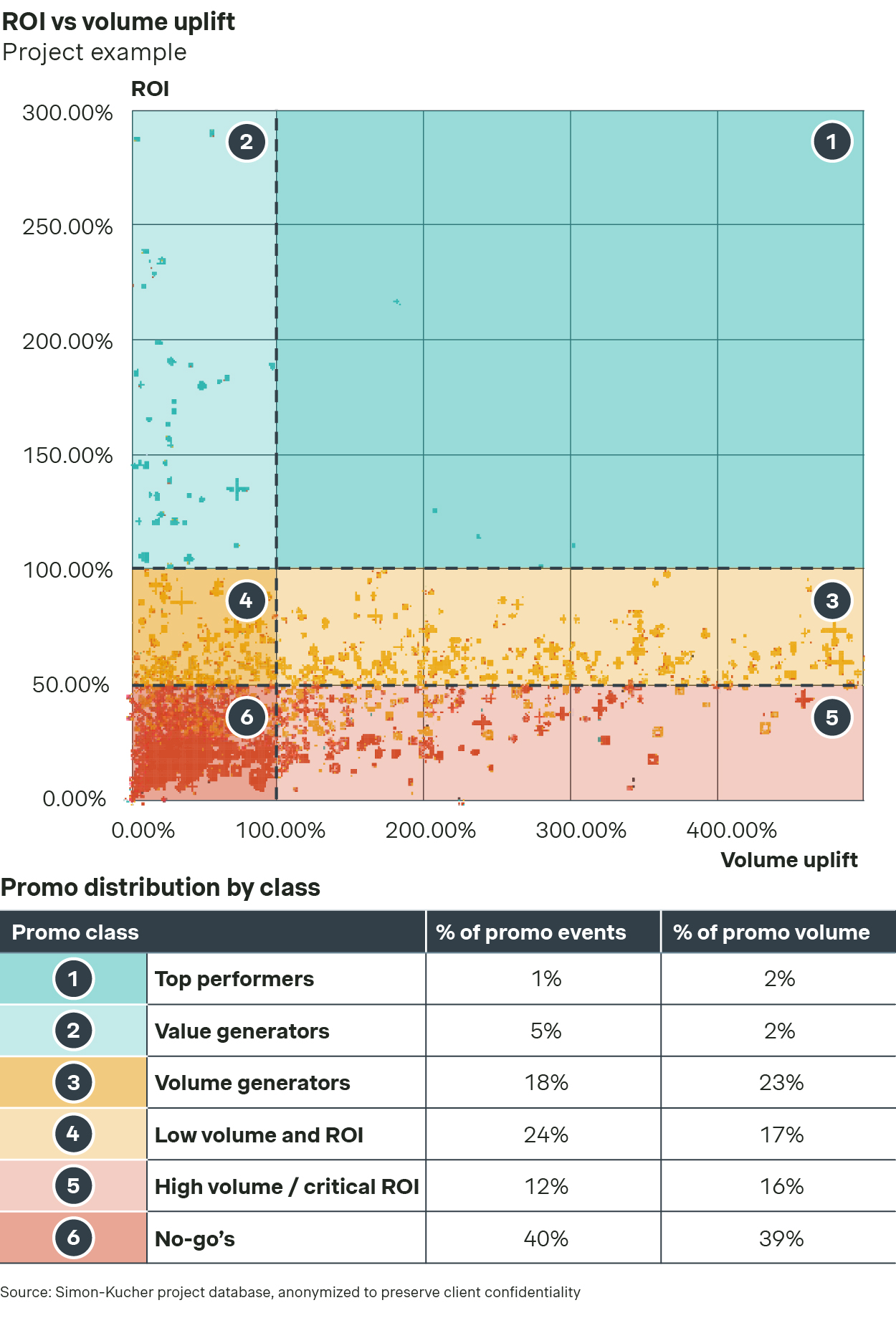
The analytical work needs to be robust enough to separate real uplift from noise, but the value lies in the commercial translation: clear guidance on which promotions to scale, redesign, use selectively or stop.
Potential impact
The impact comes from reallocating promotional investment towards the events that create real commercial value.
For example, a multi-buy mechanic may generate high unit volume but limited incremental profit if it mainly subsidizes purchases that would have happened anyway. In that case, the better decision may be to reduce frequency, adjust the mechanic or reserve it for specific categories or store clusters where it creates genuine traffic or basket impact.
By contrast, a targeted price promotion on a category with a clear traffic-building role may justify investment if it attracts additional shoppers, increases basket value or strengthens price perception. The same promotion can therefore be attractive in one category or store cluster and unattractive in another.
Our project experience shows that promotion optimization can generate up to 9% incremental promotional revenue. The value comes not only from improving individual promotions, but from creating a repeatable approach: clearer objectives, stronger ROI transparency, better calendars and better governance.
Promotion Excellence also strengthens the first two levers of commercial optimization. Store Clustering shows where promotional intensity should differ by store type. Category Role clarifies what each category should contribute and therefore which promotional objectives are appropriate. Promotion Excellence then determines when promotional investment actually creates value.
Bringing the three levers together
This article completes our three-part deep dive on structured differentiation in retail.
Store Clustering helps retailers determine where commercial strategies should differ. Category Role clarifies how categories should be managed based on the role they play in the retail proposition. Promotion Excellence identifies when promotional investments genuinely create incremental value.
Together, these three analyses help retailers move from uniform or intuition-led decision-making to structured differentiation. The objective is not to create complexity for its own sake, but to identify which decisions should differ, why they should differ, and how those differences can be translated into clear and repeatable commercial decision rules.
For retailers, the implication is clear: commercial performance is rarely optimized by looking at stores, categories, or promotions in isolation. The greatest value comes from connecting these perspectives into one coherent commercial strategy, combining local relevance by store type, clear category roles, and disciplined promotional investment.
Want to improve promotional ROI or build a more differentiated commercial strategy? Get in touch with our retail experts.