
The packaging industry is facing a structural reset. The triple threat of structural overcapacity, stagnating volumes, and the rollout of the EU’s PPWR is pushing traditional cost-plus pricing models to their absolute limit.
To understand how leaders are navigating this shift, Simon-Kucher recently hosted an industry forum with global packaging executives. The discussion revealed a widening gap between corporate intent and the everyday reality of sales execution. While the leadership team demands growth, sales teams are often losing the battle to protect margins on the ground.
State of business 2025: A commercial reality check
Our 2025 Industry Survey among packaging executives revealed three systemic challenges that are currently eroding the margins across the sector:
- The cost trap: 64% of participants are prioritizing cost efficiency, yet gains are frequently eroded by undisciplined discounting and lack of systematic price defense
- The digital gap: 52% view AI as a growth lever, but the majority remain stuck in the pilot phase. Very few have converted AI experiments into actual use cases that demonstrably safeguard margins.
- The sustainability paradox: 48% of the industry are already overhauling their portfolios to meet the EU’s new circularity mandates (PPWR). However, as consumers’ willingness to pay for a “green” premium has declined from 81% in 2021 to 54% today, firms must find a new way to monetize circularity before it becomes a pure cost center.
How can these findings be translated into operative success? Based on our global project experience, we have defined 10 levers to turn these challenges into a competitive advantage.
Strategic pillar I: Reignite growth
Reigniting growth in 2026 is no longer a matter of simply “selling more.” In an oversupplied market where home-market demand is hitting a ceiling, growth becomes a game of precision. It requires a fundamental shift from being a generalist supplier to becoming a specialist partner who knows exactly where to play and how to win.
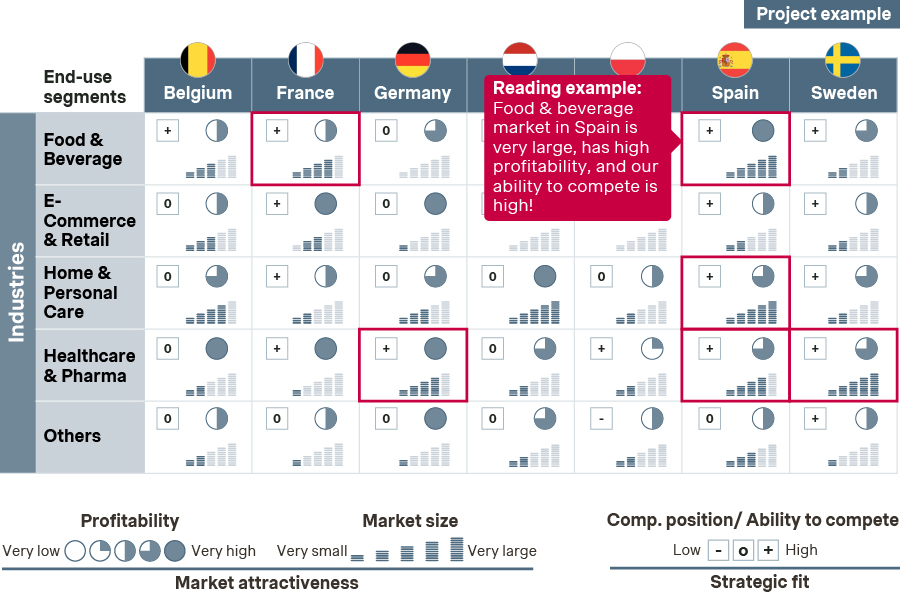
1. Target the markets and segments that actually pay
Successful expansion is rooted in selectivity rather than broad reach. So, stop trying to spread your lead-targeting efforts to every potential market. Focus on segments that possess both a high willingness to pay and a structural need for your specific innovation. Expansion is vital, but don't split your energy across low-margin territories. Identify potential markets where you can maintain healthy margins and double down on these; exit the rest to avoid splitting your energy across low-margin territories.
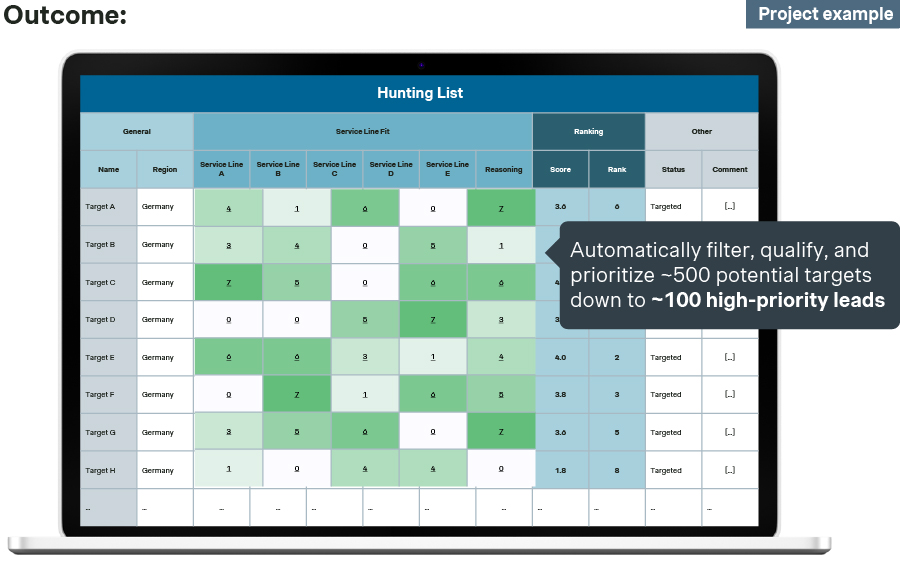
2. From longlists to shortlists: Qualify leads with AI
Stop wasting sales hours on lists that are turning cold – use AI to rapidly qualify a long list of customers, so you can bypass the manual labor of filtering "junk" leads. Get new relevant client lists from external market intelligence. By using AI to rapidly qualify longlists of purchased customer data, you can translate thousands of raw data points into a high-priority shortlist. Use machine learning to analyze buying signals and churn propensity. This allows your sales team to focus their energy only on the top 10% of prospects where the "hit rate" is highest.
3. Fill the gaps in your “share of wallet”
Internal data often hides untapped potential within your existing customer base. Use AI to compare what your customers in segments buy compared to their peers. Find the gaps – specific SKUs and services they should be buying but aren't – and fill them. This is a great way to channel your cross-selling focus and initiate many quick wins for your sales team.
4. Be the guide through the PPWR jungle
Regulatory complexity is an opportunity for differentiation, and many of your customers are lost in a complicated jungle of European regulations. If you are the one who knows the way out, you move from vendor to strategic partner. Turn packaging compliance into a value proposition that secures long-term contracts and justifies a premium.
Strategic pillar II: Capture profit
Capturing profit is where strategy meets the bottom line. In an environment defined by volatility and price transparency, pricing can no longer be a "gut feeling" or a buffer left to the discretion of individual sales reps. It must be treated as a system.
5. Centralize your pricing governance
Pricing is too critical to be decentralized. Establish a Pricing Council – a central place where every major decision is discussed and vetted by the right experts who consider global as well as regional data sets. It’s time to end the era of gut-feeling discounts and start ensuring that your global price corridors are actually respected in your sales teams.
6. Deploy a real-time pricing engine
Static Excel price lists are coming to an end. In 2026, volatility is the only constant, and your pricing must be as dynamic as the market. Leveraging pricing software – such as the Simon-Kucher Engine or similar advanced platforms – allows you to deploy algorithms that adjust for material fluctuations and hit rates in real-time, ensuring your quotes are always optimized for current market conditions.
7. Stop giving away your value-added services for free
Packaging is a value-driven industry, not a commodity market. So, tier your clients: your “key accounts” get the high-touch service, while B, C, and D clients pay for every extra layer of value. The less the volume, the more they pay for extra services. Especially if you provide design, storage, or carbon tracking, you should charge for it. Service monetization is the new normal.
Strategic pillar III: Drive Efficiency
True efficiency in 2026 goes beyond the factory floor; it must penetrate the "commercial DNA" of the entire organization. Every minute a high-value sales rep spends on administrative legacy tasks or low-margin tail customers is a minute lost on strategic growth.
8. Enforce your cost-to-serve
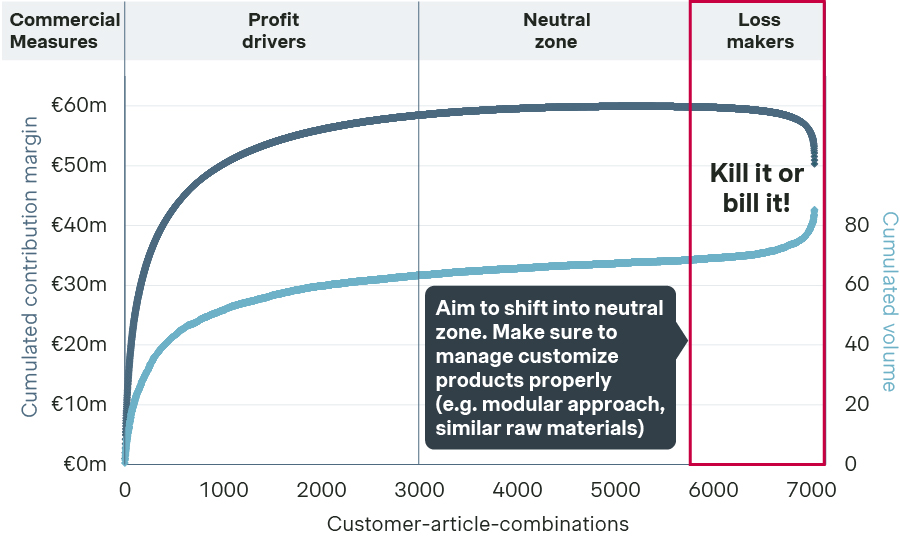
Margin leakage happens especially for small and inefficient orders. Introduce strict pallet thresholds and minimum order entry rules. Do not be afraid to lose business where you don’t make money. If a client won't meet the threshold, they are a drain on your resources, not an asset, independent of traditional sales resistance.
9. Trim the portfolio (The "key account" test)
Complexity is a silent profit drain. So, audit your SKUs and cut the low-volume items that no key account actually uses. Your sales team will claim every SKU is essential, but the data usually says otherwise. If your biggest buyers don't need it, it shouldn't be in your catalog.
10. Automate your legacy workflows
Efficiency means freeing your talent for high-value tasks. Your sales team should be using their time to sell, not to fill out spreadsheets. From automating sales mails to cleaning up legacy SAP workflows, use cases for automation are everywhere. Free your team from the admin burden so they can focus on communicating value to C-suite procurement officers.
Move now before it’s too late! Getting ahead in the 2026 packaging market
Better growth isn’t a byproduct of market recovery – it is the result of strategic commercial execution. In an era of overcapacity, the winners will be those who master the price-volume-margin trade-off and use digital tools as a strategic weapon.
Ready to move? Contact our Simon-Kucher packaging experts to sharpen your strategy now – and finally close the market gap.
For more information about packaging dynamics in 2026, check out our webinar or reach out to our Simon-Kucher Engine team to learn more about our dynamic and real-time pricing software packages.