
AI agents are no longer a future concept. They are already reshaping how software teams design products, deliver value, and think about growth.
Across our work, we see leaders optimistic about the potential, yet increasingly cautious about the commercial model that sits beneath it. That caution is justified. The AI agent market is expected to nearly double in the next four to five years, creating significant new revenue opportunities while also increasing competitive pressure and complexity.
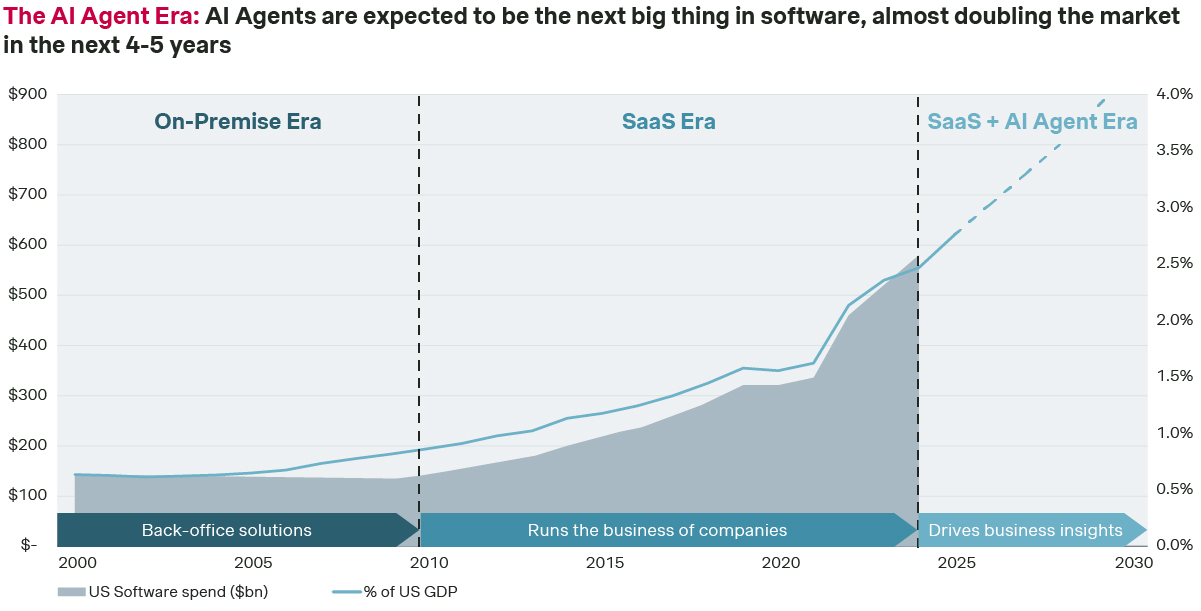
But while AI capabilities have evolved quickly, the pricing models that support them often have not. Many companies still rely on traditional structures that were designed for a very different software era. As a result, margins tighten, customer conversations get harder, and forecasting becomes more difficult. In fact, more than 75% of AI providers say they are unsure how to price their agentic solutions effectively.
The challenge is not that AI is complex. It’s that the underlying monetization strategy that links value created and value captured needs to change.
Why the old SaaS logic no longer works
For two decades, SaaS pricing has largely depended on two levers: per-user access and feature-based bundles.
This worked well in a world where people initiated tasks and software primarily made those tasks faster or easier. AI agents break that foundation.
1. One user can now command dozens of agents
In an agent-driven workflow, a single user might direct many autonomous processes. Per-seat pricing no longer reflects adoption, value, or cost.
2. Agents create value continuously, not only when a human clicks
Agents plan tasks, execute steps, and revise their own work. This means usage can spike based on internal logic rather than human activity.
3. Costs no longer scale with seats
Compute, memory, and orchestration load introduce real cost-to-serve dynamics. When pricing is disconnected from usage intensity, providers can end up subsidizing their most successful customers. A pattern we’ve seen repeatedly is that a flat per-user fee with unlimited AI usage can quickly become loss-making. In one recent example, heavy users generated compute costs several multiples above the subscription price until the company redesigned its pricing model. This is not failure. It is a natural signal that the pricing model no longer matches the product.
The real shift: from human activity to agent activity
Traditional SaaS pricing most often relies on how many people are doing the work. AI agents require us to price what work is being done and what outcomes are created.
This disconnect shows up in predictable ways:
- Usage grows faster than revenue
- Margins weaken because costs scale with agent activity, not users
- Customers hesitate, citing unpredictability
- Sales teams struggle to explain the link between price and value
Our recent Global Software Study showed that 76% of companies have launched AI features in the past two years, yet many set only modest revenue expectations because they lacked confidence in their monetization approach.
This is not a technology issue. It is a pricing architecture issue.
A reframing that consistently helps leadership teams
One analogy resonates strongly with executive teams: If this agent were a human employee, how would we compensate them?
It shifts the conversation from tokens and compute time toward value, expectations, and measurable contribution. Framed this way, different categories of agent work naturally lend themselves to different pricing logics:
- Routine tasks behave like hourly work
- Mid-level tasks resemble hybrid compensation (base + performance)
- High-value, expert tasks align with outcome-based incentives
This reframing turns abstract AI activity into a commercial language business leaders already understand. It strengthens internal alignment and clarifies how customers should think about the value the agent delivers.
Why monetization must evolve before scale accelerates
With AI, commercial risk doesn’t appear suddenly, it accumulates quietly. Companies often see early signs:
- Rising usage among a small set of customers
- Unpredictable compute invoices
- Discounts used to “explain away” unclear pricing
- Less uplift from AI add-ons than teams anticipated
- Confusion among buyers about what exactly they are paying for
As autonomy increases, these issues intensify. Without a model designed for continuous, agent-driven work, both customers and providers lose clarity. The most successful companies address these issues early, long before usage reaches scale and before legacy customers make a future transition more complex.
Three steps leaders can take now
Across our work in AI monetization, three key actions consistently improve pricing confidence and revenue outcomes:
1. Map how your agent creates value
Understand what kind of work the agent performs, how independently it operates, and which outcomes matter most to customers. This gives a clearer sense of where value is created, and which pricing structures will align with it.
2. Run controlled pricing pilots
Start with a targeted segment or new flow. A small number of well-designed tests consistently provide clearer signals than broad launches.
3. Bring commercial, product, finance, and customer success teams together early
Agentic pricing impacts forecasting, packaging, sales compensation, and architecture. It must be designed holistically and not as a late-stage commercial “wrapper”.
This is the point where many SaaS companies shift from reactive monetization to deliberate, scalable pricing strategy.
Conclusion
AI agents haven’t made software pricing harder. They’ve made it more honest.
When pricing reflects how value is truly created customers gain clarity and companies gain confidence.
In Part 2, we introduce a practical framework to select the right pricing model for your AI agents.
If you are exploring how to price, package, or scale AI agents, our global experts can help you define a clear, sustainable commercial model. Contact us to explore these topics further.