
Launching embedded finance is only the starting point. The challenge is turning the right use case into adoption, deeper customer relationships, and scalable growth.
Software companies, platforms, and marketplaces can now embed payments, accounts, lending, cards, insurance, and other financial services directly into the products and workflows their customers already use. This creates a significant commercial opportunity: new revenue pools, deeper customer relationships, and a stronger core proposition.
Embedded finance could unlock up to $800 billion in global value over the next decade. We explored the size and shape of the opportunity in an earlier article. For leadership teams, the important question is whether their own business is positioned to capture a meaningful share of that value.
Realizing the opportunity takes more than launching financial products. Businesses need to make clear choices about where they have a credible right to play, build propositions customers will actually adopt and continue to use, expand selectively into adjacent needs, and develop the commercial capabilities to scale profitably.
More products do not mean more maturity
The best way to evaluate embedded finance maturity is to assess it across two dimensions: Offering Maturity and Commercialization Maturity.
A business can commercialize a focused embedded finance proposition effectively without offering a broad range of financial services. Another may build considerable product breadth, yet struggle with adoption, repeat usage, cross-sell, resulting in unattractive economics.
Offering Maturity is not how many products have been launched but whether the proposition solves relevant customer problems, fits naturally within the core business, connects across the customer journey, and can scale through the right operating and partner model.
Commercialization Maturity is the ability to turn that proposition into sustained customer and economic value. It is reflected in activation, repeated usage, deeper relationships, monetization, and the commercial discipline required to grow efficiently.
The Embedded Finance Maturity Map
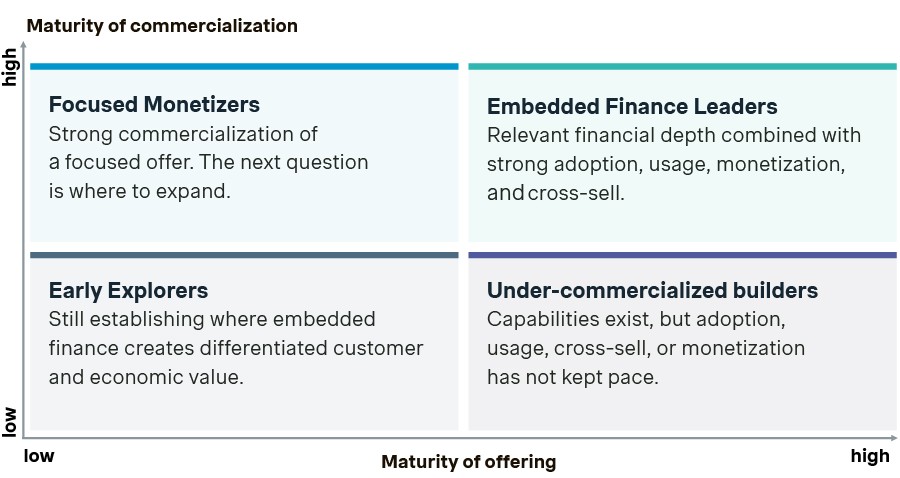
Embedded Finance Leaders combine the right financial depth for their customers with the ability to commercialize it consistently. That combination, more than product breadth alone, is what sets them apart.
Five priorities that create a durable embedded finance growth engine
Our work with businesses embedding financial services, and with the providers enabling them, points to five priorities that consistently shape whether embedded finance develops into a durable growth engine.
Four follow the evolution of the customer journey: choosing where to play, earning adoption, deepening usage, and expanding into the next relevant financial need. The fifth is the commercial system that supports each of these priorities and helps sustain growth with sound economics.
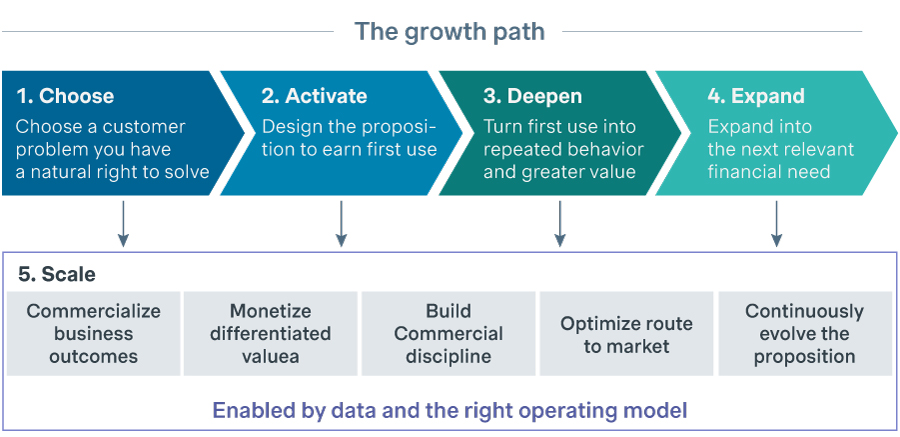
The strongest businesses develop the proposition and its commercialization together - they have the commercial model in mind from the outset, and strengthen it as the business scales.
Choose a customer problem you have a credible right to solve
Embedded finance strategies often start with the wrong question: which financial product should we add?
A better starting point is the customer problem. The most credible entry points sit inside a workflow the business already understands, where financial friction exists and the core proposition gives it a natural role in addressing it.
For a vertical software company, that might be the moment a merchant takes payment, reconciles cash, or needs working capital. For a marketplace, it could be seller payouts, liquidity, or protection around a transaction. The advantage comes from proximity to the need: the business already has the customer relationship, distribution, workflow context, or data that can make the financial service more relevant and easier to adopt.
Across our embedded finance work, the most promising starting use cases tend to combine four things: a meaningful customer pain point, a natural fit with the existing proposition, a credible advantage in distribution or experience, and attractive economics. If those conditions are weak, adding financial services can introduce complexity without creating much customer or shareholder value.
Starting narrow also improves the quality of the next decision. Companies can prove one high-value use case, learn what drives adoption and economics, and then use those findings to decide where to expand.
Design the proposition to earn first use
Choosing the right use case is not enough if the financial product still feels like an add-on. The core product and financial service need to be designed as one customer proposition, with packaging, onboarding, placement, pricing, and support built around the job the customer is trying to complete.
A restaurant owner wants to run the restaurant, get paid, manage cash, and fund growth. A marketplace seller wants to sell, receive funds, manage working capital, and protect the business. The more naturally the financial product fits into the workflow, the easier it is to make its value clear.
Strong propositions build activation in from the start rather than leaving it to chance.
Customers still need a compelling reason to try the product for the first time. That may come from a better experience, a simpler workflow, an economic benefit, or a relevant intervention at the point of need. Product placement, onboarding, eligibility, defaults, introductory incentives, promotions, sales motions, partner channels, and timely nudges can all influence whether an eligible customer becomes an active one.
In multiple Simon-Kucher engagements for software providers, the challenge has been broader than how to price payments. We found that the software and payments propositions needed to work together to improve the value of the overall offer. We redesigned packages, differentiated payment models and cross-product incentives by customer type, and aligned pricing with value. The result was a double-digit revenue opportunity from payments alone, with materially higher upside across the combined software-and-payments relationship.
Our earlier six best practices for embedded payments set out the same principle at the payments level: integration, operating model, packaging, and pricing need to be considered together.
Turn first use into repeated behavior and a deeper relationship
First use creates little economic value if the product never becomes part of the customer's usual behavior.
The levers that drive first use are not necessarily the ones that create repeat usage. Reliability, speed, ease of use, understandable pricing, service quality, workflow integration, ongoing rewards, and well-timed nudges can all help turn an occasional action into a habit.
This is where product and commercial teams need a shared view of the usage funnel. They should know which customers activate but do not repeat, which behaviors predict sustained use, where customers revert to an alternative, and which interventions increase frequency or share of wallet.
In one Simon-Kucher engagement for a restaurant management software provider that had launched embedded payments, we helped drive deal value and conversion by designing incentives leveraging software and payments tailored to customer value and price sensitivity.
Effective incentives should not only trigger first use but also encourage behaviors that make the wider relationship more valuable.
Leading players reinforce this approach with a robust KPI framework that follows customers from eligibility through activation to repeated usage and relationship deepening. Eligible-customer reach, time to first use, repeat usage, frequency, share of wallet, retention, and contribution economics tell a much richer story than product revenue alone.
Expand deliberately into the next financial need
Once the first use case is working, the next question is where to expand. Embedded payments can be an effective starting point because they sit close to frequent customer activity and can generate valuable transaction data. But the next product should follow a new customer need, not simply the availability of another financial capability.
A vertical software provider might move from core software to payments, then reconciliation, financing, and cash management. A marketplace might move from payouts to an account or wallet, then working capital and insurance. A small-business platform might connect payments with deposits, credit, cards, or FX.
A useful adjacency test is whether the next product does at least one of three things: solves a closely related customer problem, uses data or distribution advantages created by the first product, or materially improves the economics or stickiness of the total relationship. That discipline helps avoid building a broad but disconnected financial-services catalog.
Our experience points to a clear pattern: start narrow, prove customer value, and expand in layers. The management challenge is to identify which adjacent product is genuinely the next best move.
Build the commercial capabilities to scale what works
Commercialization is not something that starts once the proposition is proven. It shapes the success of each of the first four priorities well before that point. From choosing the right use case through activation, deeper usage, and expansion, the business needs to make deliberate choices about how it communicates value, monetizes it, reaches customers, and encourages the right behaviors.
Across our work in payments and embedded finance, we see stronger performers develop these commercial capabilities alongside the proposition.
They connect customer value to clear business outcomes, capture a fair share of that value, equip customer-facing teams to execute consistently, optimize routes to market, and use data and evidence to keep improving the proposition.
As we explored in our article on commercial advantage in payments, strong products do not create commercial advantage on their own. The same principle applies to embedded finance: the commercial system determines how effectively a strong proposition is converted into adoption, deeper customer relationships, revenue, and attractive economics.
Pricing, promotions, cross-product incentives, sales motions, customer success, and channels need to work together to increase adoption and deepen usage without giving away unnecessary value. Customer and usage data can make those decisions more precise, helping identify which customers to target, when to intervene, and which product or offer is most relevant next.
Scaling requires intentional choices about what to own and where to partner. Leading players retain control over activities that create genuine differentiation, strengthen the customer experience, or support attractive economics at scale. Specialist fintech partners can provide infrastructure, capabilities, and speed where building internally adds limited strategic value.
The objective is to scale the parts of the model that create and capture value, strengthening the economics as the relationship grows and adapting the proposition as customer needs change.
Embedded finance should be managed as a growth engine
For software, technology, and marketplace businesses, embedded finance can become much more than an ancillary revenue stream. It strengthens the parts of the business that are hardest to replace – the depth of the customer relationship and the value of the core proposition.
The strongest businesses will manage all five priorities – choosing the right problem, earning first use, building repeated behavior, expanding into the next need, and scaling what works – as one connected system, not five separate initiatives.
That is the difference between having embedded finance capabilities and building an embedded finance growth engine.
The accompanying Embedded Finance Maturity Assessment helps businesses understand how well positioned they are to achieve these outcomes. It evaluates Offering Maturity and Commercialization Maturity, places the business on the Growth Map, and highlights the customer moments and commercial capabilities that require attention.
Take the assessment to see where your business stands and where further development may be needed. Contact us to discuss the results.