
Does your pipeline include Class III implantables, Class D IVDs, or ARMP devices? Then EU Joint Clinical Assessment is no longer a future consideration. The first assessments begin in June this year. Here is what manufacturers need to understand and act on now.
From regulation to execution: What manufacturers need to do now
By the end of 2025, one thing has become clear: Joint Clinical Assessments (JCA) for medical devices and in vitro diagnostics (IVDs) are no longer a regulatory concept in development. The framework is defined, the rules are published, and implementation has started. For pharmaceuticals, JCAs are already live. For medical devices and IVDs, the first assessments are expected to start mid-2026.
At its core, JCA introduces a centralized EU-level clinical assessment. The outcome is a single clinical assessment report that national health technology assessment (HTA) bodies should consider in their decision-making. While reimbursement remains national, the clinical narrative will increasingly be shaped at EU level.
What has changed in the last 12 months
Over the past year, the most critical elements have been defined, including devices eligible for JCA, data requirements, the PICO methodological framework, and the JCA process.
First, it is now clear which products will be selected for assessment. JCAs will not apply to all new devices. Only devices that undergo expert panel review during CE certification will be considered for potential JCA selection. Expert panels are independent scientific bodies that provide opinions on the clinical evidence of high-risk devices within specific consultation procedures. High-risk devices eligible for JCA are Class D IVDs, Class III implantable devices, and a specific subset of Class IIb devices, namely active devices intended to administer or remove medicinal products from the human body (ARMP).
But only a subset of high-risk devices will ultimately be in scope. Additional selection criteria determine which products are assessed:
- Unmet medical needs
- First in class
- Potential impact on patients, public health, or healthcare systems
- Incorporation of AI or machine learning
- Significant cross-border dimension
- Major Union-wide added value
Considering all these criteria, EU HTAs will apply to high-risk products and category innovations, which is a subset of new medical devices entering the EU market. This stands in sharp contrast to pharmaceuticals, where EU HTAs are set to become standard for almost all drugs.
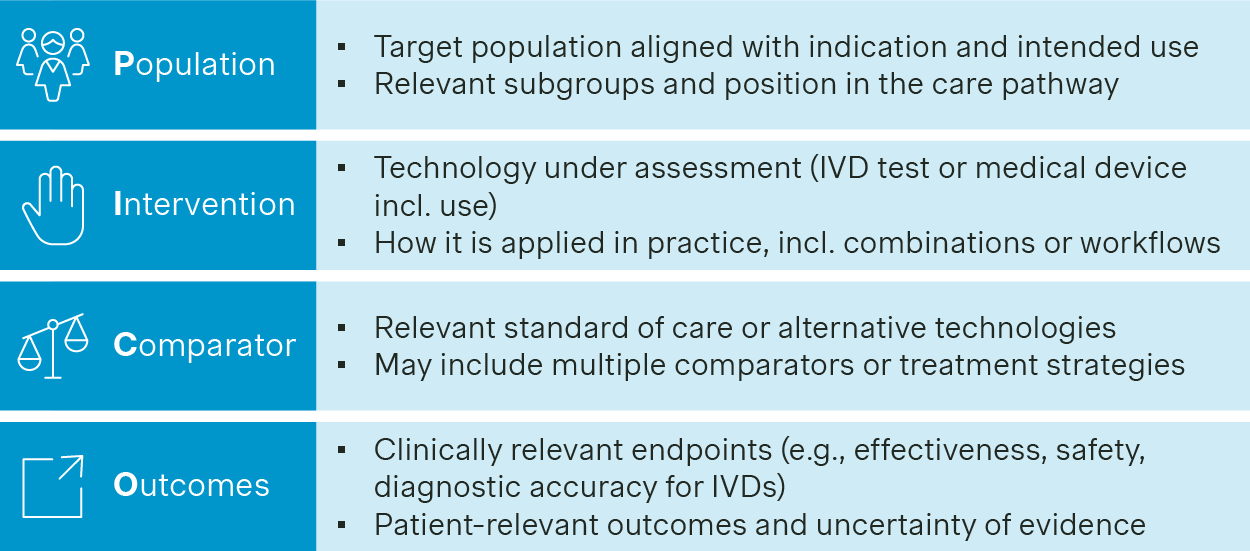
Secondly, data requirements are now clearly defined. Manufacturers must submit a comprehensive clinical dossier structured around the PICO (Population, Intervention, Comparator, Outcomes) framework, demonstrating relative effectiveness and safety versus relevant comparators based on complete and methodologically robust evidence.
Overview of PICO framework
Source: HTA CG, 2025
Thirdly, the methodological framework has been formalized. Evidence will be assessed using a standardized approach, including systematic study identification, comparative analyses, and explicit handling of uncertainty and bias.
In practical terms, this means:
- Evidence must demonstrate relative benefit, not just performance
- Comparator choice is defined at EU-level via the PICO process
- Completeness and methodological rigor are critical at submission.
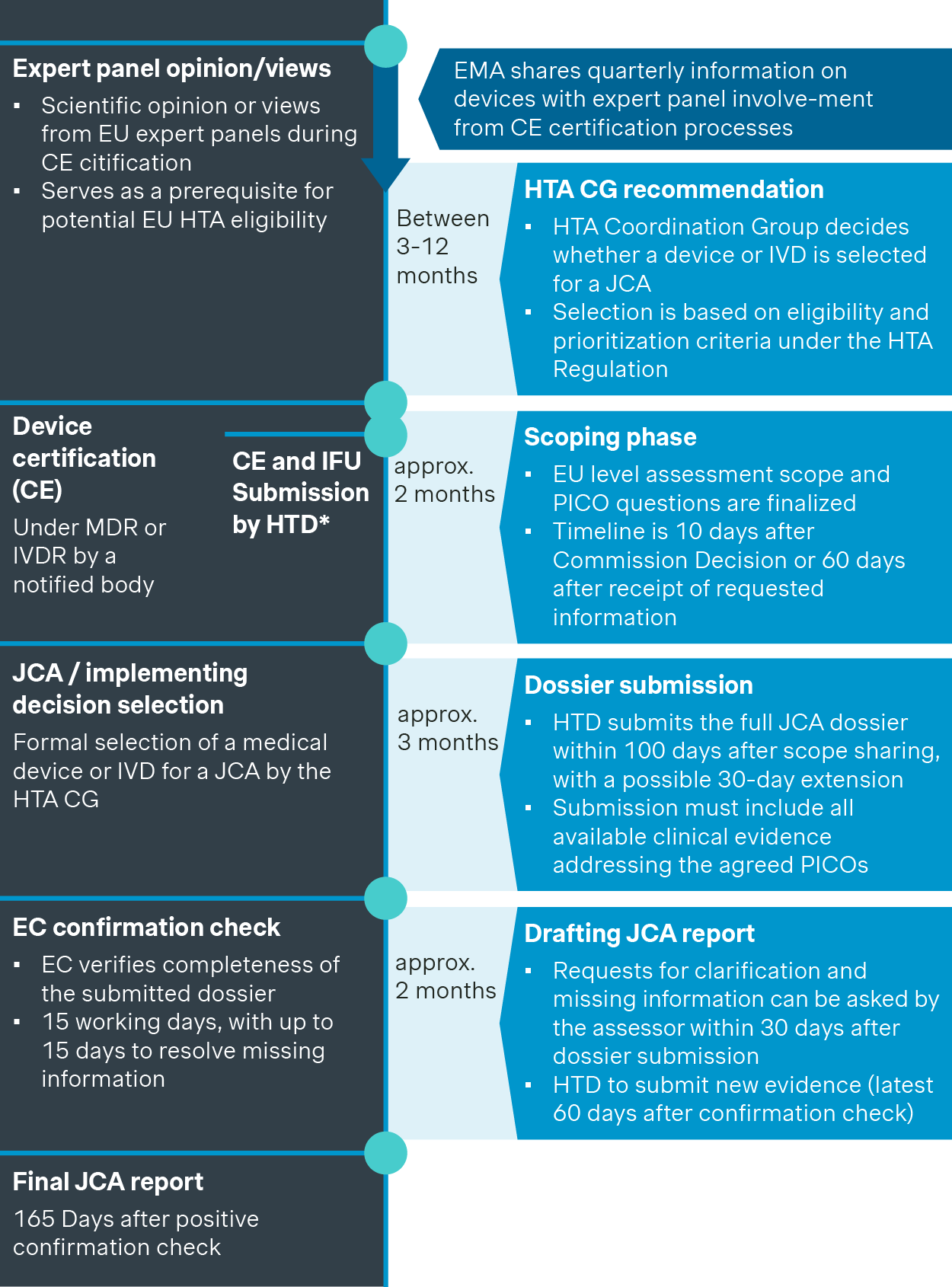
Finally, the full HTA process has been defined, including four main steps, the respective timelines, and the different bodies and stakeholders involved.
JCA process for medical devices and IVDs
Source: HTA CG, 2025; *Health technology developer
Implementation of EU JCA: What the timeline looks like
The timeline for JCA in medical devices and IVDs has been defined and is already in motion.
Joint Scientific Consultations (JSC) started in 2025 as a formal EU-level mechanism for manufacturers, allowing for early engagement with authorities on evidence strategies. Through JSCs, manufacturers can discuss clinical development plans, including study design, comparators, and outcomes, with Member States ahead of submission.
Devices will be selected for JCA for the first time in the second quarter of this year, with assessment processes beginning in June and initial reports anticipated by the end of 2026.
The rollout will start on a limited scale, with around five JCAs planned for devices in 2026 and a gradual ramp-up in subsequent years. However, the speed and scope of expansion remain uncertain, increasing the pressure for early preparation.
What does this mean for manufacturers
For medical device and IVD companies, the implications are immediate. Since most medical device and IVD launches are next-generation products within existing categories, companies should assess whether pipeline assets are likely to qualify for JCAs at all. Internal resource requirements should be aligned with the number of products potentially undergoing JCA in the future. In addition, companies should monitor how EU JCA evolves and how payers apply the results outlined in the JCA report. Clear internal accountability should be assigned for these tasks.
For those developing breakthrough innovations that meet the selection criteria, JCA preparation and a stronger focus on evidence generation will be critical. Traditional pragmatic evidence strategies may no longer be sufficient. JCA requires a structured demonstration of comparative clinical value aligned with EU-defined expectations. With fixed timelines and limited room for iteration, evidence gaps are difficult to address post-submission, increasing the risk of delays or failure. Therefore, PICO scenario modelling and early engagement through JSCs may be valuable tools to align expectations on option space and reduce risk upfront.
JCA is here - are you ready?
The transition to EU-level clinical assessments requires companies to at least understand the JCA process, the selection criteria, and whether their pipeline products might be eligible. If a product has to go through EU JCA, it will become complex and resource-intensive, requiring strategic alignment across clinical development, market access, and commercial functions.
Simon-Kucher supports medical device and IVD manufacturers across the full JCA journey, from early eligibility screening and rapid assessment to PICO simulation, implementation planning, and execution readiness. This includes aligning evidence strategies with likely PICO expectations, and ensuring organizations are prepared to navigate the new EU HTA landscape.
Drawing on experience from numerous JCA readiness projects with more than 20 pharmaceutical companies, we have defined three core project types to help medical device and IVD companies manage this emerging complexity:
1. JCA rapid assessments
We review your pipeline portfolio and assess the likelihood that future product launches will fall within the scope of a JCA.
2. Organizational readiness
We provide masterclasses on EU JCA, drawing on lessons from pharma, to build on cross-functional understanding. In addition, we help companies to ensure organizational readiness depending on their exposure to EU JCA. We identify the specific activities required to successfully navigate the EU JCA process, strengthen the cross-functional collaboration through clear responsibilities and a dedicated lead, identify capability gaps and how to close them, etc.
3. JCA strategy
When a product is likely to fall within the scope of a JCA, we strongly recommend developing a dedicated JCA strategy. By simulating the most likely PICO scenarios, medical device and IVD companies can identify the most suitable evidence-generation options to support their access and pricing objectives. Stakeholder mapping and engagement is another recommended workstream. Identifying the experts most likely to be involved in your product assessment, understanding the PICOs they will ask for, and discussing your perspective with them will help ensure you are well prepared when the formal process begins.
Our approach is designed to help companies identify risks early, adapt evidence strategies, engage with stakeholders so they are fully prepared when JCA becomes relevant for their portfolio. Feel free to reach out if you would like to learn more.
The bottom line
Joint Clinical Assessment for medical devices and IVDs is no longer “coming”. It is defined, operational, and starting in 2026.
The shift is structural. It changes how clinical value must be demonstrated and how evidence is interpreted across Europe. For manufacturers, this is not just a regulatory exercise. It is a direct determinant of future market access. Are you prepared for what comes next?
Special thanks to Clara Beggerow for her contributions to this article!