
Demand swings between scarcity and overcapacity are compressing logistics margins from both sides. Traditional pricing strategies – flat surcharges, blanket discounts – cannot keep up anymore. Learn from our Simon-Kucher experts how leading carriers are responding with pricing models that monetize volatility rather than absorb it.
Logistics markets are no longer shaped by predictable seasonality but by sharp volume fluctuations. Demand now moves faster than assets, labor, and contracts can adjust – pushing networks rapidly from overload into underutilization within weeks. Market conditions shift before most carriers can react.
In European parcel networks, daily volumes swing sharply. In 2025, DHL processed 12.4 million parcels in a single peak day in Germany versus 6.7 million on a normal day (+85%). Austrian Post and Swiss Post observed similar swings, with peak-day parcel volumes exceeding normal-day levels by more than 100%. These spikes regularly push parcel networks beyond their operational limits – transportation costs rise non-linearly when capacity cannot scale fast enough. And this is not just Black Friday: intra-week volatility has increased structurally.
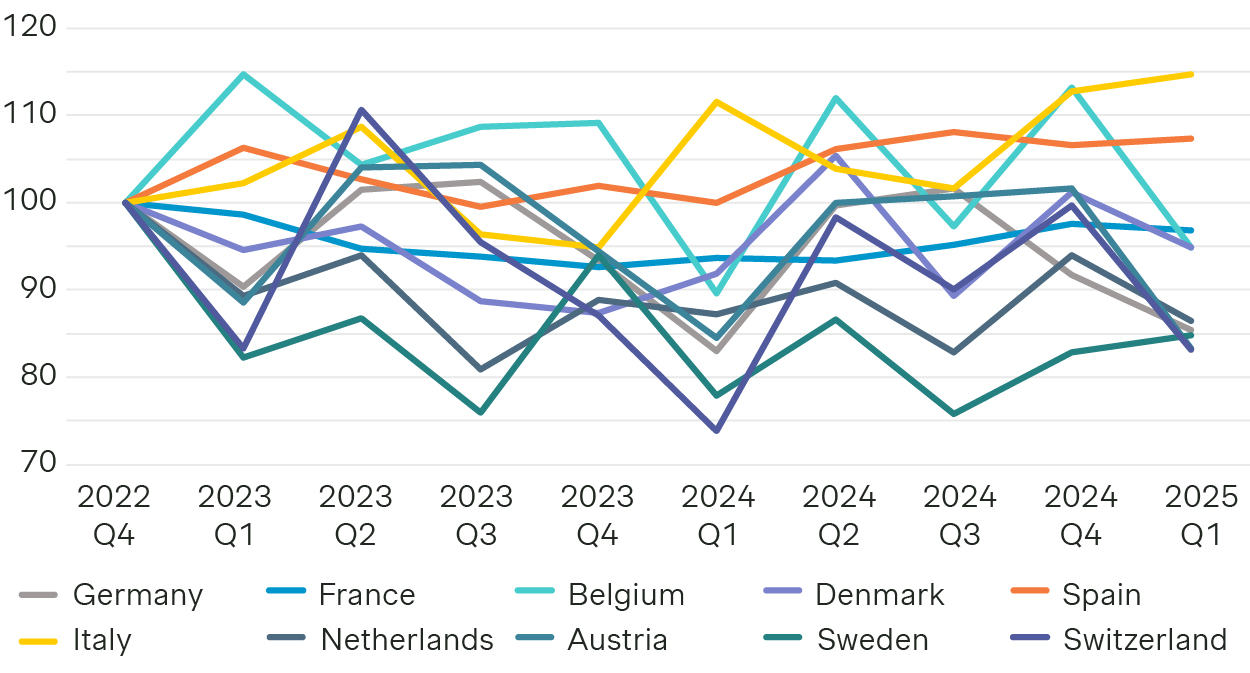
Road freight and LTL-style pallet networks show persistent short-term swings rather than isolated, predictable peaks. Large European pallet networks report quarterly volume swings of up to ±25% across markets. At the network level, this looks manageable. At the lane and customer level, volatility is significantly higher – and that is where it hits the bottom line.
Road freight transport (indexed, based on tkm) in selected European countries
In ocean freight, 2025 disruptions compressed Asia–Europe arrivals into narrow windows. Container dwell times at some Rotterdam terminals reached around 14 days, while global schedule reliability hovered near 50–55%. Then fleet redeployment pushed markets back into overcapacity within months. The episode illustrates how fast scarcity and slack can alternate – faster than most pricing models and annual contracts can absorb.
Why volatility undermines margins – from both sides
The standard assumption – higher utilization improves profitability – breaks down under volatile market conditions.
During tight phases, transportation costs rise non-linearly. Overtime, subcontracting, congestion, and service failures inflate the true cost-to-serve. If scarcity is not explicitly priced, incremental volume can reduce margins rather than improve them. The issue is not utilization per se, but operating beyond the economically optimal point without adjusting the pricing model accordingly.
During slack phases, the pressure shifts. Revenues decline, excess capacity weakens pricing power, and temporary discounts often become structural. Yield deteriorates faster than utilization recovers.
Why surcharges and discounts are not pricing strategies
Most carriers still rely on flat peak surcharges when markets tighten and broad discounts when demand softens.
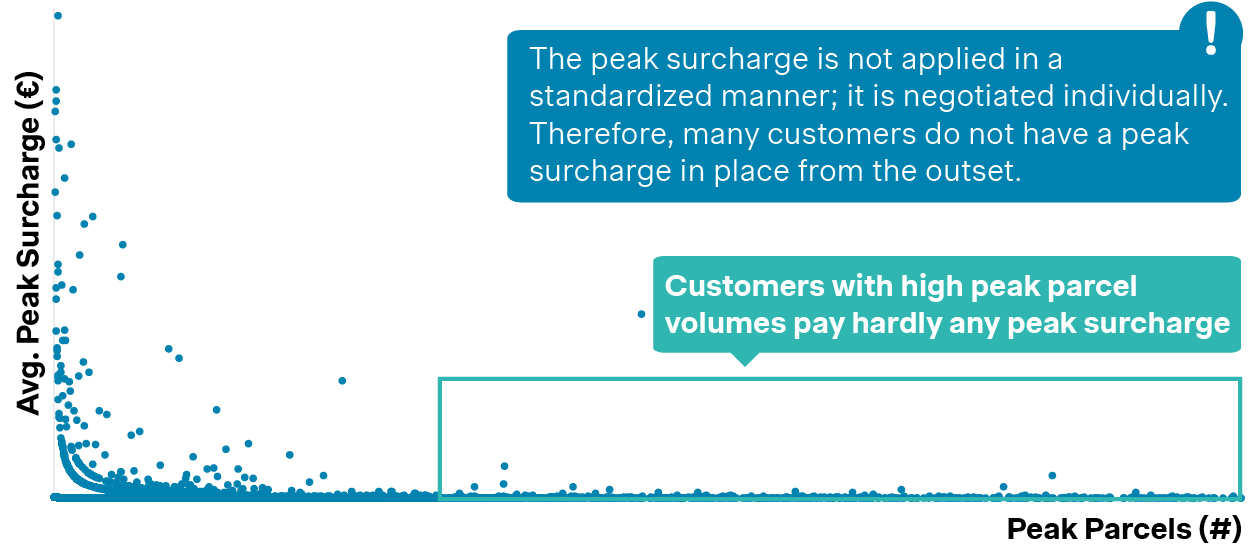
These surcharges are often negotiated by the very customers who contribute most to volatility and fail to distinguish between high-value and low-value volume. Conversely, unconditional discounts during overcapacity rarely generate additional demand. Instead, they erode carrier pricing discipline and train customers to expect lower rates as the new baseline.
Peak surcharge paid vs. number of parcels sent in peak period
The pricing models that govern volatility commercially
Leading logistics players embed clear, enforceable commercial rules into contracts and pricing to steer customer behavior proactively, rather than reacting under pressure.
While setups differ by company, three data-driven pricing models consistently prove effective across logistics segments.
1. Dynamic pricing based on real-time demand signals
Dynamic pricing adjusts rates based on bookings versus forecasted demand and available capacity. Effective pricing models combine demand forecasts, price elasticity, and utilization levels to optimize margin per transaction – not just top-line revenue. Automated, rule-based adjustments ensure consistency as market conditions change.
Application:
Ocean and air carriers already apply dynamic pricing successfully to steer their utilization. Parcel and LTL providers have not yet implemented this approach at scale – despite high potential, particularly where carrier pricing still relies on annual rate cards. However, dynamic pricing only works if exceptions are strictly governed; otherwise, it collapses into negotiated list prices.
2. Monetize priority through explicit capacity reservation (e.g. blocked space agreements)
Priority access is sold explicitly rather than granted implicitly.
Customers reserve a fixed minimum capacity at a fixed price, independent of actual utilization. Carriers gain guaranteed loads and planning certainty; shippers gain prioritized freight at predictable rates. In hard-blocked space agreements, unused allotments cannot be cancelled – creating genuine long-term partnerships rather than transactional relationships.
Effective implementation requires reliable shipment tracking, capacity monitoring, and organizational discipline in enforcing prioritization – even under pressure from large accounts.
Application:
Air and ocean freight carriers have been using blocked space agreements for many years already. Parcel and road freight carriers could apply similar models by reserving capacity (e.g. pick-up vehicles or sortation slots) for committed customers, particularly during peak periods.
3. Separate stable base volume from volatile demand – and surcharge excess volatility
Carriers and customers agree on a base volume corridor (e.g. average daily or weekly volume ± tolerance). Volumes exceeding this corridor trigger higher prices or a volatility surcharge, particularly when seasonal or concentration thresholds are breached.
The mechanism is data-driven and transparent: customers who ship predictably benefit from stable rates. Customers who impose disproportionate peak load pay for the real cost they create.
Application:
Some parcel carriers successfully apply surcharges for campaign-driven excess volumes, but often only selectively. The bottom-line impact increases significantly when applied consistently across the full customer base. Road freight and LTL providers could adopt similar mechanisms for volumes exceeding agreed shipment bands.
Conclusion: Volatility requires deliberate pricing design
Volume volatility has become a structural feature of logistics markets. It cannot be solved through operational measures alone.
Managing it requires deliberate pricing design: strategies that reflect real-time market conditions, contracts that build long-term partnerships rather than chase short-term volume, and allocation rules based on data-driven margin contribution rather than sales intuition.
The carriers that embed these mechanisms into their commercial models now will define the competitive standard. Those that wait will find themselves adapting to someone else's.
Want to know more? Reach out to our Simon-Kucher experts.