
Many field service organizations still structure technician incentives and performance measures around operational execution spanning utilization, response time, first-time fix rates, and safety.
Those measures were designed to support the easiest measurables and protect an organization’s service promise. However, they neglect the key role technicians play in shaping customer outcomes, leaving growth contribution largely outside the variable-pay equation.
For field service organizations, technicians represent a commercial advantage that few functions can match. They are the foundation of an organization’s business model and hold trusted customer access. Technicians are on-site, embedded in daily operations, and are often trusted more than anyone else who represents their company.
Alongside their familiarity with equipment, technicians can also pinpoint breaks downs in performance and where customer pain points are brewing. In many cases, their unique position outpaces many sales professionals on solution-oriented discovery.
Our previous article explored how field service growth depends on matching the commercial model to how customers buy, where expansion signals appear, and which role is best positioned to act. One constant across every scalable model is the role frontlines play in the broader commercial operating system. As organizations lean more heavily on technicians to support commercial processes, they must eventually address a key question or risk hamstringing their contributions.
How do we reward technicians for the right growth behaviors without compromising service quality, customer trust, or their role as technical experts?
Why compensation design matters
Incentives both influence pay and reveal what an organization truly values. In our experience, technician-focused commercial incentive plans typically fail in one of two ways:
- Under-designed plans leave growth on the table: Technicians may identify recurring failures, aging assets, or customer pain points, but are not given the commensurate incentive to flag or provide a route to action, and those signals rarely become commercial opportunities.
- Over-commercialized plans degrade technicians’ perception as trusted advisors to the customer and create rivalries internally: Technicians feel pushed to sell as frequently as possible. As a result, customers may begin questioning whether the advice they are receiving is technical or financial. Sales and service teams may start competing while service quality suffers.
The right design sits between these extremes. It recognizes the influence technicians have on customer decisions, and rewards commercially valuable behavior without forcing ownership where it does not belong.
Decide which roles belong on a plan
Customer proximity alone should not determine who should be eligible for a commercial incentive plan. The more important consideration is the extent to which the technician influences the customer’s buying decision. Five decision gates can be used to determine a role’s eligibility for a commercial incentive plan.
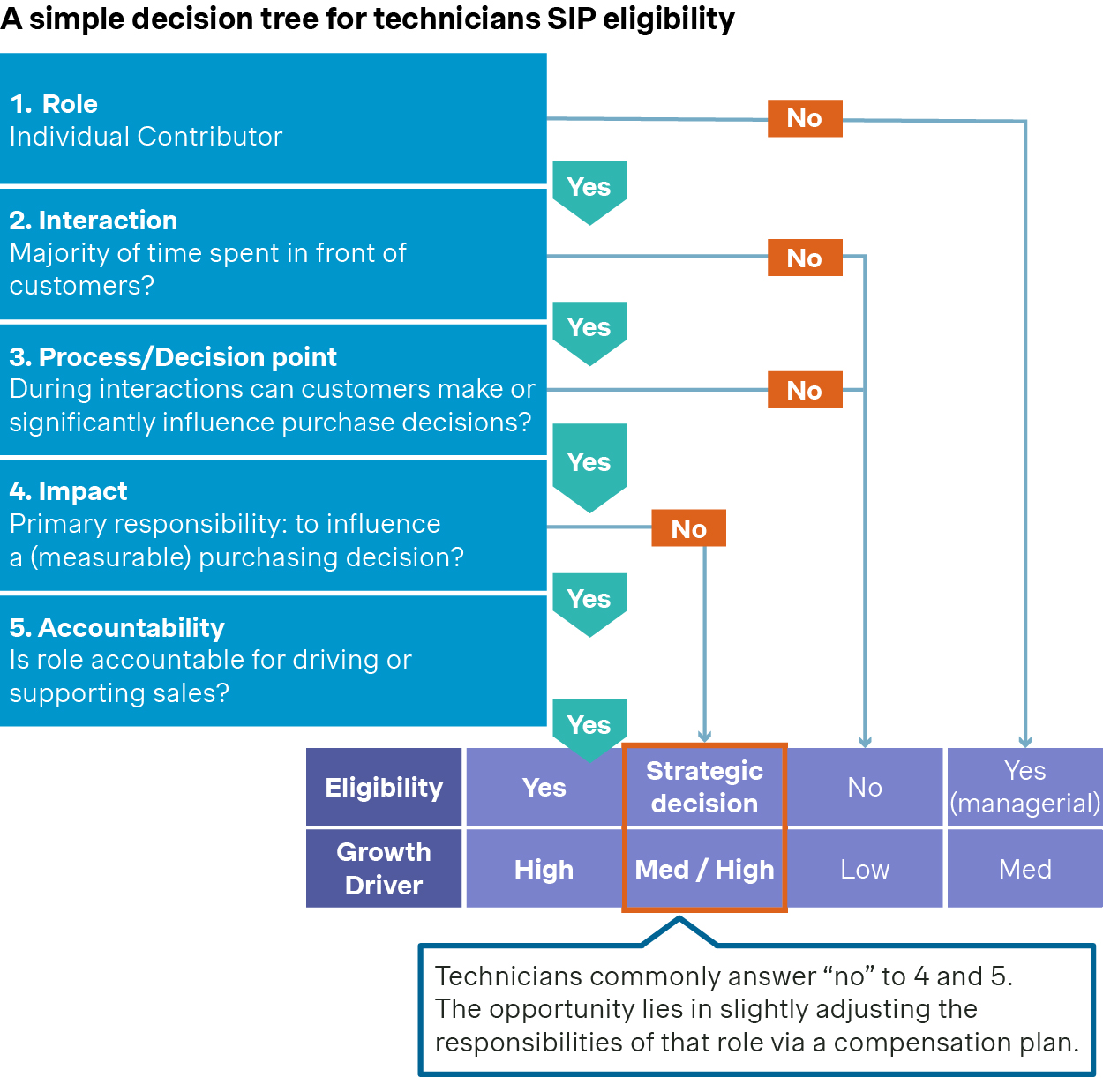
By the nature of their work, technicians often clear the first three gates, with most of the organizations we see having technicians clearing the first four gates. The strategic questions for commercial leaders then become: Should role responsibilities be redefined so it clears all five gates? If so, how do they earn revenue? Can they quote or close add-ons during the visit, or do they surface the need and pass the close to sales?
The answers that organizations provide shape the whole plan.
Index only on critical measures
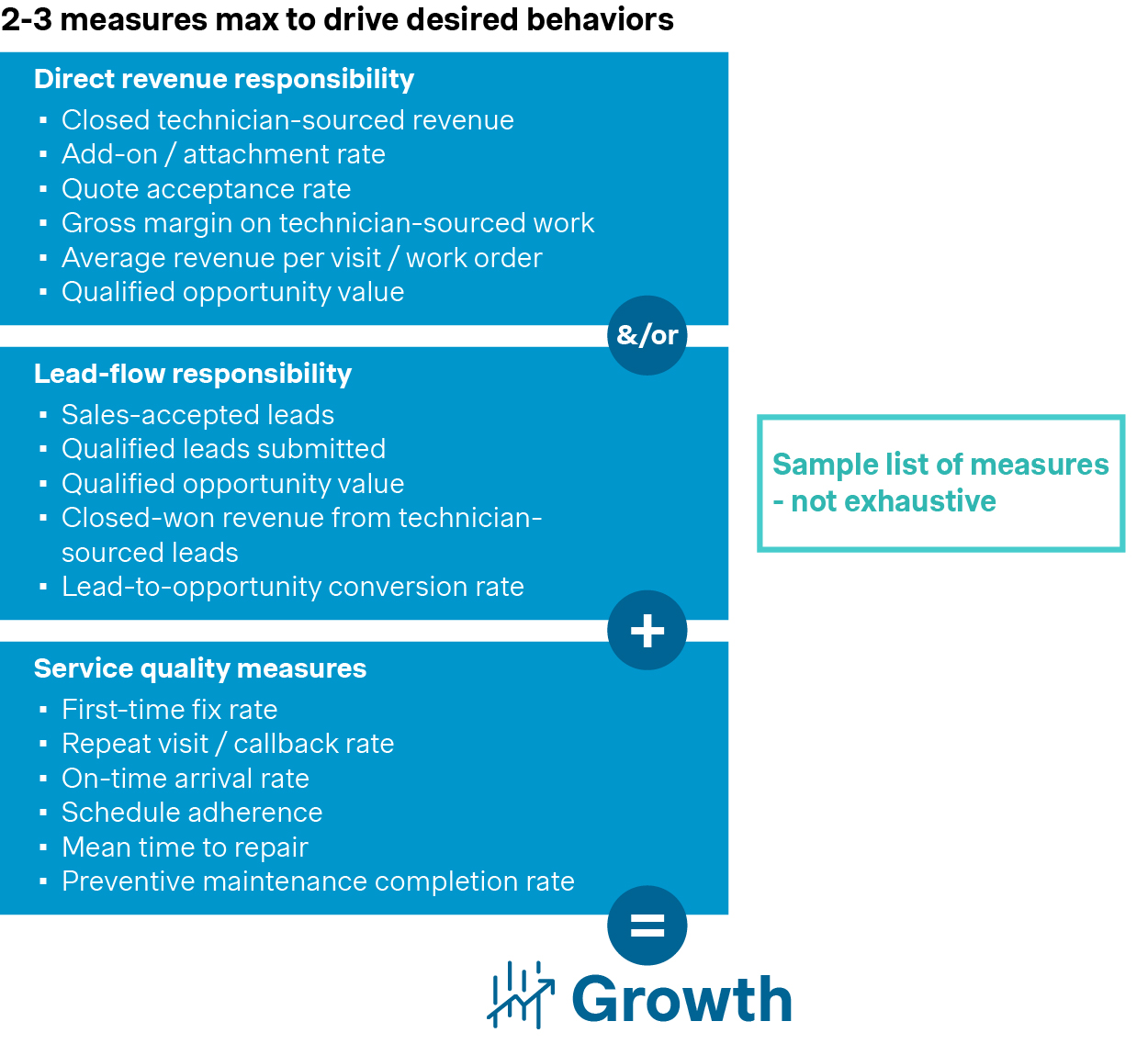
The best incentive plans are simple and designed around two to three measures that technicians can influence and that organizations can easily track. Those measures are direct revenue responsibility, lead-flow responsibility, and service quality measures.
A technician’s primary responsibilities determine which measures to apply. For a technician responsible for direct-revenue, (e.g., quoting or closing during a site visit) payment is based on the outcomes they control: closed technician-sourced revenue, attachment rate, quote acceptance, or average revenue per work order.
Another technician responsible for lead flow (e.g., identifying needs and passing the close to sales) is paid based on the quality of what they hand off. This ranges from sales-accepted leads to qualified opportunity value and lead-to-opportunity conversion.
Whatever the specialization, the growth measures are only a portion of the total incentive model. Technician incentive plans should incorporate a service-quality component as the primary metric (at least 40% of the plan’s total value) spanning first-time fix, callback rate, customer satisfaction, safety, and documentation completeness. These keep growth incentives from quietly eroding the service it depends on while reinforcing the importance of service quality within the organization.
Make the plan stick
Designing the appropriate performance measures is essential for field service organizations, but even well-designed measures can miss the mark without thorough evaluation. Organizations should pressure test their plan quantitatively and qualitatively from compensation structure to performance mechanics and governance.
Compensation structure
A sound plan is one that applies an effective compensation structure. Pay levels must be adjusted to meet desired market benchmarks set by the organization’s compensation strategy. The split between base salary and variable pay should also reflect the level of influence each role has over a customer’s buying decisions. Additionally, the plan can provide a meaningful upside for technicians, allowing top performers to earn two to three times their variable earnings compared to the median incentive amount.
Performance framework
The plan’s performance framework should help motivate employees and align with business objectives without being overcomplicated. Plan mechanics such as thresholds and payout curves serve to balance each technician’s confidence in achieving their targets while incentivizing their efforts. Ideally, quotas and crediting can be designed with favorable performance outcomes in mind (e.g., one-third of technicians below target and two-thirds meeting or exceeding it). Payouts should also align to target measures and incentivize desired behaviors.
Governance
Strong Incentive programs are typically supported by clearly documented procedures that are understood across the organizations. Effective governance highlights the plan’s credibility.
Key takeaways for field service leaders
Field service compensation is not an HR formality. When done well, it multiplies the value you drive through your frontline. When executed poorly, you risk derailing even the strongest commercial strategies.
The goal should not be to turn technicians into salespeople. It should be to design compensation that rewards the specific growth contribution each role is positioned to make, while protecting the trust that makes field service commercially powerful in the first place.
Optimal commercially focused incentive plans drive technicians to utilize the commercial influence they already have through the identification of customer needs, creation of credible opportunities, and support of account expansion without compromising the service relationship. When compensation reinforces the right operating model, field service becomes a trusted, repeatable organic growth channel.