
Where can B2B sales leaders find the best sources of near-term growth? This article examines three of ten most relevant and high-impact sales levers that our Better Growth webinar audience rated most relevant to revenue growth.
Key takeaways
- B2B revenue growth strategy can no longer rely on market tailwinds.
- Our webinar survey respondents identified revenue growth as a major B2B sales challenge, with new customer acquisition emerging as the most frequently cited issue.
- Sales leaders selected prioritizing growth customers, improving sales productivity with AI, and targeting growth segments as the three most relevant priorities for their organizations.
- Customer and market prioritization help direct commercial effort toward the strongest sources of future revenue.
- AI creates the greatest near-term value when it automates high-volume, repetitive manual tasks and gives sales teams more time with customers.
Several years of weak demand have made this the new the baseline; market momentum will not carry B2B sales and revenue plans. Growth now depends on how B2B sales organizations focus their resources: on customers with credible expansion potential, market segments where the company has a strong competitive fit, and processes that give sales teams more time for productive customer work.
These choices make sales allocation a central management issue for sales leaders.
Germany, for example, recorded two consecutive years of contraction before real GDP had a tepid +0.2% recovery in 2025. It’s one market, but some of the pressures it faces – persistent global volatility and energy price swings tied to geopolitical instability – are shared broadly across the globe and add further constraints on B2B revenue growth. Organizations operating in similarly challenging markets may therefore experience growth that is, at best, flat, and at worst, actively working against top-line ambitions.
When markets grow, sales organizations can grow with them, even with mediocre execution. When markets stagnate, organizations must engineer growth through better targeting, deeper use of existing customer relationships, and disciplined resource allocation. Innovation, new business models, and market entry all matter, but their financial impact depends entirely on how well sales teams convert those opportunities into orders and profitable revenue.
Sales executives are feeling this directly: year-over-year performance goals are getting harder to hit, independent of how sound the underlying strategy is.
These conditions framed Simon-Kucher's B2B Better Growth webinar on modern sales, where 116 commercial sales leaders in Germany weighed in live on where this pressure is being felt most.
What are the top 10 B2B sales challenges in 2026?
Across B2B sales organizations, the same ten challenges consistently rise to the top:
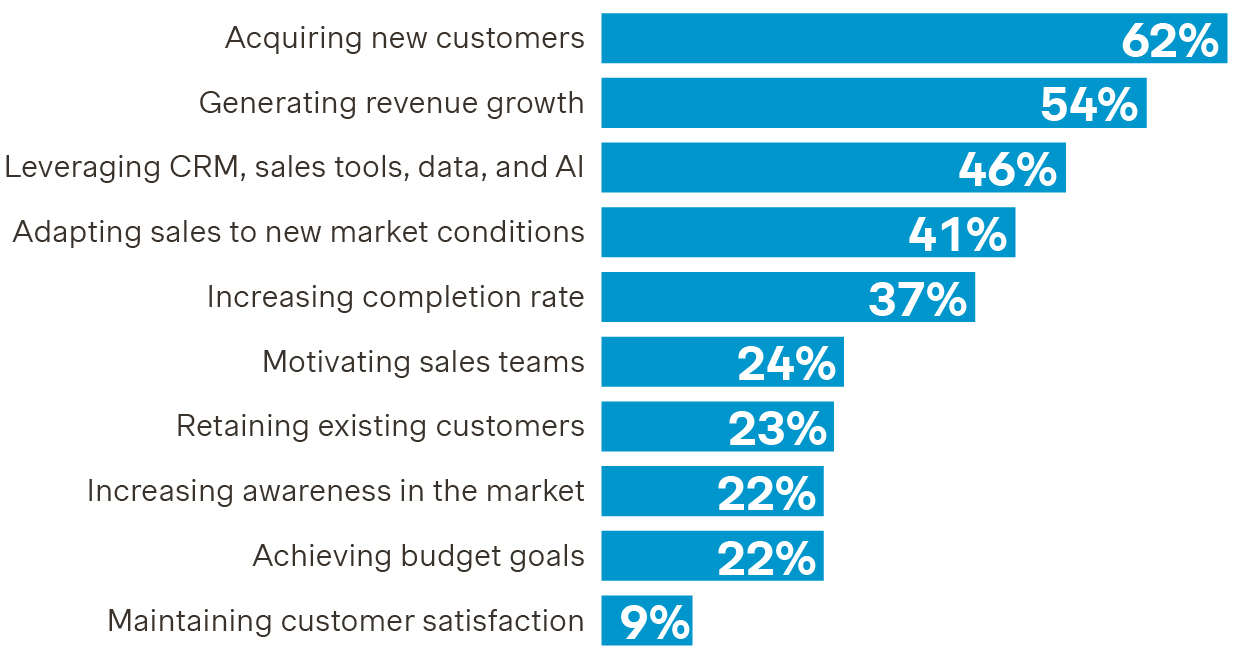
New customer acquisition and revenue growth are clearly structural priorities. Interestingly, technology adoption (CRM, data, AI) ranks third – ahead of team motivation and even budget goals – suggesting many organizations see their tools, not their people, as the current constraint on performance.
Many B2B organizations already have the ambition and a clear view of what needs to happen. What's missing is systematic execution: clear prioritization, the right tooling, and disciplined focus applied to that ambition.
Which B2B sales actions should leaders prioritize for revenue growth?
A comprehensive B2B sales and revenue growth strategy typically spans three areas: new customer acquisition, existing customer management, and sales organization design. Within these, ten specific actions are immediately actionable, from scaling AI-powered lead generation to establishing "Young Revenue" KPI.
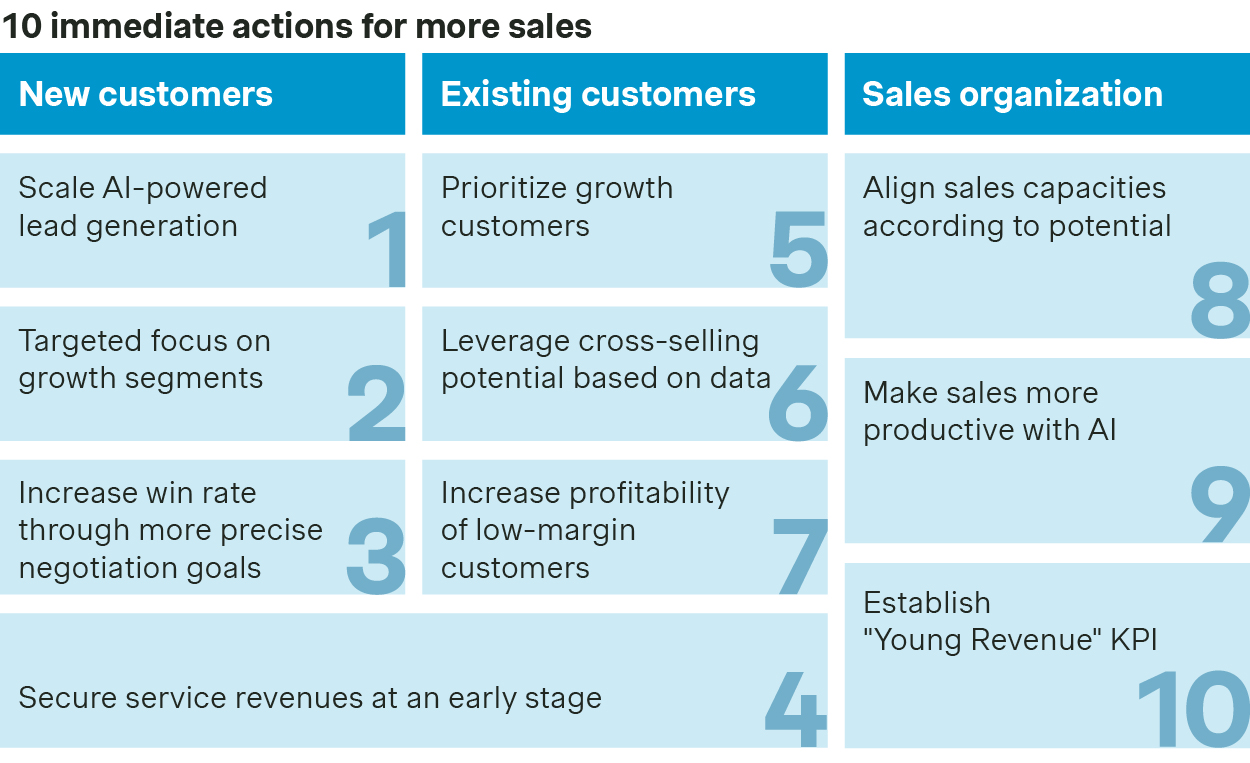
Sales leaders rank three of these actions as most critical to their own organizations:
- Prioritize growth customers
- Make sales more productive with AI
- Targeted focus on growth segments
Each reflects the same need for more precise resource allocation. Sales teams need to focus on customers and segments with credible potential and use AI in B2B sales to free up capacity for higher-value work.
First priority: How can B2B companies prioritize growth customers?
53% of webinar respondents selected customer prioritization as the most relevant immediate action for revenue growth.
What is limiting growth?
Customers that are not growing rarely contribute to organic expansion, however strong the relationship. Yet sales effort is often spread too evenly across the existing customer base, tying up valuable time and resources in accounts with limited potential.
What is the solution?
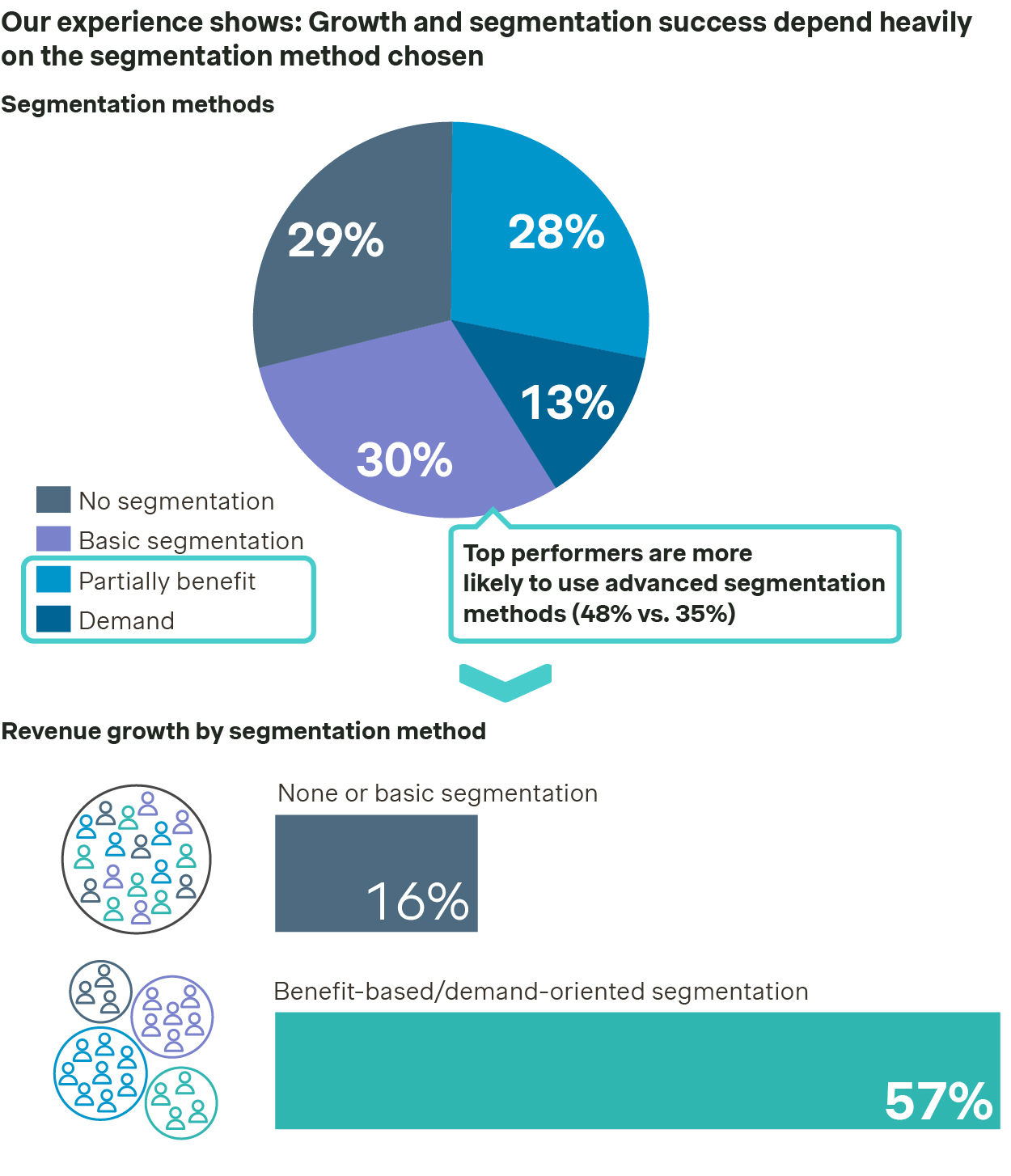
Use benefit-based or demand-oriented segmentation to distinguish between customer groups, then prioritize individual accounts according to strategic fit, volume potential, growth trajectory, and share of wallet. This helps teams focus on customers with strong sales and revenue growth potential.
What is the impact?
According to our 2025 B2B SaaS Study, organizations using benefit-based or demand-oriented segmentation methods reported average revenue growth of 57%, compared with 16% for those using no or only basic segmentation. Top-performing companies were more likely to use these advanced methods (48% versus 35% of others). Our analysis also found that 200 customers with positive three-year growth accounted for 60% of revenue.
Second priority: Where can AI improve B2B sales productivity?
According to 48% of webinar respondents, building AI-led B2B sales productivity is the next top priority.
What is limiting growth?
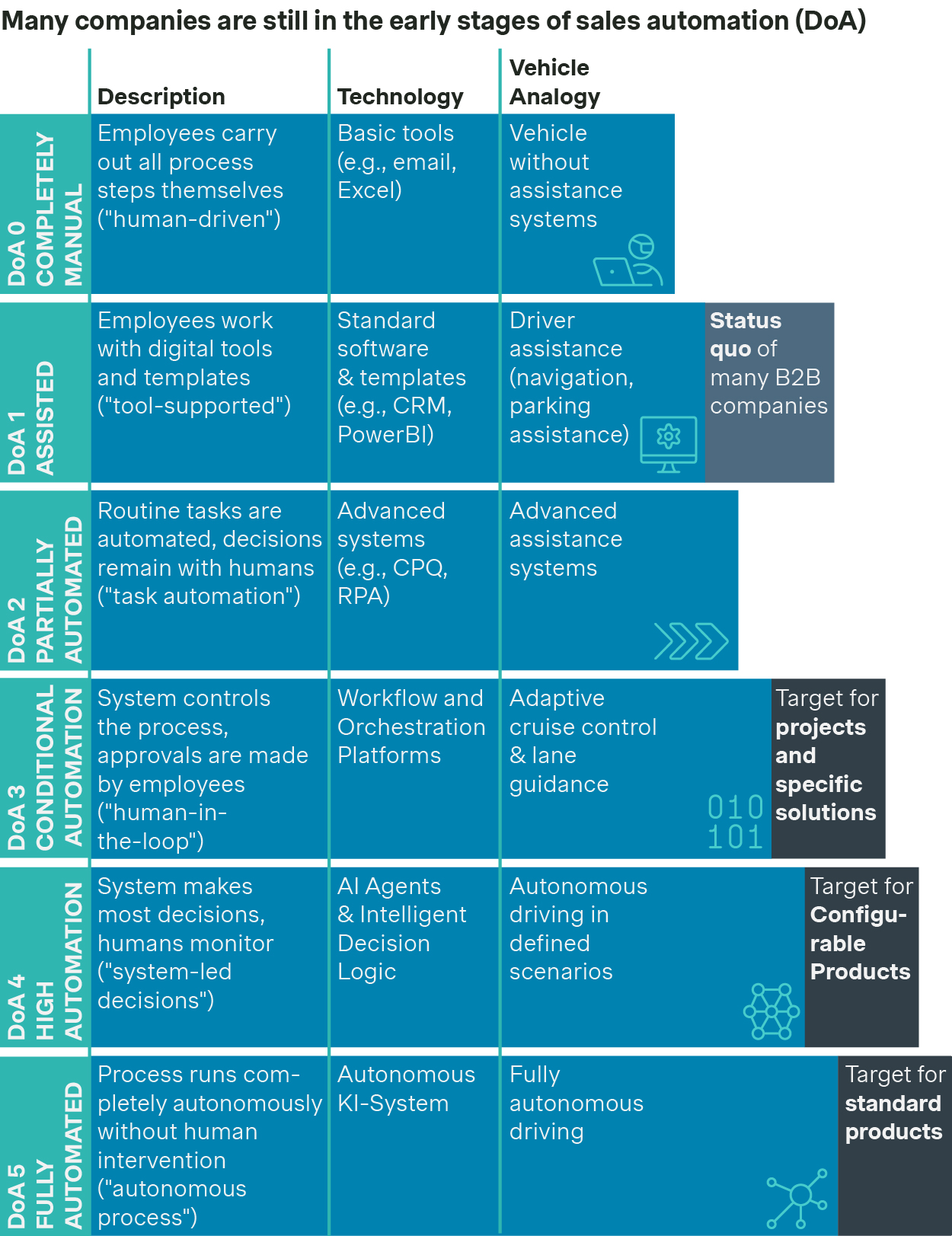
Most AI use in B2B sales is confined to an early, tool-assisted stage of automation, with employees still relying on standard software and templates for routine work. Manual tasks such as extracting data from inbound requests, preparing follow-up emails, generating quotes, and conducting compatibility checks consume disproportionate sales and operations time without adding customer-facing value.
What is the solution?
Apply AI to these high-volume, repetitive tasks where automation can reduce effort and improve response times. The right level of sales automation depends on the business model. Standard products may support highly automated workflows, while configurable products and complex solutions continue to require greater human involvement. This allows sales teams to spend more time on customers and opportunities with better revenue growth potential.
What is the impact?
Our process analysis shows that optimal sales automation can reduce processing time by 45-70%, depending on inquiry complexity. It can also lower total effort and annual processing costs by about 65%. These resource savings free up capacity unlock to support revenue growth without adding headcount.
Third priority: How can sales leaders target growth segments with precision?
40% of webinar respondents identified a targeted focus on growth segments as a priority.
What is limiting growth?
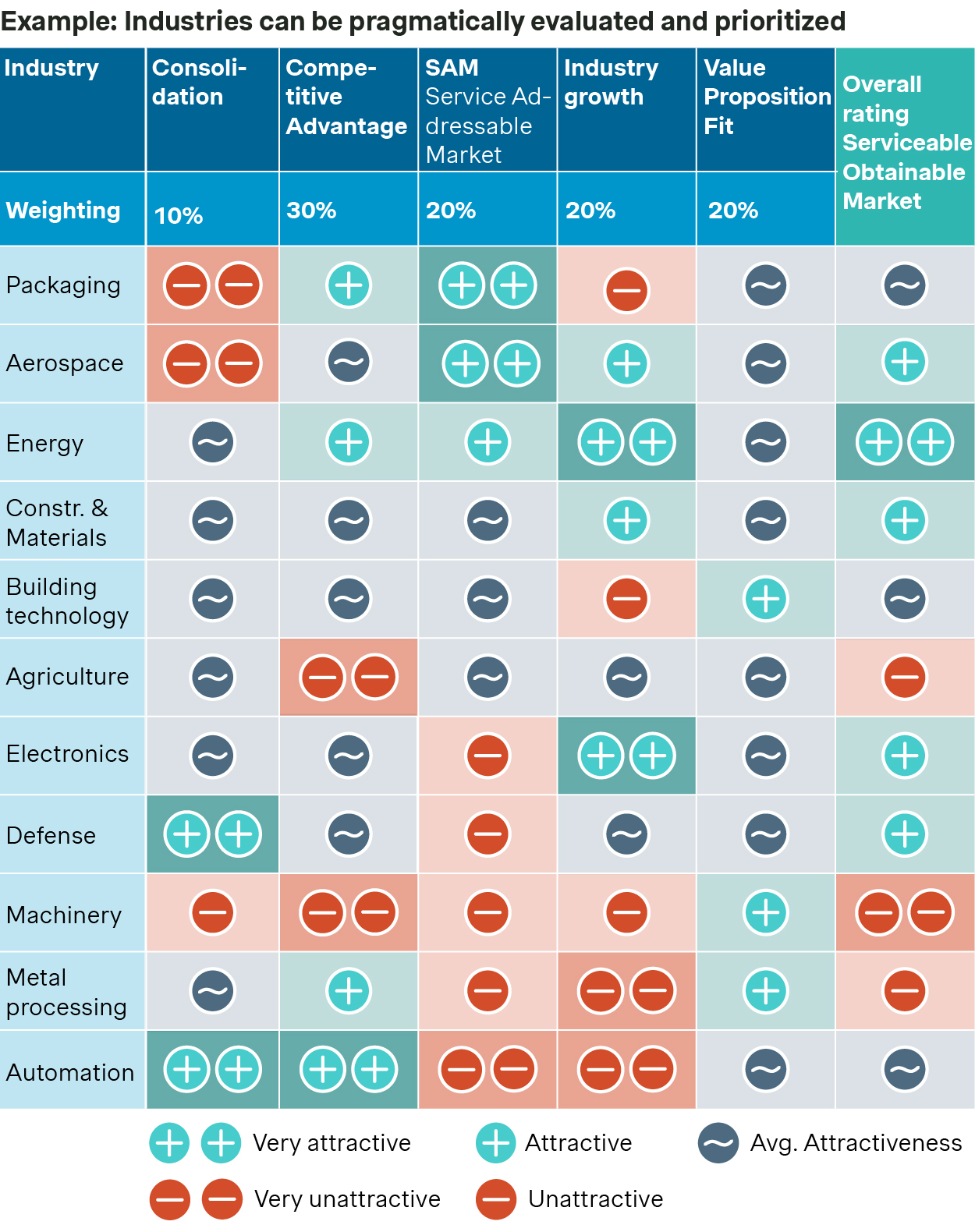
Sales teams often lack a clear view of which markets offer the strongest combination of demand and competitive fit. As a result, sales resources may be tied to historical structures rather than current market potential.
What is the solution?
Evaluate industries against a focused set of criteria, including market consolidation, industry growth, and value proposition fit. Sales teams can then move ahead to prioritize the markets where the organization has the strongest opportunity for directing new-customer activity within those segments.
What is the impact?
In one client assessment, southern Germany represented 60% of market potential but was covered by only three sales employees, while northern and eastern Germany each represented 5% and together had three. Experienced sales leaders can recognize that it does not demonstrate growth outcome on its own, but it does reveal where the limited sales capacity may be constraining growth. Then it helps identify promising markets where greater new-business focus and better sales coverage may be warranted.
How do these B2B sales priorities work together?
The three priorities are not a sequential checklist so much as a reinforcing system. The third priority follows naturally from the first two: even well-segmented customer prioritization and AI-enabled productivity gains lose impact if they target the wrong markets.
These levers are strongest when addressed as an interconnected system rather than independent projects.
Watch our webinar, "Modern sales – 10 immediate actions for measurably more revenue," to explore the full set of B2B sales growth actions.
Contact our B2B sales excellence team to start a discussion on unlocking strong revenue growth for your organization.
FAQs
- How should B2B companies identify growth customers?
Assess customers by their growth rate, strategic fit, total sales potential, and share of wallet. Accounts with strong growth prospects and a good fit should receive greater sales attention.
- Which KPI can show whether sales is creating new sources of revenue?
Young Revenue measures revenue generated from newly developed business potential within a defined period, such as the previous 12 months. It can include revenue from new customers, products, or markets.
- How do B2B companies identify unprofitable customers?
Analyze contribution margins at the customer-product level. This reveals loss-making combinations, low-margin accounts, and customers whose commercial terms or purchasing patterns reduce profitability.
- How is cross-selling potential measured in B2B sales?
Segment customers by purchasing behavior, service needs, and price sensitivity, then analyze which products or services are commonly bought together. This helps quantify the cross-selling potential for each segment and account.
- What other actions can B2B sales teams take to grow revenue?
Other actions include scaling AI-powered lead generation, improving negotiation preparation, introducing service offers earlier in the sales process, using data to support cross-selling, improving the profitability of low-margin customers, and aligning sales capacity with market and customer potential.