
Logistics markets can change within hours, but many contracts are still adjusted only once a year. Dynamic pricing offers a way to build more responsive contract models without sacrificing stability.
Monday morning, 7:30 a.m. A mid-sized food retailer in southern Germany urgently needs additional transport capacity to Northern Italy. Two days earlier, strikes at a major port had disrupted supply chains, while driver shortages tightened capacity across several lanes. Spot rates surged within hours, leaving the retailer with few viable options.
For many shippers, this is the new normal – one where transport markets react almost in real time to shifts in demand, capacity constraints, and geopolitical events. Yet across large parts of the logistics industry, 70–80% of revenues are still managed through long-term contracts.
This creates a growing disconnect: markets are dynamic, but contracts often remain static.
Dynamic pricing itself is not new in logistics. In spot markets, it has long been standard practice. The real challenge is integrating market responsiveness into contract structures without sacrificing planning reliability, operational stability, or long-term customer relationships.
Four approaches could help bridge that gap.
Service differentiation: Not every shipment has the same value
An automotive supplier facing a production shutdown because a truck arrives two hours late values transport capacity very differently from a consumer goods company with stable, predictable volumes. Yet both often receive similar contractual conditions.
This raises an important question: should pricing be differentiated more clearly by service level?
Instead of relying on a single contract rate, logistics providers could introduce multiple service tiers with clearly defined performance levels and pricing structures.
This model is already well established in parcel and express logistics. Customers understand the difference between standard shipping, express delivery, and guaranteed delivery before 9 a.m. In road freight, however, comparable models are still relatively underdeveloped.
A differentiated contract structure could include:
- Premium service: Prioritized capacity during peak periods, short-notice bookings, narrow delivery windows, or same-day pickup.
- Standard service: Planned transport flows with standard lead times and regularly allocated capacity.
- Basic service: Flexible execution without guaranteed time windows in exchange for lower rates.
For carriers, this creates a powerful mechanism to allocate scarce capacity more strategically. For customers, it brings greater transparency into the service levels they are actually paying for.
Availability-based pricing: When capacity becomes scarce
Many companies experience the same pattern every year during peak seasons such as the Christmas period: standard capacity sells out early, while short-notice transport becomes significantly more expensive.
Under this model, standard contract conditions apply as long as sufficient capacity is available. Once utilization reaches critical levels, the service offering shifts automatically.
For example, a logistics provider may reserve 20 daily transport slots on the Rotterdam–Munich corridor for a key customer. Once those slots are fully utilized, any additional volume would only be available through premium services or at spot-market rates.
At first glance, this may sound radical. In practice, many companies already operate this way, but informally and without transparent rules or structured pricing logic. Dynamic contract models would formalize these mechanisms and make them more predictable for both sides.
Market-responsive contracts: Agreements that move with the market
Both shippers and carriers face the same structural problem: contract rates are typically negotiated once a year, while market conditions can shift dramatically within weeks.
One solution is to link contract pricing more closely to external market indicators, such as spot-rate indices or freight cost benchmarks.
A contract, for example, could define a pricing corridor allowing rates to fluctuate within a range of plus or minus 15%. If the relevant market index rises significantly, contract rates adjust upward within the agreed boundaries. If the market softens, shippers benefit accordingly.
The most sophisticated of these are floater models. Similar to today’s diesel surcharge mechanisms, future contracts could automatically incorporate changes in labor costs, capacity shortages, or market rates.
The advantages are clear for both sides. Carriers reduce the risk of operating below market conditions for extended periods, while shippers gain greater transparency into why prices change.
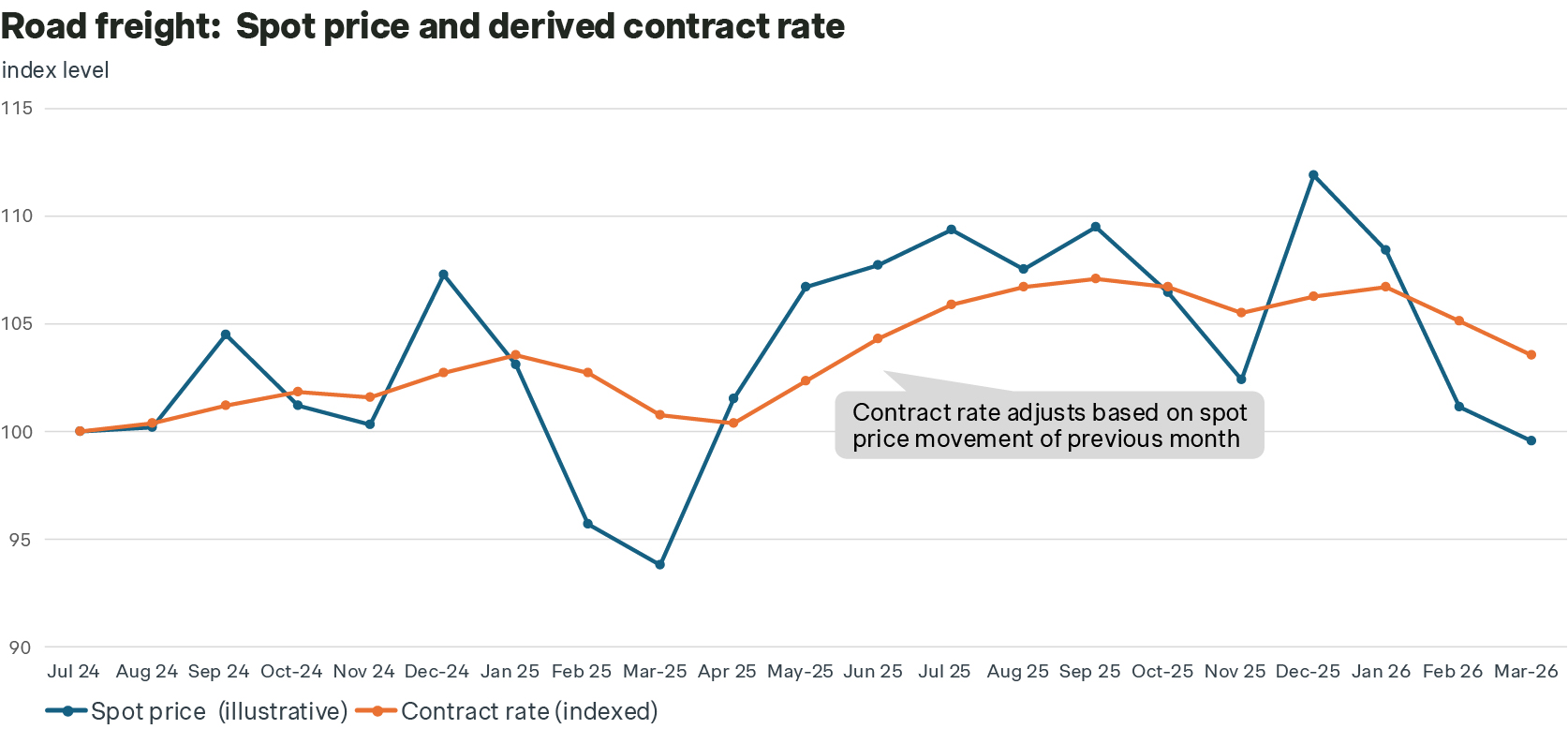
Illustration: Indexed development of illustrative European road freight spot prices and corresponding lagged contract rate adjustments (1-month delay).
Data-driven pricing: From experience-based decisions to algorithms
Pricing decisions in logistics are still heavily influenced by experience and manual judgment – even as the industry generates more operational data than ever before.
Modern analytics models can use this data to manage pricing with far greater precision.
For example, an algorithm may identify that Friday shipments between Hamburg and southern Germany are consistently oversubscribed, while return loads on Tuesdays regularly show excess capacity. Instead of applying flat rates across the board, contracts could incorporate differentiated pricing based on weekday, lead time, or network utilization.
Machine learning models go one step further by forecasting demand patterns, bottlenecks, and seasonal peaks early enough to proactively adjust pricing and service structures.
Amazon Supply Chain Services offers a glimpse of where this is heading. By opening its logistics network to external shippers, Amazon is increasingly positioning itself as an independent logistics provider. A core element of its model is the use of forecasting capabilities for demand, inventory, and capacity planning. Given Amazon’s scale and data advantage, these capabilities are likely used to optimize network utilization and commercial steering.
These insights will become the foundation for more differentiated pricing models based on capacity availability, service levels, and customer requirements.
The goal is not constant price volatility or minute-by-minute rate changes. The objective is smarter differentiation: aligning the right prices with the right customers, capacities, and service expectations.
Conclusion: Dynamic pricing becomes a strategic management tool
The logistics industry is approaching a turning point. Volatile markets, fluctuating capacity, and intensifying cost pressure are exposing the limitations of rigid contract structures.
Dynamic pricing does not mean abandoning long-term contracts or turning road freight into an “Uber model” – where every shipment becomes a spot transaction. Rather, it represents the next evolution of existing commercial models.
The key challenge will be combining transparency and planning reliability with greater market responsiveness.
This shift will also redefine the role of pricing teams. Instead of negotiating fixed annual tariffs, pricing will increasingly become a continuous management tool for profitability, capacity allocation, and network optimization.
The question is no longer whether logistics contracts will become more dynamic, but which companies will manage that transition most effectively.
Talk to our experts to make your contract structures more dynamic before your competitors do