
AI-driven commercial strategies are beginning to revolutionize the retail industry, boosting profits through improved predictions, smarter operations, and personalization that acquires, grows, and retains consumers.
By instantly analyzing vast data sets, retailers are staying ahead of rivals and reacting in real time to market realities and consumer demands. The days of traditional pricing that can be slow to execute will fade away. Businesses that fail to invest in AI tooling risk falling behind. Staying competitive means more than adopting new technology; it requires a strategic approach without risking brand value propositions. Retailers are deliberately optimizing AI to make smarter decisions when there are market fluctuations, including changes in demand, trends, sales, inventory, and supply chain. By leveraging AI, companies can create commercially savvy models that allow decision-makers to review and execute faster thus maximizing growth and revenue.
AI driven strategies are scalable and can benefit businesses of all sizes. Even small retailers can utilize AI to personalize marketing campaigns, improve customer service response, and manage inventory. For example, a retailer specializing in gifting accessories can predict demand using historical data and suggest pricing around peak periods like major holiday weekends. It can also assist with consumer engagement emails and loyalty discounts. Whereas at a large warehouse club where consumers primarily shop to stock-up, AI operates as the backbone, constantly automating and leveraging data. It anticipates demand, inventory levels, compares competitor prices, and leverages weather data for predicting sales. To forecast spring sales, AI may offer customized pricing while analyzing purchase history, frequency, browsing behavior, price sensitivity, and market trends.
Simon-Kucher’s 2025 Global Pricing Study reports that many businesses underestimate pricing as a profit lever or the potential that AI driven pricing can offer, using it only to monitor competitor pricing. Retailers who place a strong value on AI and strategy stay ahead and augment the consumer lifecycle and journey with branding, marketing campaigns, promotional offers, cross-sell and upsell motions, price optimization, customer relations and service, retention plays, loyalty, and much more.
Using AI to building consumer connections
According to Simon-Kucher's 2025 Holiday Shopping Report, 54% of consumers use AI for holiday shopping support, 23% rely on it to track deals, and 27% reference it for price comparisons. AI has become key in shaping price transparency and decision-making for the everyday consumer.
While AI algorithms operate behind the scenes, their impact is increasingly visible. For example, AI chatbots suggest products with personalized discounts to create a more engaging shopping experience. One global beauty retailer uses AI chat to provide recommendations based on a shopper’s tiered loyalty program status and beauty preferences saved. These interactions build consumer retention and enhance experiences. Features like points and rewards drive higher performance with strategic pricing, which increases total lifetime value.
Retailers, are you AI ready?
Building an AI commercial framework varies by company, depending on factors such as organizational maturity, product, and consumer unit economics. Other considerations include product categories, consumer relationships, and existing technology. To choose an effective strategy, prioritize two main factors:
- Purchase frequency: This is how often a consumer purchases something over a given period. How stable is their basket, buying habits, and impacts of seasonality. A furniture store and grocery store are diametrically opposite ends of the spectrum.
- Consumer relationship intensity: This reflects the retailer's relationship with its consumers. Is it transactional or is there a relationship with the brand. Think of airport convenience shops where it’s typically a one-time purchase vs apparel where a consumer can feel strongly about a brand.
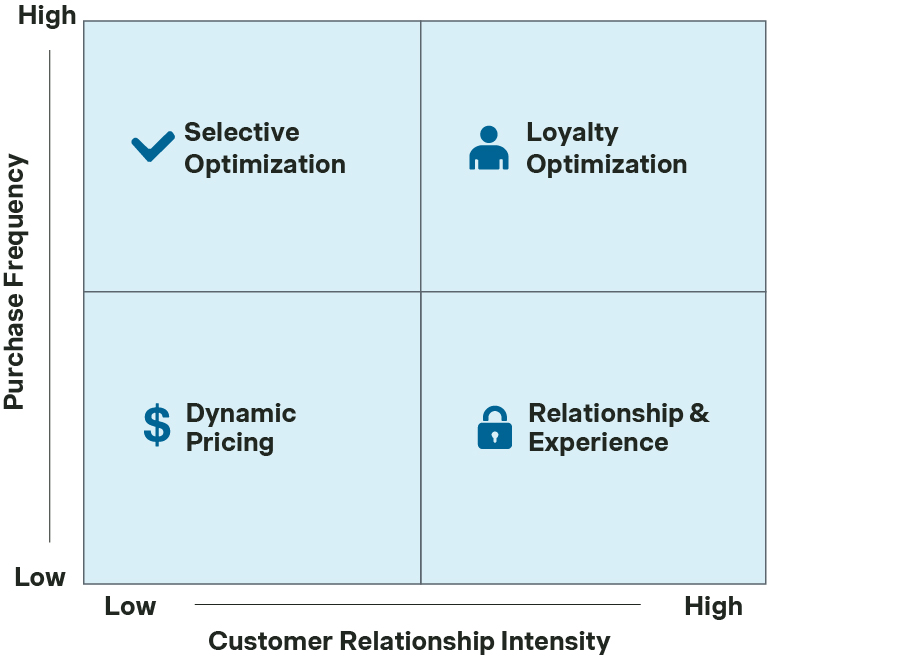
After mapping the two variables: purchase frequency and the intensity of consumer relationships, classify them into four AI zones. Each zone demands specific levels of AI maturity, investment, and organizational capability. This helps companies identify which approach aligns best with their situation.
- Loyalty optimization (high frequency, high relationship) - Use AI to combine base prices, discounts, and offers.
- Experience zone (low frequency, high relationship) - Focus on brand building such as personalization and service.
- Dynamic pricing (low relationship, low frequency) - Focus on elasticity modeling and rapid test-and-learn pricing.
- Selective optimization (low relationship, high frequency) - Prioritize AI-driven timing, promotions, and offer design.
Not all AI is equal: The maturity curve that retailers should know
To implement AI revenue growth strategies, retailers can add options to existing systems, such as the following:
- Rule-based pricing: Prices are set manually for individual SKUs based on a set of factors that drive the price up or down using rules such as margin expectations or competitive corridors.
- Elasticity models: This pricing approach uses historical data to determine how sensitive consumer demand is to price changes for each SKU over time. For example, if prices increase by 5%, sales are likely to drop by 8%. This model focuses only on traditional economic theory and does not always mirror reality
- Segmented pricing: A targeted price is set for a specific consumer group based on shared characteristics such as demographics, purchase history, and consumer lifetime value. For example, students may receive a bookstore discount.
- Personalized offers: In this arrangement, pricing and discounts are tailored to individual consumers using a customer data platform (CDP) effectively to predict whether each consumer will accept a special offer. Consumers will receive different discounts for the same product. Personalized pricing can increase competition and give consumers better deals, or it can lead others to pay more by using additional personal data.
- Unified value optimization: This advanced approach leverages rich data and infrastructure. AI balances price, discounts, and retention to achieve long-term profit and value.
Why retailers struggle with commercial AI use cases
Despite AI's advantages, implementing commercial strategies has some challenges. The market is stricken with inflation, tariffs, geopolitical uncertainty, supply chain volatility, price competition, and on-and-off data irregularities. Traditional pricing tools can’t rapidly predict outcomes or risks. Only retailers who invest upfront in systems that combine algorithms and analytics will succeed with responsible AI pricing. When rolling out, consider the following factors that tie back to the underlying data used by AI and downstream implications of its usage.
- Data infrastructure: The plumbing that collects, stores, moves, and managed data, from databases and software tools, keeping information organized and accessible.
- Data fidelity: Represents the dependability and accuracy of data.
- Data quality: AI commercial strategies are most effective with data-rich resources; otherwise, predictions may be inaccurate. Insufficient data can also lead to flawed recommendations and bias.
- Bias and discrimination: AI can be influenced by data that separates consumers into groups on dimensions that would be inappropriate (e.g. gender, political affiliation) and requires human moderation. AI is still prone to errors with reasoning, or subjective and context-dependent issues.
- Signal detection: It mixes causation and correlation by separating forecast errors into information, noise, and predictive skill. For example, umbrella sales cannot be used to predict future rain events.
- Survivorship bias: This occurs when results are based on success or survivorship, and failures are ignored. For example, in an index of stocks, the market always goes up over the long run. Stocks that don’t perform well in the index are often changed. However, the index does not report these details.
- Security: With large amounts of data, there is concern about how to protect it. AI can be exploited or misused by hackers, leading to familiar data breaches, membership attacks, ransom, and data set poisoning. Companies must comply with data protection laws by protecting customer data and purchase history.
- Consumer trust: Protecting data should be a top business priority. Shoppers entrust their personal information and purchase history to secure retailers. Companies should be upfront with consumers about how data is used and when policies change.
To streamline your operations and implement a plan that works for you, consider these questions:
- Which pricing zone do you fit in?
Of the four distinct pricing zones, which defines your businesses’ level of maturity and how can AI investment fit with that maturity and organizational abilities? - What areas of commercial strategy can AI help with the most?
Distinguishing between strategic priorities and short-term pressures will assist your business in deciding where to invest resources more effectively. This focus allows for more consistent consumer experiences and leads to stronger overall performance. - Where do you struggle when it comes to implementing AI?
How reliable is your underlying data and have you thought through secondary and tertiary impacts of AI use cases. How would core consumers react if they knew you were leveraging AI in transacting with them and to what degree is transparency required.
Retailers, let’s make AI pricing work for you
AI can help boost profits and keep consumers coming back, but it needs to be optimized correctly to deliver solutions and value. We help retailers assess their AI readiness and improve their systems to drive better growth. Let us create a plan for you.