
Semiconductor R&D partnerships are changing where pricing power is created. Leaders today must structure shared-risk agreements without turning early design-in concessions into long-term margin leakage.
The semiconductor industry is entering a new phase of innovation economics. Lengthening development cycles and exceptionally expensive capital investment requirements mean that the traditional model of unilateral, internalized R&D is under strain. Companies on the leading edge are turning to structured risk-sharing models to accelerate innovation while managing financial exposure. The biggest pricing decisions in semiconductor innovation are now made years before procurement sees a quote.
This raises the question of how semiconductor companies should think about pricing when R&D partnerships steadily shape which technologies win at the design stage. Price, in that world, becomes less of a cost recovery mechanism and more of a framework for aligning incentives. The key considerations should be rewarding collaborators, anchoring value early in the design-in cycle, and ensuring margin trajectories are set deliberately.
Why R&D risk-sharing is accelerating
For U.S. semiconductor firms, R&D intensity has exceeded 15% of sales for two decades. Globally, intensity varies by region and segment. The economics of a leading-edge node can involve tens of billions in fab investment before factoring in ecosystem-wide R&D, design enablement, and tooling. Even the largest players increasingly rely on selective ecosystem risk-sharing to manage cost, speed, and technical interdependence.
On the research side, industry research hubs like IMEC in Belgium show how this collaboration model works at scale. Rather than duplicating expensive R&D infrastructure, members contribute funding in exchange for shared access to pre-competitive research, pilot lines, and early intellectual property (IP).
For equipment makers, Applied Materials' EPIC Center in Silicon Valley is emblematic of the future. The complex represents up to $5B in capital investment, creating a shared development environment where equipment suppliers and chipmakers jointly own process-risks before a single wafer ships out. Tokyo Electron's Technology Center operates on a similar model, embedding engineering teams alongside chipmakers for joint development of next-generation process technologies.
These models demonstrate that structured R&D collaboration is becoming routine in semiconductor innovation strategy. The structure itself is key. While informal R&D collaboration has existed for years, one side has usually borne the costs. The models also shape a new commercial reality: when companies co-invest in technology development, they fix the competitive landscape for design wins years down the line. This shapes switching costs and creates vendor lock-in, process qualification, and future pricing leverage. As such, pricing decisions made at the R&D stage have long-term consequences for profitability.
Pricing mechanics in shared R&D models
1. Structured cost-sharing agreements
The most direct sharing model allocates R&D cost proportionally across partners. Defining the ‘proportion’ for each partner becomes the main hurdle. Key pricing considerations include baseline cost definition, contribution ratios, governance mechanisms, and treatment of cost overrun or timeline extension risks.
In equipment-led collaborations, pricing usually includes milestone-based funding tranches tied to defined technical deliverables. Escalation clauses may adjust partner contributions if scope expands. Cost-sharing and joint-venture mechanisms are more common, albeit the simplest vehicles for accelerating innovation on the cutting edge.
2. Prepayments and capacity-linked pricing
Prepayments and capacity guarantees link R&D investment to future commercial rights, such as priority access, preferred pricing, or guaranteed capacity once technology reaches production. ASML’s customer co-investment program is an early example of customer-funded R&D tied to advance-purchase opportunities for EUV/450mm tools. More recently, Intel’s High-NA position shows how deep technical collaboration can shape access to critical technology. Similar approaches are also common across today’s fabs.
The capacity-driven approach lessens risks for the upstream provider (e.g. equipment maker or fab), but some pitfalls remain. If capacity pricing encourages early participation without reflecting the technology's long-term value, below-market margins can become locked in for the entire lifecycle of the product. When designed well, this structure secures long-term revenue while protecting margins. When designed poorly, it trades pricing power for volume at the most critical point in the revenue lifecycle.
3. Outcome-linked royalties and revenue share
Some risk-sharing structures defer compensation until innovation success is realized. Partners agree to royalty streams, margin sharing, or performance-based premiums tied to yield improvements, throughput gains, or product adoption. Technology providers are rewarded in proportion to the impact they make, while adopters reduce upfront exposure.
Outcome-linked pricing also creates a structure that is difficult for competitors to displace at the design-in stage. A challenger must match the technology and replicate a pricing model tied to demonstrated, measurable results. The primary constraint is cash-flow intensity, as pure outcome-linked models may not generate sufficient early revenue to support development costs. Another often overlooked obstacle is accurately defining and tracking the KPIs that determine whether outcomes have been achieved. This approach is most viable for process optimization and incremental improvements, where commercial outcomes materialize faster.
4. Lifetime production value pricing
Some R&D risk-sharing arrangements are priced in relation to the full production lifecycle value of the developed innovation. However, this is not the general case. There is a risk that customers undervalue supplier contributions in an R&D context when pricing is anchored to development costs or the size of the initial production contract rather than the long-term value of the technology. If risk-sharing commitments endure for years, so might underpricing.
Suppliers who model total value delivered across the entire production life price from a fundamentally stronger position than those negotiating contract by contract. When risk-sharing partners co-develop a technology that will generate revenue for five to ten years, pricing architecture must reflect that horizon. The key is communicating the full lifespan of value. Customers accustomed to the old way of doing things may not have been exposed to the economics of risk-sharing. Short-term concessions made to close an initial production deal compound across every subsequent year of the lifecycle unless proactively accounted for.
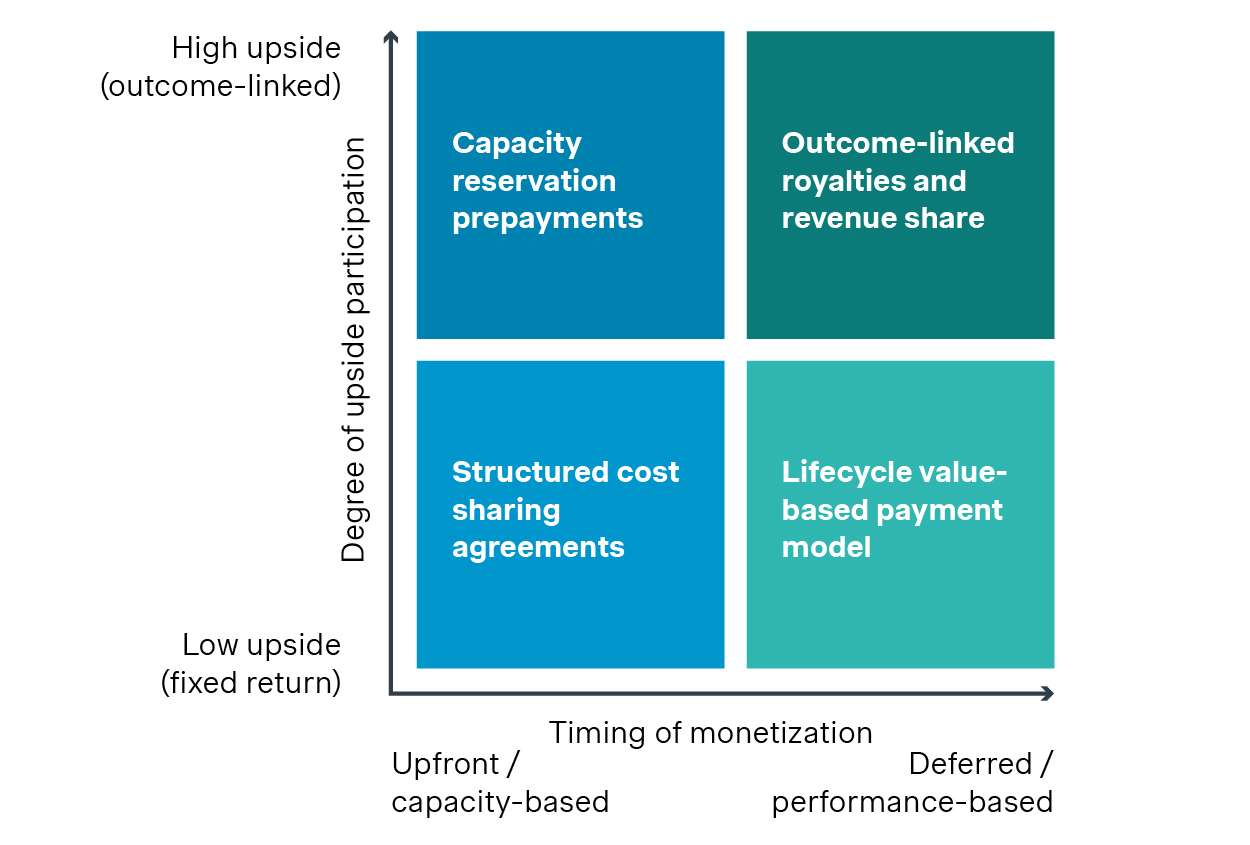
Caption: Source: Simon-Kucher insights 2026
Illustrative economics: The hidden cost of an early concession
Consider a supplier that co-invests $100 million in developing a new process module with a strategic customer. To secure the design-in and early capacity access, the supplier accepts a 5% price concession on the first production agreement.
At first glance, the concession may look manageable. But if the technology later generates $300 million in annual production revenue over a seven-year lifecycle, that 5% concession represents $15 million of annual revenue leakage, or $105 million across the lifecycle before considering node extensions, follow-on applications, or renewal effects.
In other words, a discount granted to accelerate adoption can quietly offset the entire value of the original co-investment. The commercial question is then not only “What discount is needed to win the first contract?” but it is also, “How do we structure the first contract so that early risk-sharing does not become the reference price for the full production ramp?”
Choosing the right risk-sharing pricing architecture
No single risk-sharing model is universally superior. The right pricing architecture depends on where uncertainty sits, when value materializes, and how clearly each partner’s contribution can be measured.
| Model | Use when... | Be careful when... |
| Structured cost-sharing | The work is pre-competitive, platform-based, or infrastructure-heavy. | The supplier’s differentiated IP is at risk of being priced like a reimbursable cost. |
| Prepayments and capacity-linked pricing | Scarcity, priority access, or capacity assurance is the main source of customer value. | Preferred early pricing could become the benchmark for the entire production ramp. |
| Outcome-linked royalties and revenue share | The impact can be measured through clear KPIs, such as yield, throughput, adoption, or performance improvement. | Data ownership, KPI attribution, or audit rights are unclear. |
| Lifetime production value pricing | The innovation will generate value across years of production, node extensions, or follow-on applications. | The customer recognizes near-term R&D cost but not long-term option value. |
Caption: Source: Simon-Kucher insights 2026
The common mistake across all four models is treating the first commercial agreement as a standalone negotiation. In semiconductor R&D, the first agreement often becomes the economic anchor for years of production value.
Cross-industry precedents
Risk-sharing R&D pricing is not unique to semiconductors. Other more mature and similar capital-intensive industries offer instructive parallels.
In pharmaceuticals, co-development agreements between biotech innovators and large pharmaceutical companies often involve upfront payments, milestone-based funding, and downstream royalties. Their pricing architectures explicitly distribute technical and regulatory risk across development stages, with royalty rates and milestone triggers calibrated to clinical trial outcomes.
Automotive OEMs, battery manufacturers, energy companies, and charging infrastructure operators have co-invested in EV platform development. The visible result is a global network of chargers forming the foundation of electric transport. These joint ventures combine capital contributions with long-term supply pricing agreements, most commonly for energy prices. As in the semiconductor industry, key ecosystem players in EV have shown a willingness to spend on co-development across upstream and downstream partners.
Both examples show that when innovation cost and uncertainty rise, pricing often shifts from static cost-plus mechanisms to dynamic, lifecycle-oriented value sharing models.
Strategic pricing considerations for semiconductor leaders
When evaluating R&D risk-sharing arrangements, semiconductor executives should consider five pricing disciplines:
- Anchor price at design-in, not at procurement for High-Volume Manufacturing (HVM): During design-in, buyers evaluate technology based on capability. Once the production process is established, authority shifts to procurement and the frame moves from value to cost. Suppliers who establish prices before the process is finalized can leverage value-based considerations rather than cost benchmarks to drive negotiations.
- Establish clarity on risk allocation before defining contribution ratios: Cost-sharing negotiations that clearly define ownership of technical, financial, and market risk distribution between parties produce contribution ratios that stay aligned even as scope and scenarios evolve.
- Price for the production lifecycle, not the first contract: Suppliers who anchor pricing to the full production horizon capture value across every renewal and volume expansion, not just the initial win.
- Structure capacity commitments to preserve margin throughout the volume ramp: Repricing mechanisms tied to volume thresholds or yield milestones ensure that as capacity commitments are met, pricing can be recalibrated to preserve margins throughout the entire ramp.
- Use pricing structure as a competitive moat: Outcome-linked models that tie compensation to demonstrated results create switching costs competitors cannot match with technology alone. Challengers must replicate both performance and a proven commercial model built on shared data.
Pricing as architecture, not an afterthought
Pricing must evolve as semiconductor innovation becomes more collaborative. R&D risk-sharing arrangements are not merely financial engineering, but commercial decisions that determine margin trajectories years before production revenue materializes.
The most effective pricing architectures embed discipline at each critical decision-point by structuring cost recovery to reinforce value, anchoring price during co-development, building capacity commitments that reflect lifecycle economics, and converting production-line positioning into contracts that capture full value. Companies that treat pricing as core innovation infrastructure, rather than as a downstream negotiation, will be best positioned to accelerate next-generation technologies while protecting long-term value capture.
At the leading edge, R&D risk-sharing is a given. The competitive question is how to price that risk for success.
Explore all the insights from our B2B Masterclass
Unlock practical strategies in B2B pricing, sales, and marketing