
2026 brings recurring volatility for capital-intensive sectors, plus new upside from the EU–Mercosur deal and AI-driven efficiency. We discuss how to build long-term value by turning ambition into measurable impact through a value creation bridge.
Macroeconomic volatility and structural shifts are expected to shape global and local markets in the year 2026. For capital-intense industries such as automotive, chemicals, industrials, infrastructure and pharmaceuticals, geopolitical tensions, trade unions incl. agreements, tariffs, fiscal constraints, energy price volatility, and supply chain disruptions are no longer exceptions nor temporary effects, but recurring features of the current environment.
At the same time, unprecedented opportunities emerge. The European Union – Mercosur Free Trade Agreement signed on 17th Jan 2026 covers 25% of global GDP and ~700 mn people. Innovations such as Humanoids and Artificial Intelligence boost efficiency, enable cost reduction, and offer new growth areas across verticals.
In the Simon-Kucher European Growth Study 2026, with insights of more than 1,200 top decision makers, most companies expect 2026 to be as challenging as 2025. However, confidence in achieving their targets has improved. Encouragingly, 59% of companies now integrate macroeconomic risks into their core planning processes. Yet, gaps persist. 15% struggle to assess the concrete impact of external risks, and 26% remain largely passive.
Strategic responses are key. Successful companies pursue a dual mission. They strengthen the core along existing products, markets, and business models, while treating innovations, inorganic growth, and business model advancements equally important. By contrast, they focus less on ‘all-or-nothing’ bold moves.
From outgrowth to strategic reset
Since the pandemic, industrial companies have moved from an outgrowth phase with strong demand, significant capacity investments, and pricing power in 2021 until 2023 to a survival and rebalancing phase marked by severe cost pressure, destocking, and capacity adjustments in 2024/ 2025.
A reset phase is now emerging. Companies must reassess their market share and position within a reshaped ecosystem, rethink their global footprint, optimize their in-house value creation along technical and operational capabilities, and strengthen lifecycle and installed base monetization. This is the moment when long-term value creation becomes decisive.
Long-term value creation is a cross-functional, company-wide effort to build sustainable competitive advantage in the short, mid, and long term. Along three well-defined steps, an overarching ambition and vision are defined. A consistent strategy with clear milestones is backed by concrete, actionable measures. All impacts on revenues, capital expenses, operational expenses, and cash are tied to P&L and balance sheet reports:
Full potential and ambition level
An agreed baseline, e.g., 2025 company actuals adjusted for one-time effects, together with a common taxonomy, serves as a starting point for internal and external benchmarking as well as comparisons with industry best practices and relevant success cases beyond the current one.
After the full potential has been quantified, an overarching ambition including financial and strategic aspects and yearly ramp-up is aligned with top management.
Bottom-up planning
For each function, region, and business unit in scope, the agreed ambition and yearly ramp-up are backed by concrete measures. Each measure is characterized by its yearly or even quarterly impact, required resources in cost and FTE, dependencies with other measures, and a dedicated owner.
In a second step, all standalone measures are aggregated within an overarching implementation roadmap and their impacts incl. resource requirements reconciled with the forward-looking financial statements (P&L, cash statement, balance sheet) to identify potential bottlenecks and ensure all constraints are met.
Implementation
Along the overarching implementation roadmap and measure-specific plans, each owner drives the effective, efficient measure realization supported by the respective line functions.
Long-term value creation goes beyond isolated actions. Short-term cost cutting may limit long-term efficiency gains. Pricing defines market perception, cost-cutting affects resilience, and organizational redesign influences execution capacity.
In cyclical markets, deep and reactive cuts often weaken the capabilities required most for a fast recovery. Sustainable value creation therefore requires improving performance today while protecting structural strength for tomorrow.
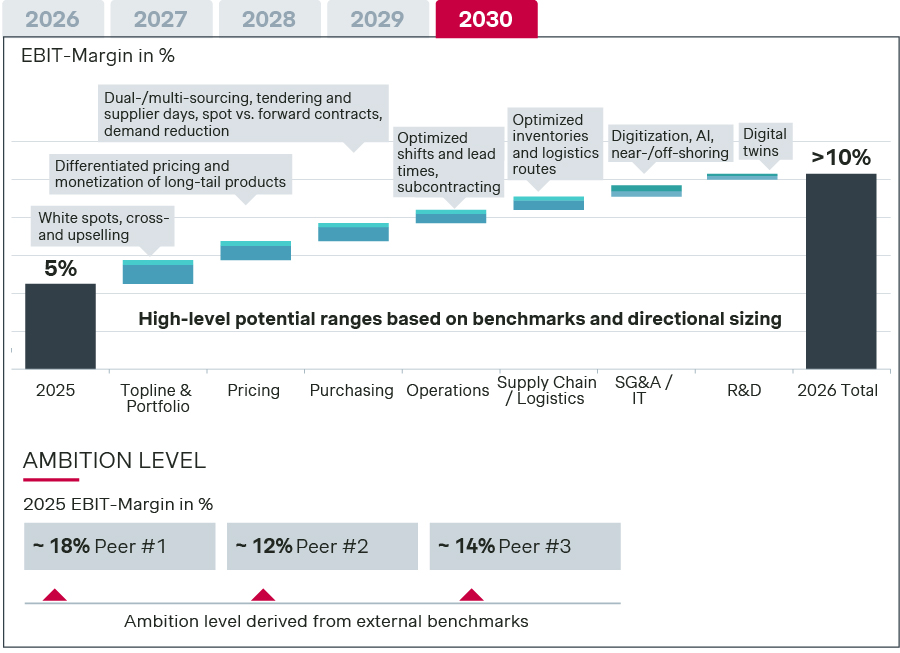
Long-term value creation is measurable when ambition is translated into a clear financial pathway. A structured value creation bridge connects today’s baseline performance to a defined margin ambition and clarifies which levers deliver impact and when. Margin expansion typically unfolds across three horizons:
Short term: Stabilize
Pricing enforcement, reduction of discount leakage, tactical portfolio cleanup, procurement renegotiations, and working capital improvements protect margin and cash.
Medium term: Optimize
Differentiated pricing architectures, SKU rationalization, dual-sourcing strategies, utilization optimization, and automation reshape cost structures and revenue quality, strengthening mid-cycle competitiveness.
Long term: Redesign
Portfolio repositioning, footprint redesign, digital backbone integration, AI-enabled decision systems, and disciplined capital allocation redefine structural advantage.
Along all functions (i.e., Topline & Portfolio, Pricing, Purchasing, Operations, Supply Chain, SG&A, IT/Digital, and R&D) the EBIT-bridge makes transparent how revenue quality, cost structure, capital efficiency, and working capital improvements accumulate into durable margin expansion.
It also clarifies trade-offs, showing which levers affect revenue, capital or operational expenditure, cash, and how initiatives build on one another over time.
A journey, not a program
Especially for capital-intense companies, long-term value creation is far beyond a pure, short-term profitability boost program. It is a continuous discipline embedded across the full P&L and balance sheet. It integrates growth, cost, capital, and cash levers under a clear ambition and translates them into measurable impact through structured value bridges and aligned performance metrics.
In a world defined by recurring volatility, those companies that combine strategic clarity with disciplined execution will go beyond enduring cycles. They will outperform peers and build sustainable enterprise value for shareholders.
Our experts are always happy to discuss solutions to your most pressing issues. Reach out, and we’ll connect you with a member of our team.
Explore all the insights from our B2B Masterclass
Unlock practical strategies in B2B pricing, sales, and marketing