
Wholesale is entering a more demanding phase. For decades, its role in the value chain was clear: connecting manufacturers with customers, bundling demand, managing inventory, and ensuring efficient distribution. It was an indispensable intermediary, giving suppliers and customers reach, reliability, and market access.
Today, however, this role is increasingly under pressure. Digital platforms enable direct sales, logistics is becoming more standardized, and transparency continues to rise. This raises a fundamental question: Will wholesale still be relevant in the future?
Yes, if the model changes. By 2035, wholesale' will remain relevant only if it evolves from a distributor of goods into a manager of value.
The current reality: Intensifying margin pressure
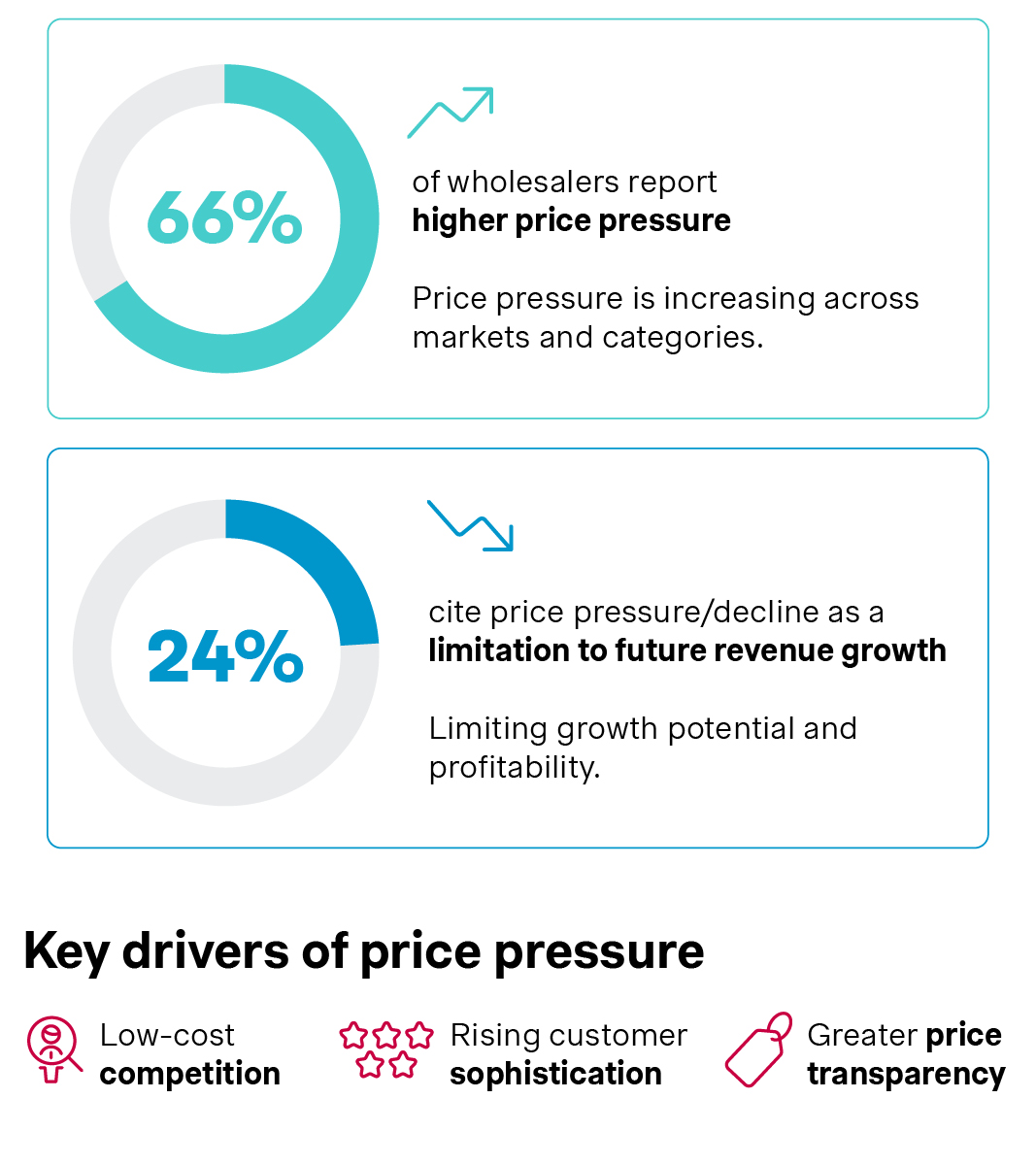
Markets worldwide are becoming more competitive and less forgiving. Margin pressure is intensifying across industries, including wholesale. According to the Simon-Kucher Global Pricing Study, 66% of wholesalers report higher price pressure, and 24% cite price pressure as a limitation to future revenue growth, driven by low-cost competition, rising customer sophistication, and greater price transparency. At the same time, many wholesalers struggle to translate price increases into actual margin gains, with significant leakage caused by negotiation dynamics and inconsistent execution.
The industry is still growing but not necessarily gaining control.
Wholesale’s relevance now depends on sharper value creation
Despite pressures, wholesale continues to play a critical role in the value chain. It reduces complexity for both suppliers and customers, provides access to fragmented markets, and ensures availability and service reliability. Particularly in Europe, with its diverse and fragmented customer base, this intermediation function remains highly relevant.
However, the source of value is shifting.
Historically, wholesalers created value through scale, assortment breadth, and logistics efficiency. The classic “one-stop shop” model, offering everything to everyone, was a key differentiator. Going forward, that model will carry less weight.
By 2035, success will come from offering the right assortment, at the right price, to the right customer.
The shift in value creation will require wholesalers to strengthen the commercial capabilities that matter most. Pricing, sales, assortment, and digitalization will become the core levers for protecting margins and improving customer relevance.
Lever 1: Data-based, differentiated pricing
Pricing will become the single most important profit lever in wholesale.
Today, pricing is still often cost-plus driven, relatively static, and only partly differentiated. Many companies fail to fully realize planned price increases due to customer resistance and competitive pressure. Meanwhile, there is a clear shift toward more structured approaches, including index-based contracts and more dynamic pricing mechanisms.
For wholesalers, this means pricing must evolve along three dimensions:
- More agile: Prices updated more frequently to reflect market dynamics
- More differentiated: Tailored by customer segments, products, and willingness-to-pay
- More data-driven: Powered by real-time data and AI
In the future, pricing must become a continuous steering mechanism. Companies that manage margins at a granular level will create a clear competitive advantage.
Lever 2: Sales excellence in a hybrid model
The role of sales is also undergoing a fundamental transformation.
Traditionally, wholesale sales has been relationship-driven and negotiation-heavy. Those strengths still matter but are no longer sufficient. Customers increasingly expect seamless digital interactions alongside stronger value communication.
This leads to a hybrid sales model, combining:
- E-commerce and digital channels for efficiency, transparency, and scalability
- Human sales expertise for complex negotiations, relationship building, and value communication
Sales excellence in the future will depend on orchestrating these channels with clear roles, consistent governance, and the right capabilities in value selling, negotiation, and customer segmentation.
In this context, the sales function will carry a broader mandate. It will become less about processing orders and more about actively managing customer value and profitability.
Lever 3: Assortment strategy for margin and differentiation
Assortment management is another major commercial lever.
The traditional wholesale model relied on broad portfolios and the promise of being a one-stop shop. While this approach offered convenience, it also created complexity, inefficiencies, and often undifferentiated offerings.
The future points to sharper portfolio discipline including more focused and curated assortments, clear and targeted portfolio strategies, and stronger emphasis on high-margin, differentiated products.
Rather than maximizing assortment size, successful wholesalers will optimize their portfolio for profitability and strategic positioning. This may include private labels, exclusive products, or value-added services.
The foundation: Digitalization, data, and AI
Digital transformation will make these commercial moves scalable.
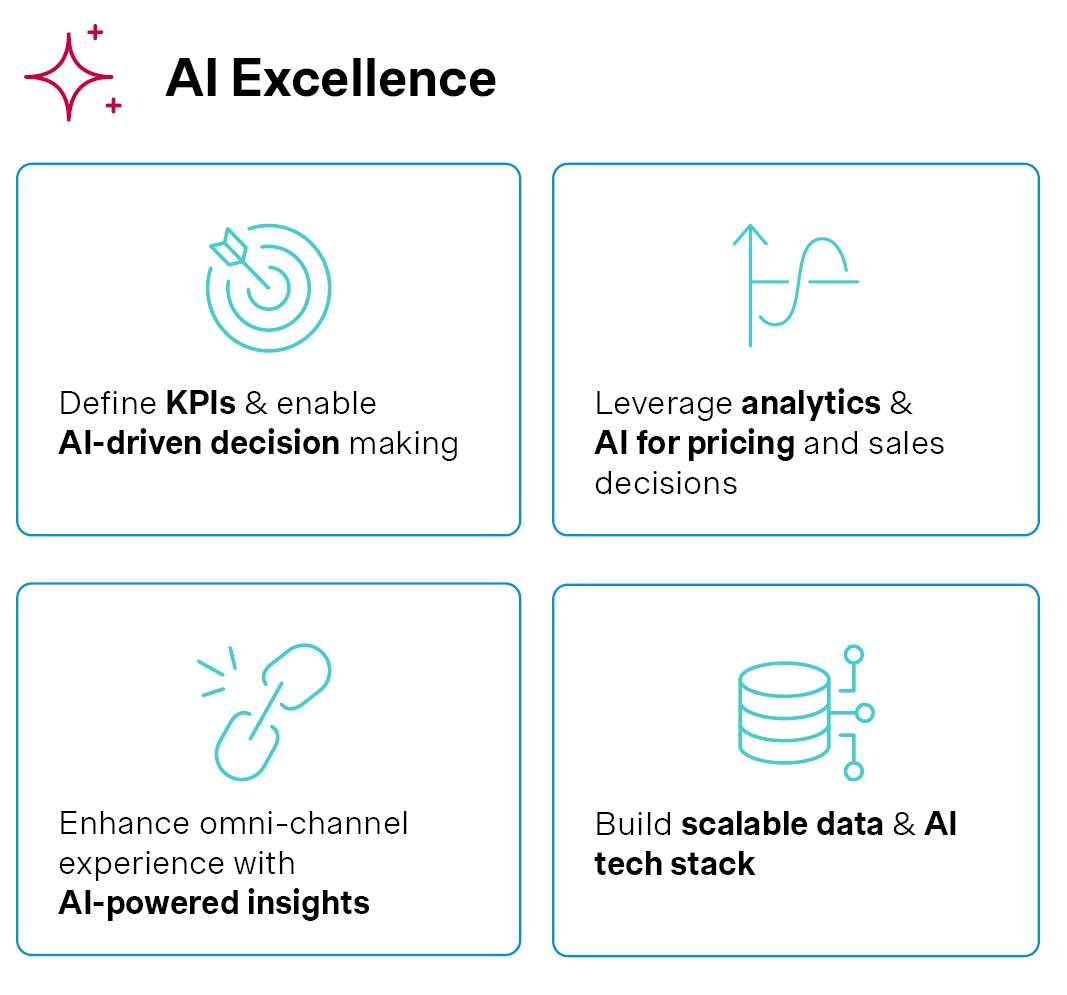
Data will become the central asset for wholesale businesses. Companies need integrated data across pricing, customers, products, and supply chains to enable better decisions. Software systems will replace fragmented tools, creating end-to-end transparency.
Artificial intelligence will play a key role in this evolution. Over time, its application will move beyond analysis to automation, supporting real-time pricing decisions, demand forecasting, and sales recommendations.
Today, 41% of wholesalers say AI is not used in pricing. Current AI use is concentrated in demand forecasting (34%) and market intelligence (31%), while real-time price optimization is still limited (13%) according to our Global Pricing Study.
Many companies still face barriers such as lack of expertise, data limitations, and integration complexity. Addressing these hurdles will determine how much value companies can capture from AI.
Efficiency as a hygiene factor: Cost and supplier management
While commercial excellence becomes the primary differentiator, operational excellence remains essential.
Cost management will continue to be a key priority, especially in an environment of economic uncertainty and margin pressure. At the same time, supplier management is also gaining importance with implications for cost, resilience, and sustainability.
Regulatory developments such as the Carbon Border Adjustment Mechanism (CBAM) will further increase complexity. Wholesalers will need to manage carbon-related costs, ensure compliance, and integrate these factors into pricing and sourcing decisions.
In this context, operational efficiency is the baseline for competing. It supports differentiation, although it rarely creates it on its own.
The future role of wholesale
By 2035, wholesale will remain essential to the value chain albeit with a more commercially sophisticated role.
The companies leading this market will master data-driven pricing, build hybrid, high-performing sales models, focus their assortment strategically, leverage digital technologies and AI, and maintain operation excellence amid complexity.
Value creation, hereon, will depend on understanding, shaping, and monetizing demand better than anyone else, with distribution as the foundation and commercial excellence as the differentiator.
Explore all the insights from our B2B Masterclass
Unlock practical strategies in B2B pricing, sales, and marketing