
Defense markets offer attractive growth potential for B2B industrials. The risk, however, is not missing the market but entering the wrong programs with the wrong economics. Profitable dual-use growth requires four deliberate choices: where to play, which programs create value, how to become defense-ready, and how to scale.
Why B2B industrials need to act now
Many B2B industrial companies are seeing pressure build in their core business. Growth in traditional markets is often limited, cost bases are rising, and customers continue to demand efficiency, reliability, and price competitiveness. At the same time, geopolitical tensions are changing defense spending priorities, creating new demand for equipment, technologies, components, and services.
Major defense markets are creating industrial growth potential
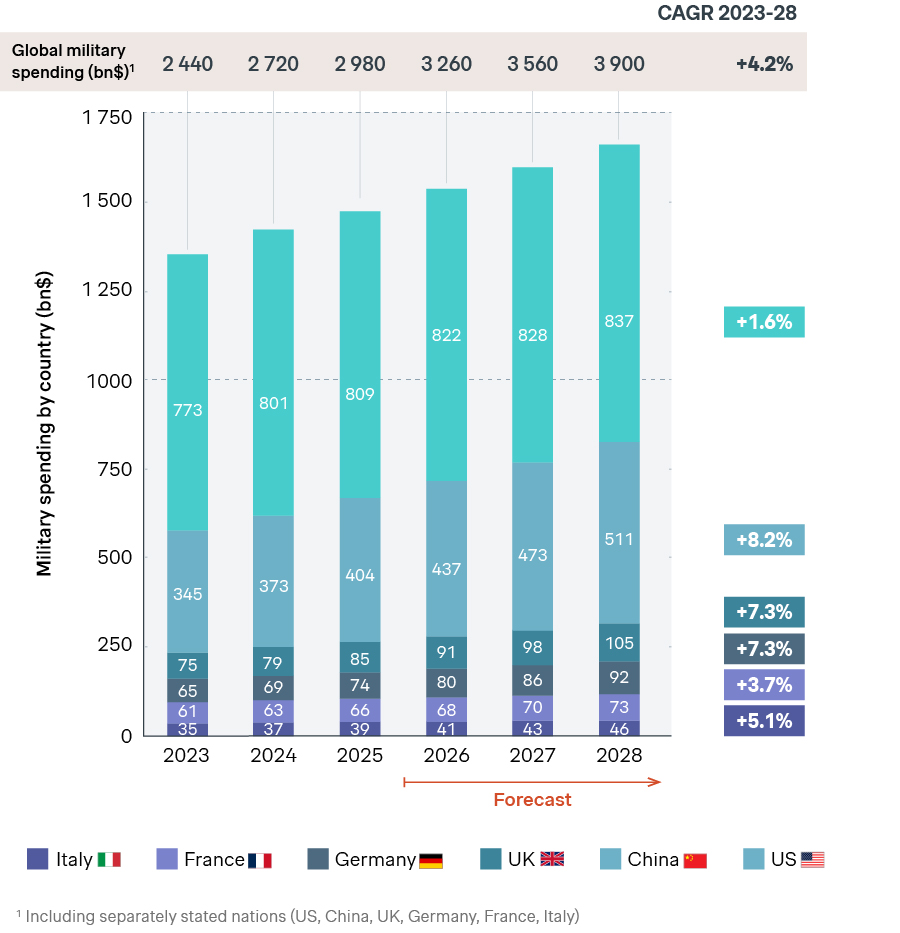
Source: SIPRI 2024 & 2025, Markets&Markets 2023 & 2024; 1: Including separately stated nations (US, China, UK, Germany, France, Italy)
This demand overlaps directly with capabilities many industrial companies already have. Dual-use technologies originally developed for civilian applications can often be adapted for defense contexts with targeted modifications. These include actuation systems, electronics, sensors, materials, drive systems, precision components, sealing solutions, software-enabled systems, and maintenance services.
However, dual-use is not a simple “copy and paste” growth route. Defense customers have different procurement processes, longer planning horizons, and stricter requirements for compliance, certification, documentation, and quality assurance. A component that performs well in civilian industrial machinery may need to meet additional standards for vibration, temperature, humidity, electromagnetic compatibility, or airworthiness before it can be used in military applications.
The challenge for B2B industrials is therefore twofold:
- Identify where their existing capabilities carry real defense relevance and have potential to create value
- Build the commercial, organizational, and operational model required to win.
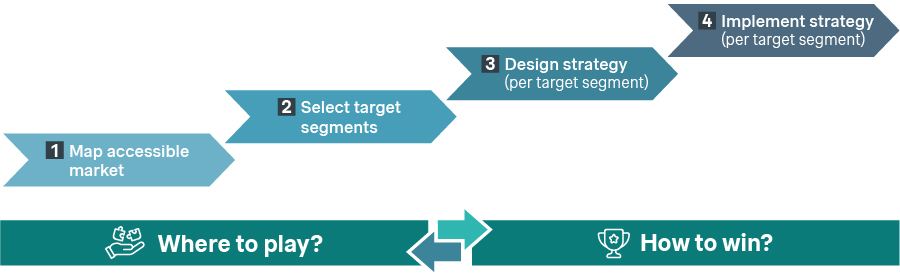
A structured dual-use growth approach moves companies from opportunity identification to hands-on implementation.
1. Start with a realistic dual-use opportunity map
The first step is to translate existing products, technologies, and know-how into potential defense applications, guided by a precise question: “Where does our current capability solve a specific defense customer problem better, faster, or more reliably than existing alternatives?” This is a sharper starting point than simply asking “What can we sell to defense?”.
Existing capabilities often map to defense applications more directly than expected:
- A manufacturer of precision gear systems may identify applications in UAV payload alignment, landing gear mechanisms, or flap adjustment systems.
- A supplier of advanced lightweight materials may find relevant use cases in drone structures, aircraft components, or protective housings.
- An electronics company may identify opportunities in sensors, connectors, avionics-related sub-systems, or ruggedized control units.
The output should be a structured market model that links offering categories, defense applications, customer groups, and geographies. This brings transparency and prevents companies from chasing every possible opportunity. It also helps management define strategic guardrails, including ethical boundaries, export-control limitations, and regional focus.
2. Prioritize segments using market potential and company fit
Not every attractive defense segment is accessible. A large market can still be the wrong target if incumbents are entrenched, entry barriers are high, or the company lacks key certifications. Conversely, a smaller segment can be attractive if the company has a strong technical edge, existing customer relationships, or a clear path to qualification.
Segment prioritization should therefore combine market potential with company fit, weighing criteria such as:
- Market size and growth
- Expected volumes and price levels
- Competitive intensity
- Technical and certification requirements
- Customer access
- investment requirements
- Time to revenue.
Military drones offer a practical example. These platforms create demand for multiple industrial components, including moveable payloads, landing gear mechanisms, and flap or wing adjustment systems. Yet each application has different requirements.
- Payload systems may require high-precision movement and low weight.
- Landing gear mechanisms must withstand repeated stress and harsh environments.
- Wing adjustment systems need reliability, fail-safety, and material performance.
A structured prioritization makes these differences visible and helps companies decide whether to target drones, remote weapon stations, flight-control systems, vehicle actuation systems, or other applications.
3. Decide which programs create value, not just revenue
This is where many dual-use strategies remain too superficial. Market potential and technical fit can identify where a company could participate, but they do not show whether the opportunity will create value. Defense programs often require significant investment before recurring revenue materializes, so companies need commercial structures that allow them to recover those costs.
A robust business case should model the full lifecycle rather than the expected unit price alone. It needs to include non-recurring engineering, qualification and certification costs, tooling, customer-specific documentation, production ramp-up, working capital, warranty and liability exposure, localization requirements, spare-parts obligations, service support, and potential obsolescence management.
Six questions to answer before committing
- How much of the addressable revenue is realistically accessible, and when will it materialize?
- How will development, qualification, and customization costs be funded or recovered?
- What margin remains after lifecycle support, risk provisions, inflation, and working-capital effects?
- Which contractual terms could shift technical, schedule, or volume risk to the supplier?
- How dependent is the business case on one platform, one prime contractor, or one country?
- What are the exit costs if the program is delayed, descoped, or cancelled?
This analysis should become the backbone of a disciplined bid/no-bid process. The goal is not to reject long-cycle opportunities, but to differentiate between strategic investments and unmanaged commercial exposure. In defense, selective growth is often more valuable than broad participation.
4. Close the technical and compliance gaps early
Many industrial companies underestimate the effort required to become defense ready. Technical fit is necessary, but defense applications often require additional testing, documentation, traceability, and certification. Depending on the application, companies may need to address standards such as environmental testing, electromagnetic interference control, NATO quality assurance requirements, or airworthiness-related rules.
The key is to compare requirements against existing capabilities at an early stage. A company may already have strong engineering know-how, quality systems, and production discipline but still lack military-specific certifications or experience with defense documentation. Identifying these gaps early enables realistic planning of investment, timing, and resources.
This also avoids a common pitfall: entering customer discussions with an attractive product story but without a credible path to qualification. In defense, credibility is built through proof points, industry standards, reliability data, and the ability to support long program lifecycles.
5. Build the right route to market
Defense markets are relationship-driven, regulated, and often shaped by established value chains. Many B2B industrials will not sell directly to armed forces or ministries of defense. They may need to enter the market through OEMs, Tier-1 suppliers, system integrators, technology partners, or local distribution partners with existing customer access.
The optimal route to market depends on the company’s value-chain position. A component supplier may need a strategic partnership with a system integrator. A materials company may need to qualify through a Tier-1 supplier. A company with strong technology but limited defense access may benefit from a sales or manufacturing partner with an established defense network.
Therefore, it's critical that the partner selection is systematic. Criteria can include market coverage, customer access, technical complementarity, revenue potential, interdependency risk, compliance maturity, and cultural fit. The goal is not simply to find “a defense partner,” but to define which activities should be owned internally and which should be accelerated through partnerships, joint ventures, or acquisitions.
6. Adapt the value proposition and pricing logic
Defense customers do not base purchasing decisions only on unit price. They value reliability, mission readiness, lifecycle availability, documentation quality, security of supply, technical support, and long-term program commitment. This requires a sharper value proposition than in many civilian markets.
For instance, a supplier of actuator systems should go beyond technical precision and explain how its solution improves payload stability, reduces failure risk, supports harsh-environment performance, and can be delivered with the documentation required for qualification. A materials supplier should emphasize weight reduction alongside durability, corrosion resistance, stealth-relevant properties, or lifecycle cost benefits.
Pricing should reflect this value. Defense applications may involve lower volumes but higher requirements, longer support periods, and greater engineering intensity. Companies need a pricing model that accounts for customization, certification costs, service levels, spare parts, lifecycle support, and risk allocation.
7. Create an organization that can execute
Dual-use growth cannot be managed as a side activity. Companies need clear ownership, dedicated capabilities, and a governance model that matches the scale of their ambition. Some may establish a dedicated defense unit. Others may build a hybrid model that combines central defense expertise with existing business-unit resources. A third option is to keep the setup lean and scale once the business case is proven.
Regardless of the model, the company needs capabilities in defense sales, bid management, regulatory compliance, export control, technical documentation, partner management, and long-cycle project steering. It also needs management alignment on strategic guardrails, investment appetite, and target customers.
A business case is essential to define the right level of commitment. It should model required investments, expected revenue ramp-up, margin expectations, and best- and worst-case scenarios. This helps leadership decide whether to enter, where to focus, and how much to invest before revenues materialize.
8. Move quickly on implementation and quick wins
Once the target segments and go-to-market model are defined, companies should act pragmatically. Quick wins can include:
- Improving external positioning
- Updating the website and trade-fair messaging
- Preparing defense-specific sales materials
- Responding more professionally to incoming RFQs
- Nurturing existing leads
- Translating technical USPs into customer-relevant value messages.
This is particularly important for companies that already have defense-relevant products but are not yet visible to defense customers. A strong product portfolio will not create growth if the market does not understand its relevance.
Turning dual-use potential into growth
Dual-use opportunities can create a meaningful momentum for B2B industrial companies, but only with a disciplined approach. Success depends on four overarching management decisions: where the company can win, which programs create value, how it will become defense-ready, and how it will enter and scale. Companies that answer these questions rigorously will be better positioned to convert rising demand into sustainable returns while avoiding unmanaged complexity and risk in the core business.
For companies that move early and selectively, the prize is attractive: diversified revenue streams, stronger utilization of existing capabilities, access to growing end markets, and a more resilient strategic position.
Get in touch to start your opportunity assessment.