
Salesforce, Dust, and HubSpot are reshaping how they charge for AI. Behind it lies a broader shift: traditional seat- and subscription-based models are evolving toward usage-based pricing, with flexible credits emerging as its most practical form. Our Simon-Kucher software experts explain what drives the trend, when credits fit your portfolio, and what they demand of you.
When GitHub launched Copilot in 2021, it made a choice that looked generous and turned out to be a very expensive one. Its AI coding assistant shipped as a flat user-based fee add-on with virtually no usage guardrails. Of course, developers loved it – and many used it far more than anyone had priced in.
The problem: every suggestion consumed compute that GitHub had to pay for. While GitHub charged around 20 dollars per seat, its most active users reportedly cost the company up to 80 dollars a month. For a while, that was a price worth paying: an underpriced product is how you win an adoption race, and with AI features, adoption came before monetization. But cost was only part of the equation.
As AI agents take on more work independently, software vendors also face a more structural question: if fewer human users are needed to produce the same output, can seat count remain a reliable basis for revenue growth? Usage-based metrics offer a way to align monetization with activity and value creation rather than with a potentially declining number of users.
But adoption phases are meant to end.
What followed over the next few years was a lesson in commercial adaptation: first tiers with different usage allowances, then premium requests metering the most “expensive” features in terms of computing, and in 2026 the final step, GitHub AI Credits: a flexible pool that customers draw down as they use AI capabilities across the platform.
So none of this was ever a story about a pricing mistake. Instead, it is the story of an industry discovering, in real time, that its pricing structure no longer matches the cost structure of its products. GitHub simply got there earlier – and more visibly – than most other software vendors, many of whom are only waking up to the shift in 2026.
What is actually changing in the software market?
The underlying trend is moving from subscription-based models to usage-based pricing – away from charging for access toward a model where customers pay for what they actually consume and get value from.
Flexible credit models are the form in which B2B software is standardizing that shift. Instead of buying a subscription for one specific product, your customer purchases a pool of credits and spends it across products and capabilities. There is only one contract, one invoice, and on top: only one currency for everything your platform can do.
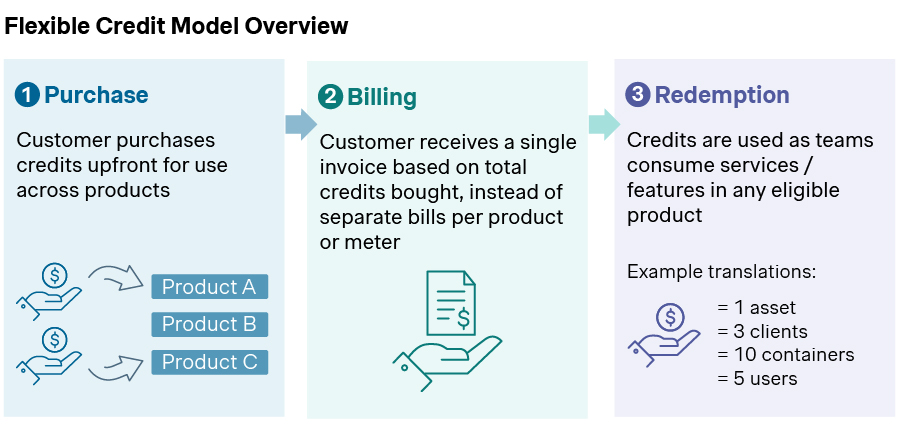
In our software pricing work at Simon-Kucher, this has become the most frequent boardroom question that we’ve heard in the past year. If you run a commercial strategy for a software or AI company, it is no longer a trend to observe from a distance.
The question has moved from whether to respond to when, and in what form.
From seats to credits: a shift in four phases
Let’s have a brief look across the software as a service (SaaS) landscape, where a remarkably consistent pattern emerges:
- 2020–2022: Most B2B SaaS companies sold seat-based or flat-fee subscriptions, calibrated on existing data and expected usage volume. Buyers valued predictability, vendors valued recurring revenue.
- 2023–2024: The most advanced vendors began shipping AI functionality into their products, mostly included at no extra charge. Adoption came first, monetization later.
- 2025–2026: The economics of AI came into sharper focus, from generating returns on AI investments and managing variable costs to reducing dependence on potentially declining seat counts. Shared credit pools appeared, either layered on top of seat licenses or replacing older usage metrics.
- Next phase: Credits tied increasingly to business outcomes, such as resolved tickets or qualified leads, rather than to raw model calls and resources spent. Most vendors are not there yet, but the direction of travel is hard to miss.
The current phase is best understood through the companies driving it, because each moved for a different reason:
- HubSpot layered AI credits on top of its subscriptions rather than replacing them, preserving predictable recurring revenue while letting AI monetization scale with customer usage.
- Lovable moved its agent away from a flat one-credit-per-prompt rate toward complexity-based consumption, because not all prompts cost or deliver the same: “change this button color” is not “create an entire landing page”.
- Synthesia, the British AI video platform, shifted from minutes to credits so that video generation and AI dubbing, which create very different value, no longer share one blunt metric.
- Salesforce moved Agentforce from 2 dollars per conversation toward Flex Credits, after learning that one conversation can land a million-dollar deal or accomplish nothing at all.
- Dust, the Paris-built agent platform, ran two years on a flat per-seat fee with unlimited usage – and switched in mid-2026 to fully credit-metered seats, because agent workloads made usage intensity, not headcount, the real cost driver.
AI investment returns, variable costs, pressure on seat-based revenue models, value variance, and portfolio expansion: different forces, but they lead to the same destination. When companies with such different starting points converge on the same answer, the shift is usually structural rather than temporary.
Tokens versus credits: two currencies, two purposes
Here we have to draw an important distinction, because these terms are often confused. They go hand in hand although they mean different things.
Tokens are a cost currency: an abstraction of the compute, GPU capacity, and memory required to run AI models, packaged into a single consumption metric, much like cloud providers translate underlying infrastructure consumption into standardized billing units. Model providers such as OpenAI, Anthropic, Mistral, or Google then charge software vendors based on token consumption, with costs varying by model and volume processed.
Credits are a monetization currency: the unit a software vendor defines to charge its own customers for the capabilities of its platform.
Tokens measure what intelligence costs you; credits price what your product is worth to customers. The spread between the two is your margin, and much of credit model design is about managing that spread.
Five forces behind the SaaS market shift
Why now? As we observe across our clients’ engagements, five forces are working in the same direction:
- Market education: By pricing their own services in tokens, the LLM providers trained even conservative B2B buyers to accept variable components. Procurement teams that demanded fixed annual budgets three years ago suddenly find themselves negotiating usage corridors.
- Value alignment and easier expansion: On the vendor side, a credit pool lets you ship a new capability into an existing contract instead of a new SKU into a new negotiation, removing the single largest source of friction in account expansion and revenue growth.
- Platform buying: Customers increasingly want end-to-end platforms rather than point solutions, and a single credit pool that spans the portfolio matches how they now prefer to purchase.
- Rising inference costs: As AI adoption scales, vendors consume more tokens across a growing number of use cases, while newer and more advanced models can also require more tokens to complete increasingly complex tasks. Even if competitive pressure continues to reduce the cost per token for established models, growing consumption can still push total AI costs upward. The trajectory of unit costs also remains uncertain, particularly as Chinese models and small language models introduce new competitive dynamics.
- Model providers exercising pricing power: The market for frontier artificial intelligence models has only a handful of suppliers, and it prices accordingly. Flagship tiers launch at a premium – Anthropic's newest model Fable, for example, debuted at double the per-token price of its predecessor – and the terms move on the providers' schedule, not yours: prices, rate limits, and model retirements are set upstream and arrive as facts. Credits give vendors a mechanism to pass part of that volatility through without reopening every contract.
None of these forces looks temporary, which is why we read the shift as structural rather than as another pricing fashion.
When does a credit model fit your business?
Not every product belongs on credits, and not all consumption-based pricing models are credit models. The fastest way to locate the fit is to look at the full spectrum of AI pricing metrics, from cost-centric to value-based.
| Referred to as Access-based pricing | Referred to as Usage-based pricing | Referred to as Outcome-based pricing | ||
|---|---|---|---|---|
| Access Number of users/Agents | Technical Cost to serve | Activities Derivative of resource consumption | Output Derivative of outcomes | Outcomes Customer value & success |
Pricing metrics
| Pricing metrics
| Pricing metrics
| Pricing metrics
| Pricing metrics
|
Examples (AI) Copilot | Examples (AI) AWS | Examples (AI) Clay | Examples (AI) Synthesia | Examples (AI) Intercom |
Relevant if... Augmenting human impact High need for visibility on costs from target customers Need for ‘unlimited’ usage phase to support adoption | Fall-back option if... High variations in costs, putting margin at risk High variability of use cases, making proxys for value impossible to find | Credit Model relevant if... High number of actions / activities of value via AI Heterogeneity of value across actions / activities Compatible with client maturity & budgeting | Relevant if... Outputs clearly defined and tied to tangible value Sufficient value homogeneity across outputs Ability to forecast output volumes | Relevant if... Measurable € value created for customer business Unquestionable attribution Compatible with client budgeting process / visibility |
A deep dive into the pricing spectrum
At one end sits access-based pricing: per user, per agent. It remains the right choice when you need to protect adoption or when your AI augments human work rather than replacing it.
At the other end sits outcome-based pricing, the model everyone talks about: charge only when the product delivers. Intercom's Fin is the reference case, resolving support tickets directly at 99 cents per resolution. Outcome-based pricing is compelling in every sales pitch and rare in practice, because three conditions must hold at once:
- A measurable monetary value per outcome (for Fin, the cost of a human-handled ticket provides a clean proxy)
- Attribution beyond dispute (the customer has to agree that your product, not their team, produced the result)
- Compatibility with the customer's budgeting process. We have seen deals where value and attribution were unambiguous, and the model still failed, because the buyer could not map variable outcome charges onto any budget line they owned.
Between those two ends lies the territory where credits win: activity-based pricing for solutions whose outputs vary too much in value for one flat metric, and whose outcomes are too hard to attribute for outcome pricing.
When do you enter credit territory? Three signals to look out for
Based on the experience from our Simon-Kucher experts, three signals reliably mark the point where you enter credit-pricing territory:
- High value variance across outputs: Picsart illustrates this trend well – removing a background from a product photo and generating a full AI video of a ring worn on a model's hand are both one job for the platform, and worth entirely different amounts to the merchant using them. A credit model can price that difference; a per-job metric cannot.
- A fast innovation cadence across a multi-product portfolio: When new agents and capabilities ship every quarter, monetizing them through the existing credit pool beats creating a new SKU each time.
- Expansion as your primary commercial goal: Credits let customer usage grow over time without contractual friction.
If two of these three sound familiar, the question is less whether a credit model fits than whether you are ready for one. Two conditions decide that. Adoption has to be mature enough that precise monetization will not choke usage; monetizing too exactly too early is how promising AI features die. And your customer base has to be ready for a variable pricing structure.
Our experience across both sides of the Atlantic shows that readiness is unevenly distributed: US buyers are, on the whole, further along than European ones, and the gap runs through professions as well. Digital marketing teams adapt quickly, while segments such as independent healthcare practitioners remain firmly attached to seat-based simplicity. Reading that maturity correctly, market by market, is half the timing decision.
A new pricing model comes with its own risks
The benefits of usage-based pricing are real. So are the risks, and a candid look at them belongs in the decision. We cover them briefly here, and in depth later in the next parts of the series on credit-based pricing models.
Predictability suffers on both sides: Customers lose visibility into future spend, which can slow adoption and complicate renewals. You give up financial control too: forecasting becomes harder for your finance teams when consumption, not commitment, drives the number.
Operational complexity rises: A credit model is usage-based billing at scale. It touches your product telemetry, your billing system, your CRM, and your compensation plans at once. Tracking usage data accurately across systems is a cross-functional build spanning every financial and billing cycle, not a pricing page update.
Transparency becomes existential: Customers who cannot see, in real time, where their credits go will experience the model as a black box, and confidence erodes quickly, taking customer satisfaction with it. Real-time usage dashboards and proactive alerts are the trust infrastructure a credit model runs on.
How will usage-based pricing impact your revenue predictability?
Among the risks outlined above, revenue predictability deserves particular attention. Moving from subscriptions to usage-based pricing changes not only how customers pay, but also how reliably vendors can forecast revenue. In the short term, predictability can decrease. Seat-based subscriptions and classic subscription models are predictable by design: fixed fees, annual contracts, revenue you can plan a year ahead. Usage-based pricing ties revenue to how customers actually use your product or service, which means it moves in both directions – up when adoption grows, down when it stalls.
But predictable revenue is not lost in a credit model; it is re-earned through design. Committed credit packs put a floor under every account. Hybrid structures keep a fixed subscription base and let only the AI component breathe. And usage data itself becomes a forecasting asset: consumption trends are a leading indicator that subscription models never had. In our experience, vendors that design these mechanisms deliberately end up forecasting better than before – because they see revenue moving months before it lands on an invoice.
Should you embrace the credit-based pricing trend? Four key questions
Four questions give you a fast read on whether your company is fit for a credit-based model:
- Value variance: Does the value of your outputs vary widely across business cases?
- Innovation cadence: Do you ship new capabilities faster than your sales team can integrate them into new contracts?
- Buyer readiness: Is your customer base – in the markets that matter to you – ready to accept a variable component?
- Usage visibility: Can you measure and show customer usage today, at the level of detail that a credit model demands?
If you answered “yes” to two or more, a flexible credit model belongs on your commercial agenda.
In our client work across the US and Europe, we see the same pattern: deciding to adopt credits is rarely the hard part. Designing a model that aligns value, protects adoption, and holds up in procurement over the long term is where the real work begins.
Reach out to our Simon-Kucher software pricing strategy experts to discuss what a flexible credit model could look like for your portfolio.
Next in our Simon-Kucher credit-based pricing series: Learn how to structure a credit model – the key questions to answer before you set a single price.