
This is the second article in our series on structured differentiation in retail. In the first article, we introduced three dimensions of commercial optimization: where strategies should differ across stores, how categories should play different commercial roles, and when promotional investments create value. This article takes a closer look at the first dimension: Store Clustering.
Most retailers know that store performance differs across their network. But do they know which differences are structural, which are temporary, and which should lead to different commercial decisions?
Some stores serve high-income customer groups. Others operate in highly competitive areas, smaller catchments or locations with different shopping missions. Yet these differences are not always translated into assortment, pricing, promotion or investment decisions.
Stores are often managed through broad segmentation logic, such as region, format or size. These dimensions are useful, but they do not always explain what makes stores perform differently or what each store type needs commercially.
This creates a clear opportunity: move from broad store management to structured differentiation by store archetype.
From store differences to store archetypes
The key question is not whether stores are different. The key question is which differences matter commercially.
Store Clustering helps retailers answer that question. It groups stores with similar commercial characteristics into a limited number of actionable store archetypes. These archetypes provide a practical basis for tailoring commercial strategies across the network without creating a bespoke strategy for every individual store.
A strong Store Clustering exercise does more than explain performance differences. It identifies structural performance drivers and translates them into commercial decision rules. For example, one store cluster may have strong premium potential and require a broader, higher-end assortment. Another may need sharper entry price points, more traffic-building promotions or a more focused range.
The outcome is a clearer answer to a strategic question many retailers face: which stores should be managed similarly, and which stores require a different commercial approach?
What Store Clustering delivers
Store Clustering creates a fact-based view of the retailer’s network. The output is typically a limited number of distinct store archetypes, each with a clear commercial profile.
For each archetype, retailers can define tailored guidelines for decisions such as:
- assortment breadth and depth;
- premium versus value positioning;
- price point architecture;
- promotional intensity;
- stock and space allocation
This makes store-level differentiation more manageable. Instead of relying on local exceptions or ad hoc adjustments, commercial teams work with a structured framework. Stores within the same archetype follow similar decision rules, while stores in different archetypes are managed according to their specific potential and constraints.
That is where the commercial value lies. Store Clustering is not a reporting exercise. It is a way to make better decisions on where to invest, where to simplify, where to localize and where to protect margin.
Which data is needed?
Store Clustering does not necessarily require complex or hard-to-access data. The critical step is not only bringing the right data together, but interpreting it commercially: which differences between stores are meaningful, which are noise and which should lead to different decisions.
A robust Store Clustering exercise typically starts with internal performance data: sales, baskets, category mix, purchase frequency and other transaction-level indicators. This is combined with store characteristics such as format, size, opening date and location type.
The view can then be enriched with external or manually added data. Relevant examples include local demographics, income levels, population density, urbanity and competitive intensity.
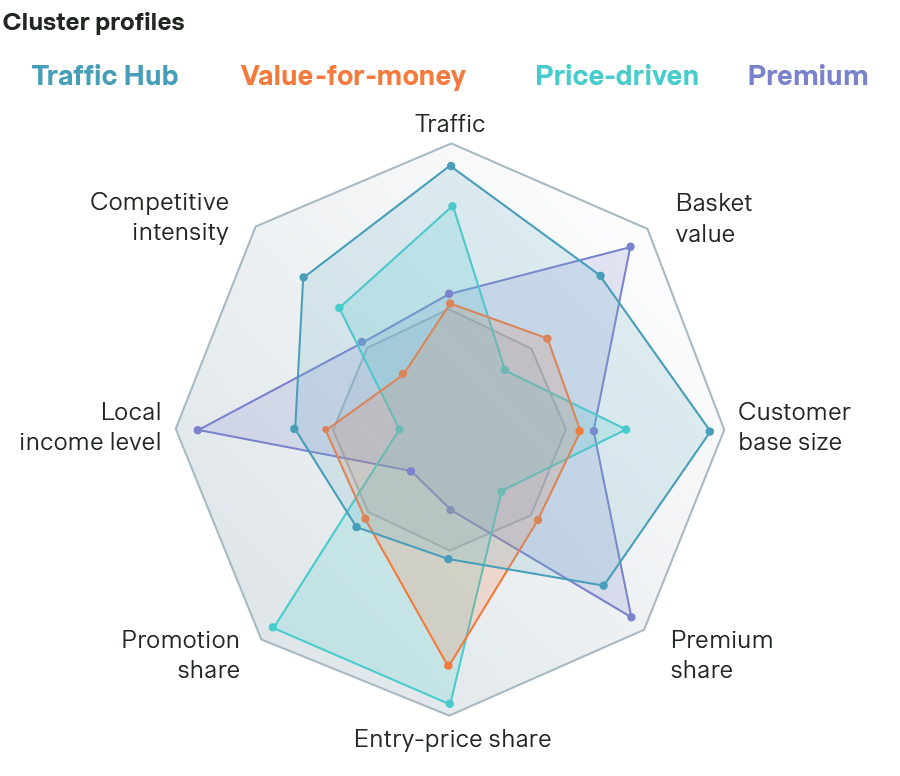
Statistical techniques are used to identify patterns across these variables and group stores into commercially meaningful clusters. The objective is practical: to create store groups that commercial, pricing, category and operations teams can use to make better decisions.
Potential impact
The impact comes from aligning commercial choices with store potential.
A store with strong traffic but low basket value, for example, may benefit from targeted basket-building actions: broader cross-sell categories, stronger impulse placement, bundled offers or promotions designed to increase items per visit. A store with high basket value but limited footfall may require a different playbook: sharper traffic-driving promotions, stronger entry price points, local activation or investment in destination categories that give customers a reason to visit.
When these differences are understood and acted upon, retailers can improve both customer relevance and financial performance. Our project experience shows that localized commercial decisions can increase average basket value by 5–10% and drive up to 4% additional foot traffic.
The benefit is not only financial. Store Clustering also improves decision quality. It gives commercial teams a shared language for discussing store differences and a repeatable framework for translating those differences into concrete actions.
What comes next
Store Clustering answers the first question of structured differentiation: where should commercial strategies differ?
In the next article, we move from how to differentiate to when to differentiate. We will explore how Category Role helps retailers define the strategic purpose of each category and translate that into better decisions on assortment, pricing, promotions and merchandising.
Want to understand which store types deserve a different commercial playbook? Get in touch with our retail experts.