
Throughout 2025, U.S. consumers faced sustained price pressure across everyday categories. Whether driven by tariffs, inflation, supply dynamics, or cost volatility, price increases became a defining feature of the consumer experience, shaping sentiment, value perception, and purchasing behavior.
Drawing on our 2025 U.S. Consumer Tariff Market Study, conducted monthly throughout the year, this article reviews how consumers responded to rising prices in 2025 and what those patterns signal for the next 12 months.
Price awareness remained high, but understanding stayed shallow
Consumers consistently noticed price increases but rarely distinguished between their underlying causes.
Key data points
- Awareness of price increases remained stable and elevated throughout 2025.
- Most consumers associate rising prices with broad cost pressure rather than specific policy or economic mechanisms.
- Only about one-third of consumers report a strong understanding of tariff impact of tariffs.
- The dominant consumer takeaway remained simple: prices are going up, and households are paying for it.
Consumer perception of economic and trade issues associated with tariffs
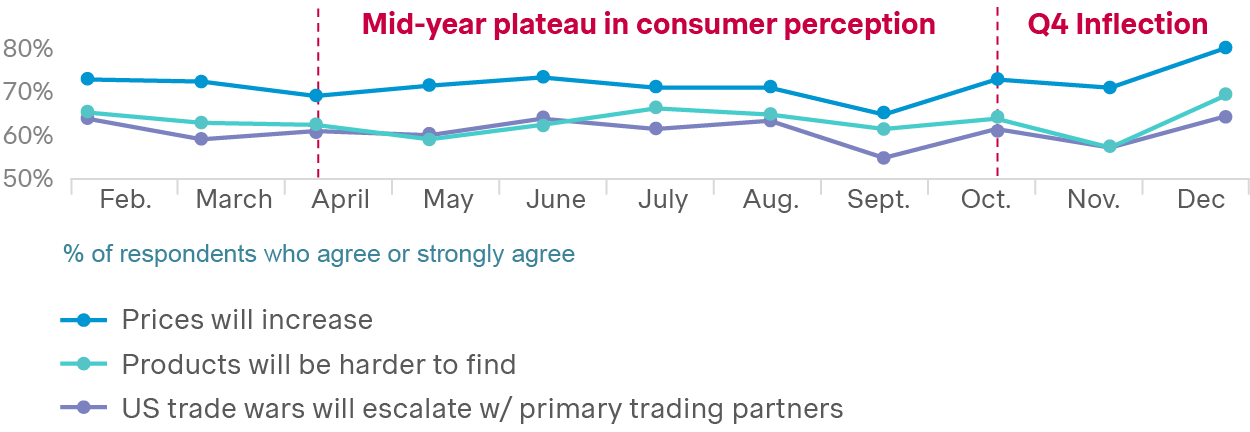
Source: Simon-Kucher 2025 US Consumer Tariff Survey (N=5,054), February-December results aggregated; Q: Who do you think is most impacted by tariffs?
Implications for pricing and commercialization
- Cost-based justifications alone are unlikely to improve acceptance without a clear value story.
Closing thought: For companies, the lesson is simple: if consumers don’t understand the “why,” they default to frustration, making strong value communication more important than ever.
Price anxiety intensified toward year-end
As 2025 progressed, concern about rising prices slowly built, then accelerated in the final months. By Q4, consumers weren’t just noticing increases, they were expecting them. Broader uncertainty about the economy and product availability added to the tension, leaving many households feeling uneasy heading into 2026.
Key data points
- By late 2025, a strong majority expected prices to continue rising.
- Concerns about product availability and broader economic uncertainty increased toward year-end.
- The perception that U.S. consumers bear the greatest burden of rising prices strengthened in Q4.
Implications for pricing and commercialization
- The window for price acceptance narrowed heading into 2026.
- Late-year sentiment signals higher resistance to additional price moves without clear justification.
Closing thought: Cost explanations alone won’t cut it. Price moves now need to be more deliberate, better timed, and anchored in clear, tangible benefits if companies want consumers to stay on board.
Inflation fatigue: Why consumers feel more strained than ever
After several years of sustained pressure, consumers aren’t just adjusting to higher prices, they’re worn down by them. Even modest increases can feel heavier than they are because they layer on top of years of financial strain. For certain groups, especially women, this fatigue is even more pronounced.
Key data points
- 78% of consumers say inflation has impacted them somewhat to overwhelmingly over the past three years.
- Price pressure remained elevated throughout 2025, with no clear signs of relief.
- Women consistently report feeling the squeeze more acutely than men.
Share of consumers perceiving prices as too expensive (past year) by gender
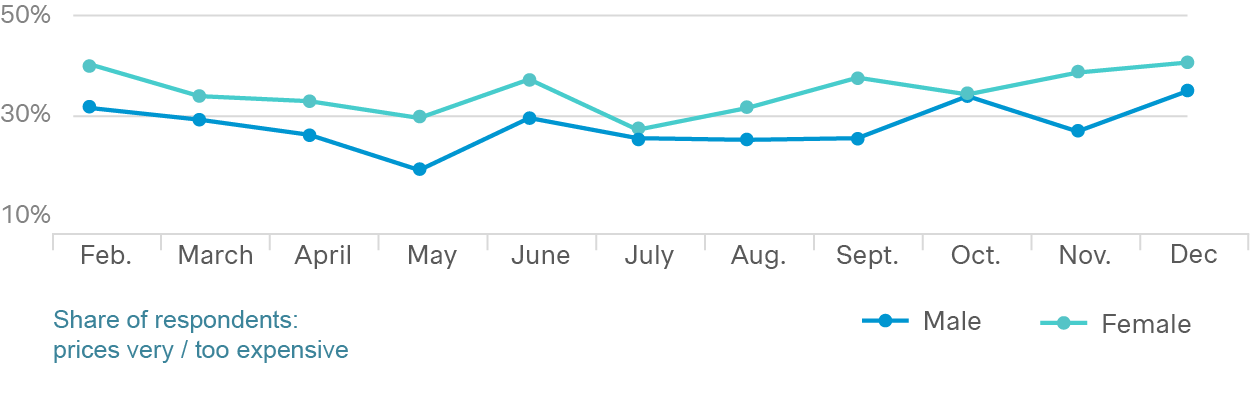
Source: Simon-Kucher 2025 US Consumer Tariff Survey (N=5,054), February-December results aggregated; Q: To what extent have your expenses increased over the past 3 years? Q: How do you feel about current price levels in comparison to the foods you purchase?
Implications for pricing and commercialization
- Even incremental increases can feel cumulative and trigger stronger pushback.
- Improving perceived value and clarity of trade-offs becomes more important than explaining cost drivers.
Perceived value shifted decisively toward essentials
With budgets tightening, consumers have become more deliberate about where they still see value. Core necessities, food, fuel, everyday basics, continue to feel worth the spend, while many discretionary categories are losing momentum. People are prioritizing differently, and the divide between “essential” and “optional” is widening.
Key data points
- Essentials such as food, fuel, and household basics improved or maintained value-for-price perceptions.
- Discretionary and durable categories (e.g., apparel, electronics, home goods) showed declining value momentum.
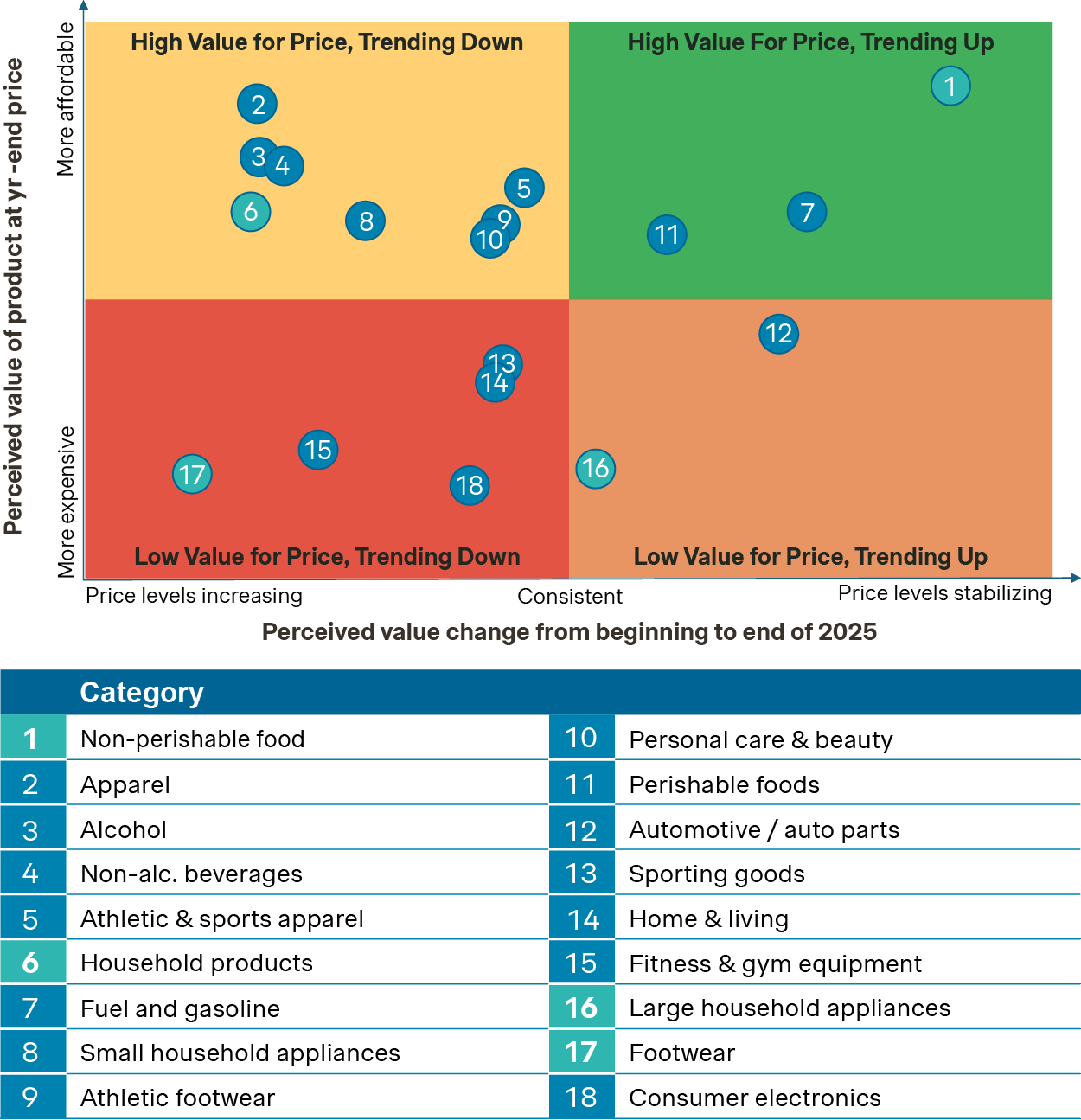
Source: Simon-Kucher 2025 US Consumer Tariff Survey (N=5,054), March-December results; Q: How do feel about current price levels in comparison to the goods you purchase?
Implications for pricing and commercialization
- Pricing power is consolidating, not disappearing.
- Portfolio-wide increases are riskier than targeted actions aligned to category role.
Closing thought: Success will come from doubling down where value is strongest and being precise where sensitivity is rising.
Rising visibility of price increases across key categories
As the year progressed, consumers picked up on more and more price increases across a wider set of categories. What may have gone unnoticed earlier became much more obvious by late summer and fall. With visibility rising, consumers became quicker to question increases and connect them to broader economic pressures.
Key data points
- Visibility peaked in late summer and early fall, marking a clear perception inflection point.
- Consumer electronics stood out, with nearly 60% of consumers noticing increases by year-end.
- Food, apparel, and home essentials also showed rising visibility across the year.
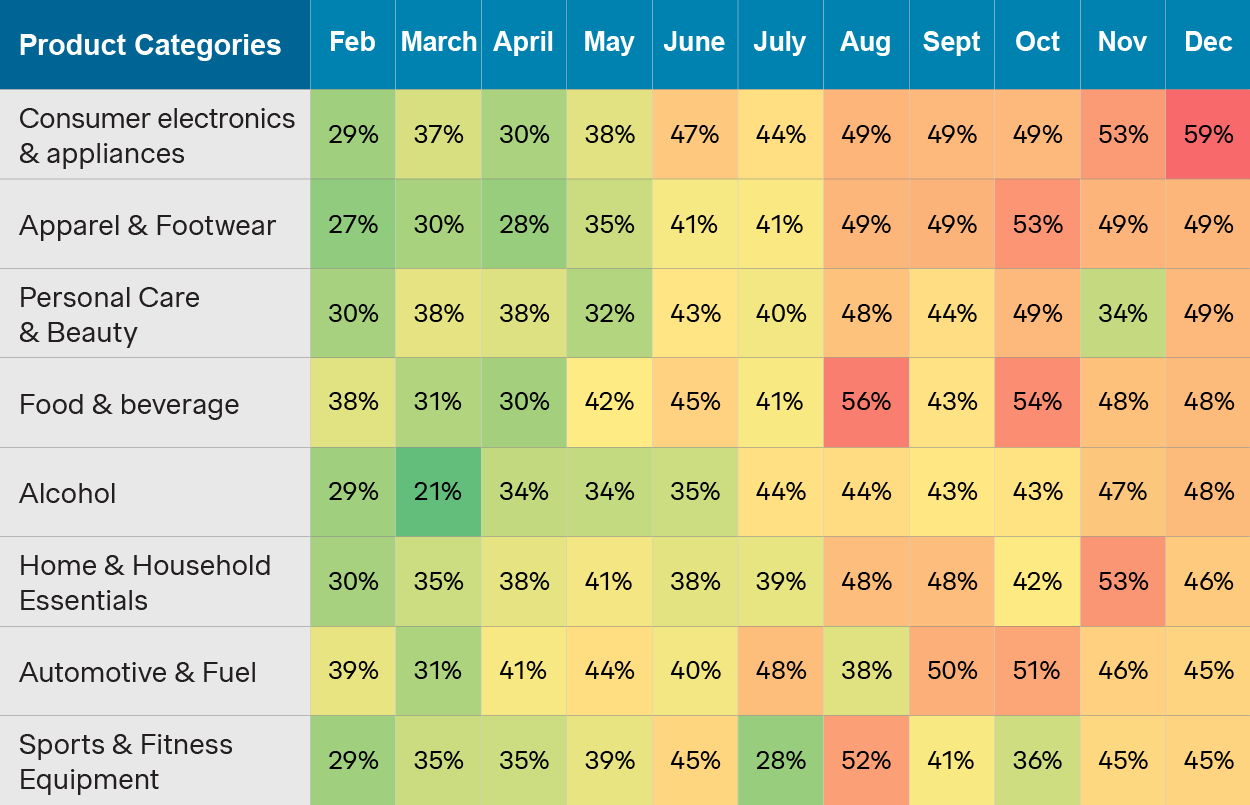
Source: Simon-Kucher 2025 US Consumer Tariff Survey (N=5,054), March-December results; Q: Have you noticed an increase in prices for any of these categories that you believe could be related to tariffs?
Implications for pricing and commercialization
- Quiet price increases are harder to execute and easier to attribute to external drivers.
- Communication and adjustments to portfolio architecture (pack-price, thresholds, guardrails) become critical.
Closing thought: The more visible the increase, the more important it is to pair it with thoughtful design and communication.
Price increase tolerance is highly category-specific
Not all price increases trigger the same response as consumer behavior breaks at different thresholds.
Key data points
- At 5% increases, most categories see limited behavioral change.
- At 10% increases, demand drop-off accelerates in discretionary categories.
- At 20% increases, up to ~30% of consumers stop buying in non-essential categories.
- Food and fuel remain the most price-resilient categories, even at higher increases.
Implications for pricing and commercialization
- Consumer response is non-linear; threshold discipline matters (especially beyond the 10% mark).
- Category-specific playbooks outperform broad pass-through approaches.
Closing thought: Companies that respect category thresholds, and price accordingly, will protect both margin and loyalty.
Looking ahead: What to expect over the next 12 months
Based on 2025 patterns, we expect continued price sensitivity, uneven tolerance, and sharper consumer scrutiny in the year ahead. Furthermore, tariff-driven price risk is likely to stay uneven, and harder to pin down. Recent legal developments underscored that some “emergency”-based tariff actions can be challenged and curtailed, which could quickly change the assumed baseline for duties and landed costs.
12-month outlook
- Price sensitivity will remain elevated, particularly for discretionary and durable goods.
- Tariff-related cost assumptions may shift abruptly, causing increased uncertainty and volatility.
- Acceptance windows will narrow, requiring more precise timing and sequencing of price actions.
- Consumers will increasingly evaluate value, not just price, rewarding clear trade-offs.
- Price increases will face higher visibility and faster backlash if misaligned with perceived value.
What leading companies should do now
In an environment of sustained price pressure, winning companies are moving from broad cost pass-through to targeted, value-led pricing strategies.
Recommended actions
- Segment pricing actions by category role and price tolerance.
- Use threshold-based increases rather than uniform hikes across the portfolio.
- Protect price image on hero SKUs while rebalancing margins on the long tail.
- Pair increases with clear, credible value communication (not only cost explanation).
- Prepare for pricing sensitivity and underlying cost/tariff changes through scenario planning and guardrails.
We’ll keep tracking these trends and share quarterly insights as they evolve. The takeaway is clear: smart, value-led pricing will matter more than ever in 2026.
Please reach out if you’d like support translating these insights into concrete pricing actions.
Contributing author: Julia Hines