
2025 was the breakout year for AI. Rising confidence unlocked investments into AI infrastructure and AI-native companies. With notable examples such as Lovable, Perplexity and Cursor that turned product momentum into commercial traction. Our latest software study confirms that this momentum is durable. Nearly three quarters of buyers plan to adopt AI, and budgets are rising, with spending expected to increase by up to 9% over the next two years.
Yet the market is already diverging sharply. A small group of AI leaders is winning big, scaling faster, and capturing outsized value. At the same time, a much larger group is struggling to translate AI ambition into sustained commercial success. Numbers show that venture capital is back to 2021 levels, but 50% of that funding is going to only 4 deals.
This gap is not driven by technology alone. As AI capabilities become more accessible and customer expectations rise, companies must go beyond marginally improving their existing product and build a solution that dramatically impacts companies’ operations. These are the real winners as they have access to company budgets that are 10x-100x larger than traditional software companies.
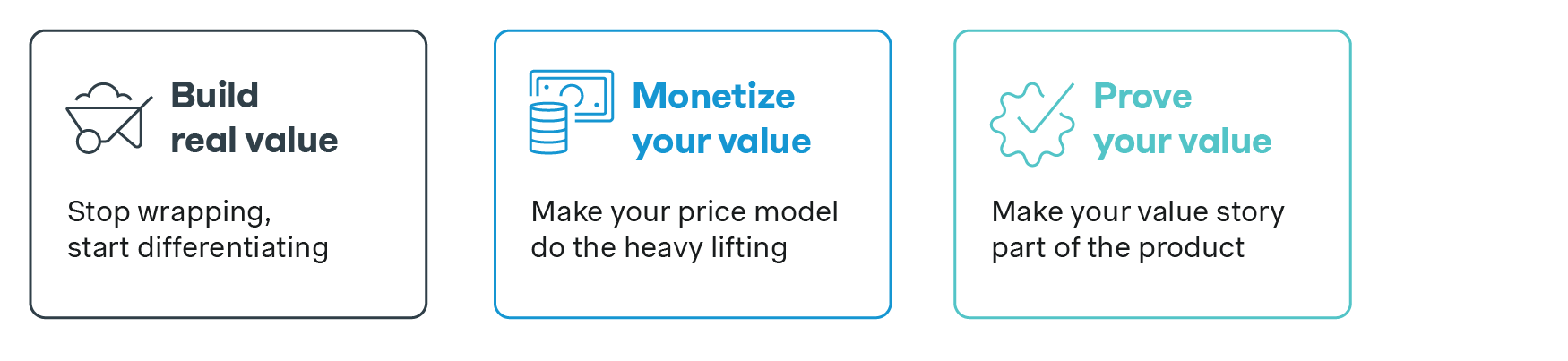
This article outlines three commercial focus areas that define how to win with AI in 2026. Because what ultimately separates the winners is commercial execution: how clearly value is built, monetized and proven.
How to become an AI winner in 2026
1. Build real value: stop wrapping, start differentiating
ChatGPT wrapped products may demo well, but they rarely become mission critical, are easy to replicate and harder to differentiate. According to our global software study, top software executives are not worried about “how do we build with AI,” but “how do we defend against AI-driven disruption”. The best answer is to build value that is hard to replace.
First, you need to tailor your solution. Buyers are no longer looking for generic intelligence added onto their stack. They want AI that understands their industry, their workflows, and their constraints. Vertical AI solutions such as Harvey, a legal AI assisting lawyers in their day-to-day work, illustrate how focused specialization translates into commercial traction.
Second, AI must move beyond assistance to automation. When AI agents begin completing work, resolving issues and running processes, they move from novelty to necessity. Combined with sector intelligence is what turns an agent from “occasionally useful” into “consistently trusted.”
In practice, leading players developing Agentic AI solutions are already differentiating along these new AI value drivers with security emerging as a critical third dimension. Perplexity is pushing agent-based automation, Sintra focuses on vertical specialization, and Anthropic emphasizes enterprise-grade security. As AI moves from augmentation to automation, value-based differentiation (not features) determines the winners.
2. Monetize your value: make your price model do the heavy lifting
Companies are racing to launch AI features. Results from our software study show that 96% of companies are planning to launch new AI features in the next 2 years. Yet for most, revenue impact remains modest, typically below 10%.
This is because many companies are still unsure on how to package and monetize their added value. The 2025 software study shows that AI monetization remains fragmented. With companies often combining AI within premium tiers while also offering it as a standalone add-on. For Agentic AI providers this struggle runs even deeper, with three out of four providers unsure how to price their solution at all, according to plaid.ai. Unsurprisingly, pricing was highlighted as one of the biggest frustrations for software buyers especially when it’s unclear, unpredictable, or too rigid.
In 2026, packaging and pricing your AI will require a break from traditional software monetization. We expect AI to become more embedded into standard product packages rather than sold as separate offerings. Usage-based pricing is becoming the default pricing for these packages, since traditional metrics like seats and licenses break down as soon as AI starts replacing work. We see many companies struggle to implement usage-based models effectively. Getting it right requires coordination across multiple departments. However, when well designed, it aligns pricing with value and drives NRR growth as usage scales. For companies not yet ready to make a full shift, hybrid models that combine a base license with a usage-based component offer a pragmatic intermediate solution.
And the next frontier is already clear: outcome-based pricing, where customers are charged for success, not activity. Buyers are already signaling this shift in our study with 86% preferring usage or outcome-based pricing models. Examples such as Intercom’s Fin show how customers can be charged per successfully resolved support ticket. At the same time, outcome-based pricing comes with its challenges. Only a limited set of use cases are truly suited for this model, and providers must price outcomes they can directly influence. When this alignment is missing, margins erode quickly, and customer relationships suffer. But when done right your pricing model becomes a growth engine rather than a constraint.
3. Prove your value: make your value story part of the product
As AI capabilities are normalizing, proof of impact becomes an important differentiator. Study results shows that nearly a third of buyers cite unclear business impact as their top concern when adopting AI. Simply labeling a feature as AI-powered is no longer enough.
Leading companies treat the value story as part of the product itself. They translate AI capabilities into measurable outcomes e.g., time saved, quality improved, or risk reduced, and make that impact visible. To drive adoption, you should translate your added benefit in a compelling value story.
An exemplary case comes from 11x, which positioned its AI agents as digital employees complete with roles, responsibilities, and expected economic impact. Similarly, in our work for a unicorn tech company we found 40% additional willingness-to-pay from an improved value story powered by AI. By clearly proving your value to your buyer investment decisions are easier to make and AI providers can capitalize on their potential delivered.
A promising year ahead
Winning in AI in 2026 will come down to three capabilities: building differentiated value through vertical specialization or automation; monetizing your innovations with usage-based or hybrid pricing models; proving tangible business impact. This year, we are excited to dive deeper into these must-wins in upcoming articles, with practical guidance for SaaS executives.
And for those looking to connect with the brightest minds in tech, our 10th anniversary Tech Summit in June will be a highlight of the year; a space to share ideas, spark innovation, and shape the future of AI.
The authors wish to thank Isabelle van Keulen (Senior Manager) and Seeger van Hengel (Senior Consultant) for his contribution to this article.