
As customer expectations rise and route-to-market models become more complex, consumer businesses need to make better decisions about channels, partners, and service models. Route to market helps organizations design the most effective and profitable way to reach customers, improving commercial execution while balancing growth, cost-to-serve, and profitability.
Why route to market has become more challenging
Getting products to market has never been more complex. Consumer businesses are navigating more channels, more customer types, more partners, and more shopping occasions than ever before, while having to balance rising service costs with growing expectations for seamless customer experiences. What was once a relatively stable distribution model now demands constant refinement as customer needs, channel dynamics, and partner ecosystems continue to evolve.
Today's leaders face difficult decisions.
Should growth come through direct sales, distributors, marketplaces, or hybrid models? Which customers and channels warrant greater investment? Where is cost-to-serve eroding profitability? And how can organizations maintain consistent execution across increasingly complex partner networks?
These questions have become more pressing as consumer expectations continue to evolve. Shoppers expect the right product, in the right format, at the right location, and for the right occasion. Whether buying a fizzy drink from a convenience store, ordering one through an e-commerce platform, or purchasing in bulk from a wholesale club, they expect products to be available when and where they need them. If they are not, they are likely to buy a competitor's brand instead.
At the same time, route-to-market ecosystems have become more intricate. Many manufacturers depend on distributors, wholesalers, retailers, brokers, service partners, and digital platforms to reach customers. Every additional intermediary adds complexity, increases cost-to-serve, and creates more opportunities for inconsistent execution and value leakage.
As the fourth pillar of the End-to-End Commercial Excellence framework, route to market helps organizations determine the most effective, efficient, and profitable way to reach customers. Rather than treating distribution as an operational challenge alone, it focuses on the commercial decisions that shape channel strategy, partner performance, customer reach, and ultimately, profitable growth.
The 7 levers of End-to-End Commercial Excellence
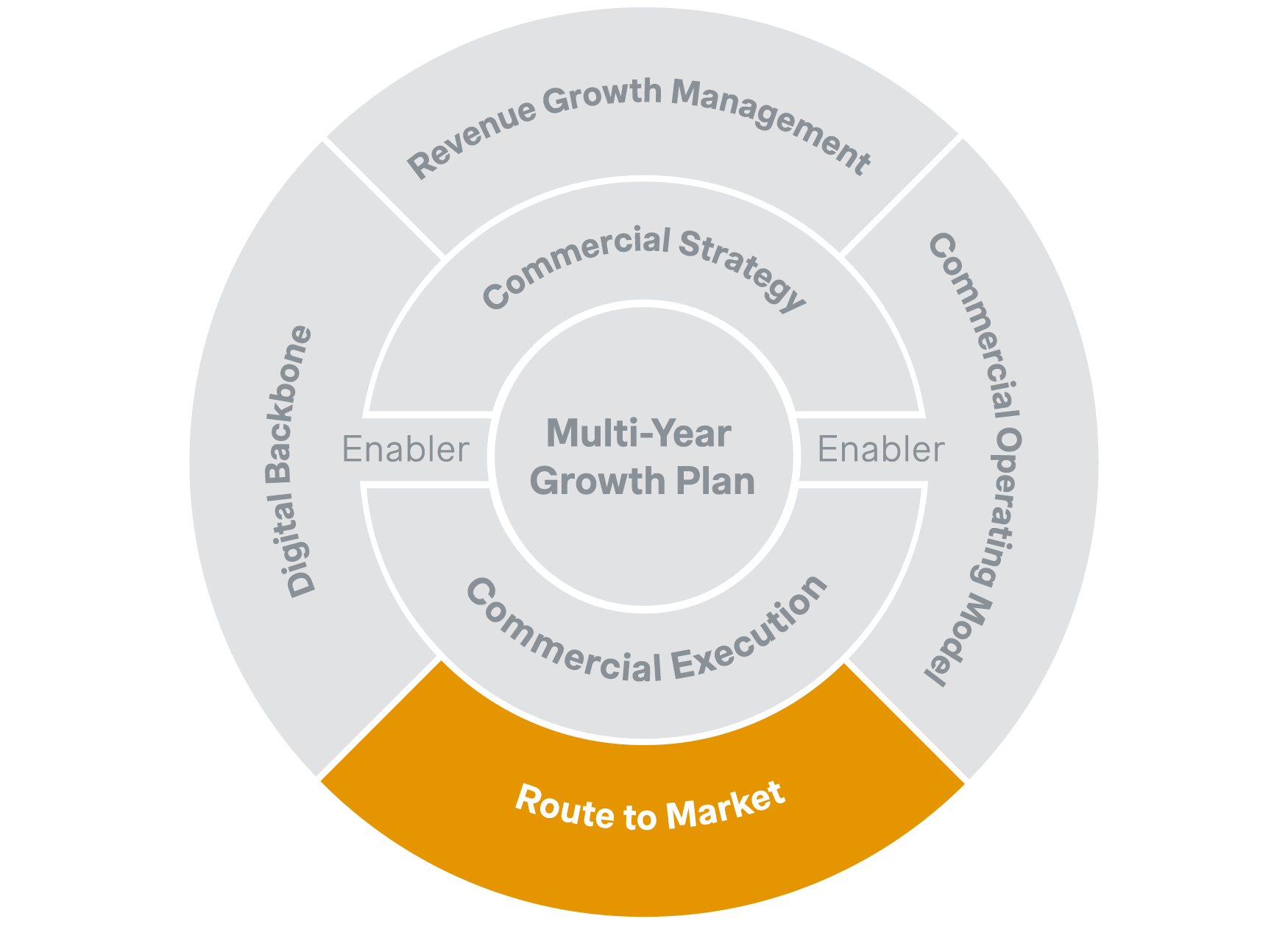
Source: Simon Kucher
Building a route to market that delivers profitable growth
An effective route-to-market strategy aligns commercial ambition with the realities of customer demand, channel dynamics, and execution capability. It helps organizations reach customers more effectively while balancing growth, service, and profitability. Four connected capabilities underpin a successful route-to-market model:
Every route-to-market strategy begins with one fundamental decision: how products should reach customers.
Different customer segments, channels, and markets require different approaches. Direct sales can strengthen customer relationships and improve control, while distributors and strategic partners often provide broader market coverage and greater scalability. Digital commerce adds further opportunities, complementing traditional sales models rather than replacing them.
The objective is not to identify a single route to market. It’s to build the right mix of channels, balancing customer reach with commercial effectiveness, cost-to-serve, and long-term profitability.
Few consumer businesses go to market alone. Success depends on strong relationships with distributors, retailers, wholesalers, brokers, service providers, and other commercial partners.
Effective route-to-market models establish clear governance, aligned priorities, and shared performance expectations across the partner network. This helps organizations understand where execution supports commercial objectives and where improvements are needed.
Better access to distributor data, retailer insights, and advanced analytics also gives leaders a clearer view of market performance. Instead of relying on limited visibility, they can identify execution gaps earlier and make more informed decisions across increasingly complex partner networks.
Growth should never come at the expense of profitability.
Many organizations underestimate the true cost of serving different customers and channels. Transport, merchandising, account management, technical support, field service, and logistics all shape the economics of a successful route-to-market model.
A structured cost-to-serve assessment provides a clearer understanding of commercial profitability across the customer base. Instead of applying the same service model everywhere, organizations can align investment with customer value, adapt service levels where appropriate, and improve commercial efficiency without compromising the customer experience.
The strongest route-to-market strategy only delivers results if it is executed consistently in the market.
This requires coordinated decisions across assortment, merchandising, pricing, promotions, and retail activation, as well as a clear understanding of which customers, stores, and outlets warrant the greatest commercial focus.
With richer data and AI analytics, organizations can monitor execution across thousands of outlets, identify gaps more quickly, and continually refine commercial priorities. This allows leaders to replace broad assumptions with more targeted decisions that strengthen both growth and profitability.
The Simon-Kucher advantage
Effective route-to-market design delivers far more than just efficient product distribution. At Simon-Kucher, we help organizations build commercial models that support sustainable growth while adapting to changing customer needs, channel dynamics, and evolving market conditions.
By combining deep commercial expertise, proven methodologies, and data-driven analysis, we help businesses expand channel coverage, improve customer experience, and direct commercial investment where it will generate the greatest return. Our approach also provides greater visibility into partner performance and cost-to-serve, enabling leadership teams to make better decisions about where to invest, where to simplify, and where to adapt their route-to-market model.
Most importantly, we recognize that route-to-market decisions cannot be made in isolation. Our recommendations align route-to-market design with broader commercial priorities, from commercial strategy and pricing to account management, promotions, and execution in the field. The result is an integrated route-to-market model that strengthens commercial execution, improves profitability, and gives organizations the confidence to capture growth opportunities more effectively.
Ready to redesign your route to market?
A well-designed route-to-market strategy helps organizations reach customers more effectively, strengthen channel performance, and improve profitable growth. Discover how the right route-to-market model can help your business optimize commercial investment, improve execution, and build a stronger foundation for long-term success.
If you're interested in further discussion, reach out to us today: Contact us