
Commercial strategies succeed when every function works toward the same objectives. A commercial operating model aligns people, processes, governance, and decision making across the organization, enabling leadership teams to improve collaboration, accelerate execution, and scale Commercial Excellence with confidence.
How organizations turn strategy into execution
Consumer organizations face growing commercial complexity. New channels, evolving customer expectations, and larger volumes of commercial data require faster decisions and closer collaboration across sales, marketing, finance, supply chain, and other commercial functions. Yet many organizations continue to rely on operating models that have evolved gradually over time, creating overlapping responsibilities, disconnected processes, and inconsistent ways of working.
These challenges reduce organizational agility. Teams often work toward different priorities, similar activities are completed by multiple functions, and decisions take longer than they should because responsibilities and governance are unclear. As organizations expand across markets and customer segments, balancing global consistency with local flexibility becomes even more difficult.
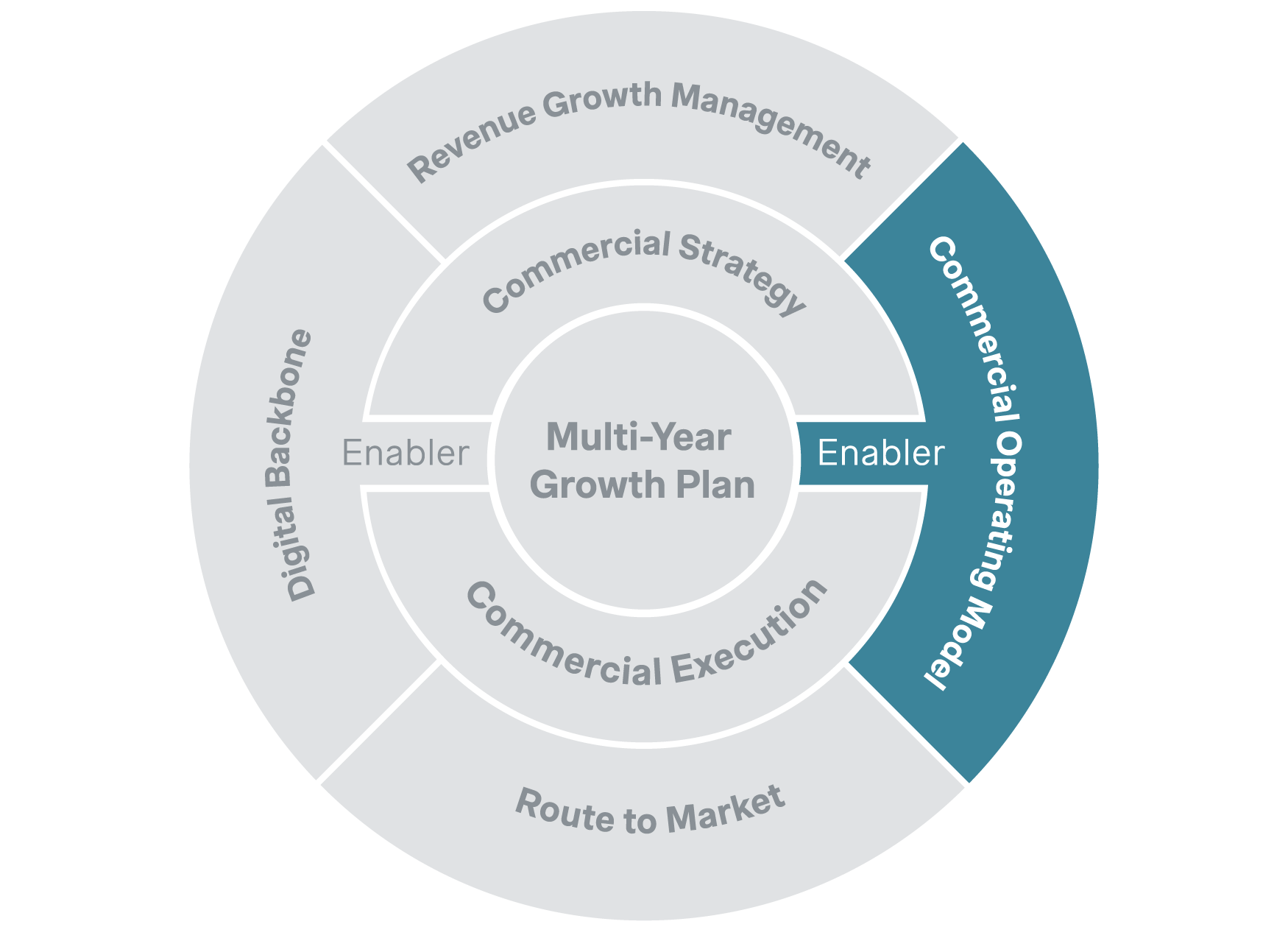
As an enabling pillar of the End-to-End Commercial Excellence framework, the commercial operating model connects every commercial capability. It defines how people work together, how decisions are made, and how commercial priorities are translated into consistent execution across the organization.
The 7 levers of End-to-End Commercial Excellence
Source: Simon Kucher
Building a commercial operating model that delivers results
An effective commercial operating model is built around clear accountability, efficient cross-functional processes, and governance that supports commercial priorities. Four capabilities create the organizational foundation for long-term success:
Commercial performance depends on coordinated execution across multiple functions.
Activities such as forecasting, budgeting, demand planning, and sales planning require contributions from teams across the organization. A strong operating model defines responsibilities, clarifies how information moves between functions, and establishes efficient processes that reduce duplication while improving collaboration.
The result is a more connected organization where commercial priorities are translated into coordinated action.
Organizations make better decisions when ownership is clearly defined.
As businesses grow, decisions are often shared across global, regional, and local teams. Without clear governance, responsibilities overlap, decisions slow down, and different parts of the business begin working toward competing priorities.
A well-designed commercial operating model establishes clear decision rights, governance structures, and ownership models. Leadership teams gain greater transparency into who is accountable, how decisions are made, and how commercial objectives are consistently delivered across markets.
Operating models should evolve alongside the business.
Many organizations continue to add teams, processes, and responsibilities without reviewing whether existing ways of working remain effective. Over time, this creates unnecessary complexity and reduces organizational efficiency.
A structured review identifies opportunities to simplify processes, improve coordination, and remove duplication. This enables leadership teams to respond more quickly to changing market conditions while creating an operating model that supports future growth across multiple markets and business units.
New ways of working only deliver value when they become part of everyday operations.
Successful operating models define clear responsibilities, equip people with the skills they need, and reinforce new ways of working through governance and incentives. Regular communication and shared performance measures help embed these changes across the business.
The result is an organization where improvements become part of day-to-day operations and continue to deliver value over time.
The Simon-Kucher advantage
A commercial operating model delivers value when it strengthens commercial performance, not simply because organizational structures have changed. At Simon-Kucher, we help leadership teams design operating models that directly support commercial strategy and business objectives.
Our approach starts with commercial priorities. We first build a clear understanding of how the organization works today by examining cross-functional processes, governance, decision making, and organizational responsibilities. This creates the foundation for an operating model aligned with the way the business needs to compete. We then use benchmarking, stakeholder interviews, and maturity assessments to identify capability gaps and develop a practical roadmap that balances quick wins with longer-term transformation.
Unlike broader organization design consultancies, we specialize in commercial organizations. Every recommendation is connected to the wider Commercial Excellence agenda, from growth strategy and pricing to revenue growth management, route to market, and commercial execution.
By combining deep commercial expertise with proven organizational methods, we help businesses create operating models that improve collaboration, strengthen accountability, and support sustainable growth.
Ready to strengthen your commercial operating model?
An effective commercial operating model helps organizations make faster decisions, improve collaboration, and execute commercial priorities more consistently. Discover how the right combination of governance, processes, capabilities, and ways of working can strengthen every element of Commercial Excellence.
If you're interested in further discussion, reach out to us today: Contact us