
For software companies, profitable growth increasingly depends on what happens after the initial sale. While new customer acquisition remains important, a significant share of sustainable growth lies within the existing customer base; Net Revenue Retention (NRR) captures how effectively companies retain and expand that revenue over time. Improving NRR therefore depends on how well companies manage customer value across the entire lifecycle: identifying churn risks and expansion opportunities early, prioritizing the right accounts, and acting before value is lost.
Proactive customer base management is becoming an even more important management priority as many software companies face pressure on retention and expansion performance, net revenue retention has declined 10-20pp across segments since 2022. At the same time, the shift toward hybrid and usage-based pricing is making customer revenue more dynamic: declining usage can translate directly into revenue contraction, while growing adoption can create expansion opportunities throughout the contract lifecycle.
Economics reinforce the case for action. Acquiring €1 of ARR costs approximately €1.80, while expanding an existing customer by €1 of ARR costs approximately €0.90. Strong NRR is also closely linked to higher valuation outcomes. Yet many software companies still focus retention efforts on renewal or cancellation, when it may already be too late to influence the outcome.
This article shows how software companies can improve NRR by shifting from reactive retention management to proactive customer base management.
Why NRR must be managed way before the contract is signed
Effective NRR starts before the contract is signed. Strong customer retention begins with acquiring the right customers: a company that sells into a weak-fit segment may show attractive new ARR in the short term, but the customer base can become expensive to serve and hard to expand. The ideal customer profile should therefore reflect the right use case, company size, maturity level, implementation readiness, and willingness to adopt.
Onboarding is the next critical point. In many software businesses, early usage patterns are a strong signal of future retention: customers that fail to activate, integrate, train users, or reach first value quickly are more likely to question the investment later. Onboarding should therefore be treated as the first key opportunity to prove value.
Proactive customer base management: Monitor → Prioritize → Act
Once customers are live, continuous customer experience monitoring becomes critical. Software companies should understand whether customers are extracting value from the full breadth of the solution or experiencing friction. Lagging indicators such as renewal outcomes, churn reports, or periodic NPS surveys can be useful, but they are often too slow for intervention. Leading indicators such as product usage, login frequency, feature adoption, and support ticket volume are more actionable before the customer is considering churn. Under hybrid and usage-based pricing models, this becomes even more important: changes in customer usage can translate directly into revenue contraction or expansion during the contract period, well before renewal.
As AI will automate parts of onboarding and monitoring, Customer Success is moving closer to the moments that drive usage and revenue, making clear ownership, usage visibility and Sales-Customer Success coordination increasingly critical.
Turning customer signals into stronger NRR requires a repeatable commercial system. Proactive customer base management rests on three levers. Firstly, data monitoring that detects both upsell or cross-sell opportunities and churn risk. Secondly, segmentation and prioritization based on current and potential future value. Thirdly, targeted actions that match the signal and the commercial objective.
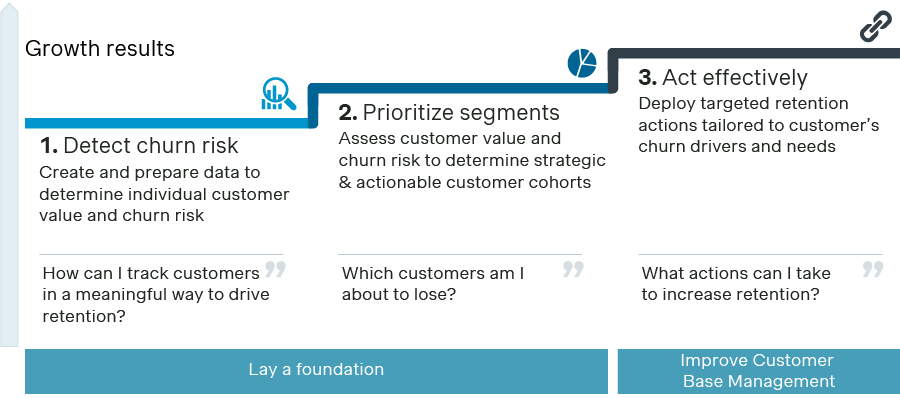
1. Monitor risk and opportunity
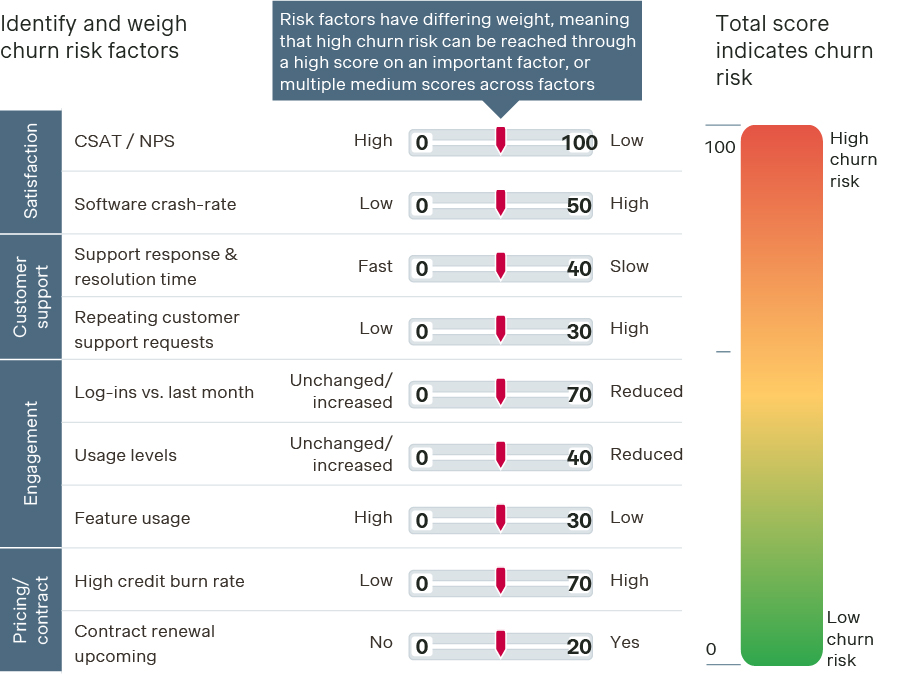
Customer-base monitoring starts with visibility at the individual customer level to identify account-specific risk or opportunity. The relevant indicators differ by company, but most indicators fall into four broad buckets:
• Satisfaction indicators: NPS, CSAT, survey feedback, customer sentiment, executive sponsor feedback, qualitative customer comments
• Support interaction indicators: number of tickets, ticket severity, unresolved issues, escalation frequency, resolution time, repeat issues
• Engagement indicators: product usage, login frequency, feature adoption, seat utilization, integration usage, active-user trends, decline in usage depth
• Pricing and contract indicators: discount pressure, payment delays, downgrade requests, license utilization, upcoming renewal complexity, procurement friction
Some signals are strong standalone indicators: a severe unresolved technical issue with a high-value customer may require immediate intervention, while a formal downgrade request is a clear commercial sign. Other indicators only become meaningful in combination. For example, high usage of advanced features combined with fully used seats may indicate an upsell or seat-expansion opportunity, while declining usage combined with increasing support tickets may indicate churn risk.
For software companies with usage-based or hybrid pricing, engagement signals can have an even more direct commercial impact. Changes in consumption may affect current revenue as well as signal future churn or expansion, making usage monitoring relevant for both downside protection and growth.
The objective is to translate these indicators into two actionable outputs for each customer: an opportunity score and a churn-risk score. The opportunity score estimates the likelihood and magnitude of expansion; the churn-risk score estimates the likelihood and severity of revenue loss. These scores do not need to be perfect to be useful. In most software companies, a pragmatic scoring model based on available data and expert judgment is a strong starting point and can be refined over time using actual renewal, downgrade, expansion, and churn outcomes.
2. Prioritize accounts based on value at stake
Once risk and opportunity are visible, the next question is where to act. Not every customer should receive the same level of attention. A common mistake is to treat customer experience management as a universal service standard rather than commercial resource allocation. Retention and expansion resources are limited, so software companies need to focus where intervention creates the highest return.
Customer value is not only defined by current ARR. Relevant dimensions may include gross margin, growth potential, license type, strategic importance, product fit, reference potential, and cost to serve. A customer with modest current revenue but strong enterprise expansion potential may deserve more attention than a larger but structurally limited account.
High-value customers should receive proactive and tailored attention, including executive engagement, proactive commercial reviews, and coordinated support from Customer Success, Sales, and Product. Lower-value customers may need to be managed through more scalable motions such as digital adoption campaigns, self-service training, structured renewal communications, or pooled Customer Success coverage. By segmenting customers into high and low value, retention costs can be matched to the economic value at stake.
This also means that some customers may not justify retention efforts. If an account is structurally unprofitable, consistently poor-fit, consumes disproportionate support resources, and has limited expansion potential, selective non-retention may be the right commercial decision. Ultimately, NRR improvement is about building a healthier and more valuable customer base.
A simple prioritization matrix can help:
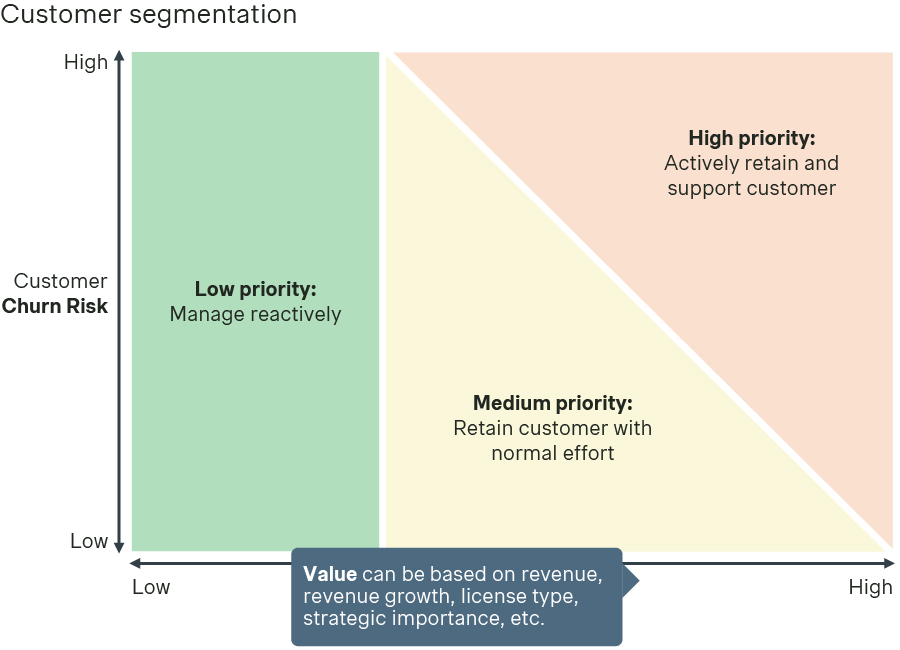 This prioritization matrix gives commercial teams a practical way to focus scarce resources where they matter most.
3. Act with targeted interventions
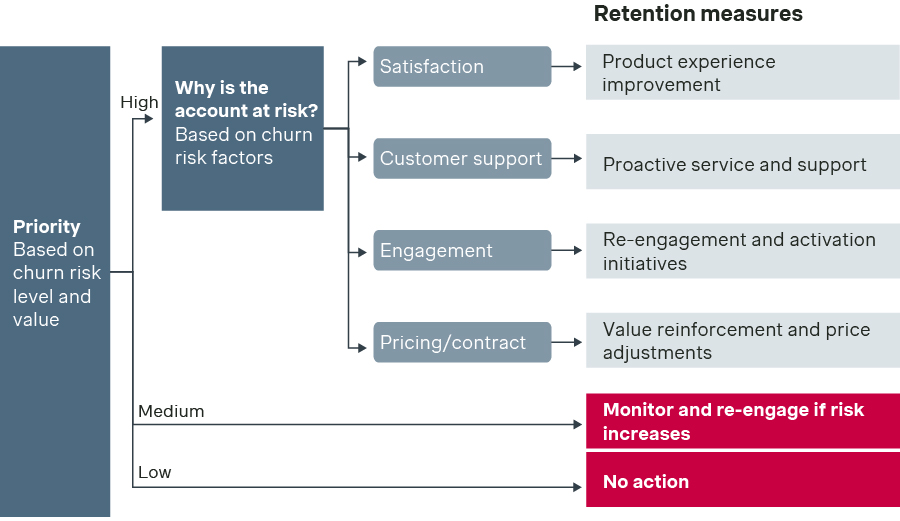
Prioritization only creates value if it leads to the right action. The most effective software companies connect each intervention to the specific signal that triggered it and the value at stake. They do not respond to every risk with a discount, every usage decline with a generic training email, or every expansion opportunity with a sales pitch.
• When satisfaction issues are the primary signal, the right response may include product experience improvements, executive check-ins, roadmap clarification, and structured customer feedback loops. The goal is to rebuild confidence and show that the company understands the customer’s priorities.
• When support issues drive risk, the response should focus on service recovery, such as prioritized issue resolution, technical success support, root-cause analysis, escalation management, or changes to the support process. A commercial concession rarely solves a technical problem in the long term.
• When engagement issues appear, the intervention should focus on adoption. Reactivation campaigns, training, onboarding refreshes, feature education, workflow reviews, and adoption playbooks can help customers return to product usage and extract value from the solution.
• When pricing or contract issues emerge, the response should start with value reinforcement. software companies should link product value to desired business outcomes, clarify the value delivered, review packaging fit, and address metric misalignment where needed. Temporary commercial flexibility should not be the default retention tool, although sometimes it may be justified for a high-value account.
Software companies should start with low-cost actions, such as better value communication, targeted training, improved adoption guidance, or executive engagement. More expensive actions, such as deep technical support, bespoke product commitments, or commercial concessions, should be used selectively. They may be appropriate for high-value accounts with strong strategic fit, but they can destroy margin and set poor commercial precedents if used broadly.
Growth management also needs to be signal based. Cross-sell opportunities may emerge when a customer expands into adjacent workflows. Upsell opportunities may appear when utilization crosses defined thresholds. Seat expansion may be appropriate when adoption is high and user groups are growing. Premium package migration may be justified when customers are already using or requesting advanced capabilities. Broader contract expansion may be appropriate when business outcomes clearly support a wider deployment.
Best-in-class software companies act when churn risk increases or expansion signals become visible; they do not wait for fixed renewal or QBR moments. The timing of the intervention should primarily be determined by customer behavior.
From reactive retention to proactive customer growth
Improving NRR requires software companies to move from reactive retention to proactive customer growth. Renewal management remains important, but it is too late to be the primary control point: by the time a customer reaches the renewal discussion, many of the most important value perceptions and revenue movements have already been formed.
A structured customer base management system continuously monitors customer signals, prioritizes customers based on value, and triggers targeted retention and growth measures. It also includes a new role for customer success to ensure adoption and usage, as usage or outcome-based monetization models are expected to grow by 20-40pp within the next 24 months. Software companies that win on NRR are the ones that see risk and opportunity early, allocate commercial resources where they matter most, and act before value is lost.