
Most Business Services firms have an AI strategy. Very few have AI applications that pay back. In part two of our Services-as-Software series, we look at three high-value use cases that AI Front Runners are already deploying – led by contract intelligence – and what it takes to turn them into commercial reality.
Most Business Services firms have an AI strategy. Very few have AI applications that pay back. Across the industry, 90% of firms are AI-active or want to start within the next 12 months. The strategic conviction is there. What still remains unanswered is the practical question:
- Where exactly does AI deliver measurable commercial value?
- What does it take to get there?
Both halves of that question matter equally. The first determines which AI investments are worth making. The second determines whether they actually deliver.
Part one of this series argued that the commercial logic of Business Services is shifting from service-led to software-like – services as software (SaS). Behind that commercial shift sits a technical reality: Front Runners – 18% of firms that are six times more confident in their growth targets – are not just thinking differently about pricing.
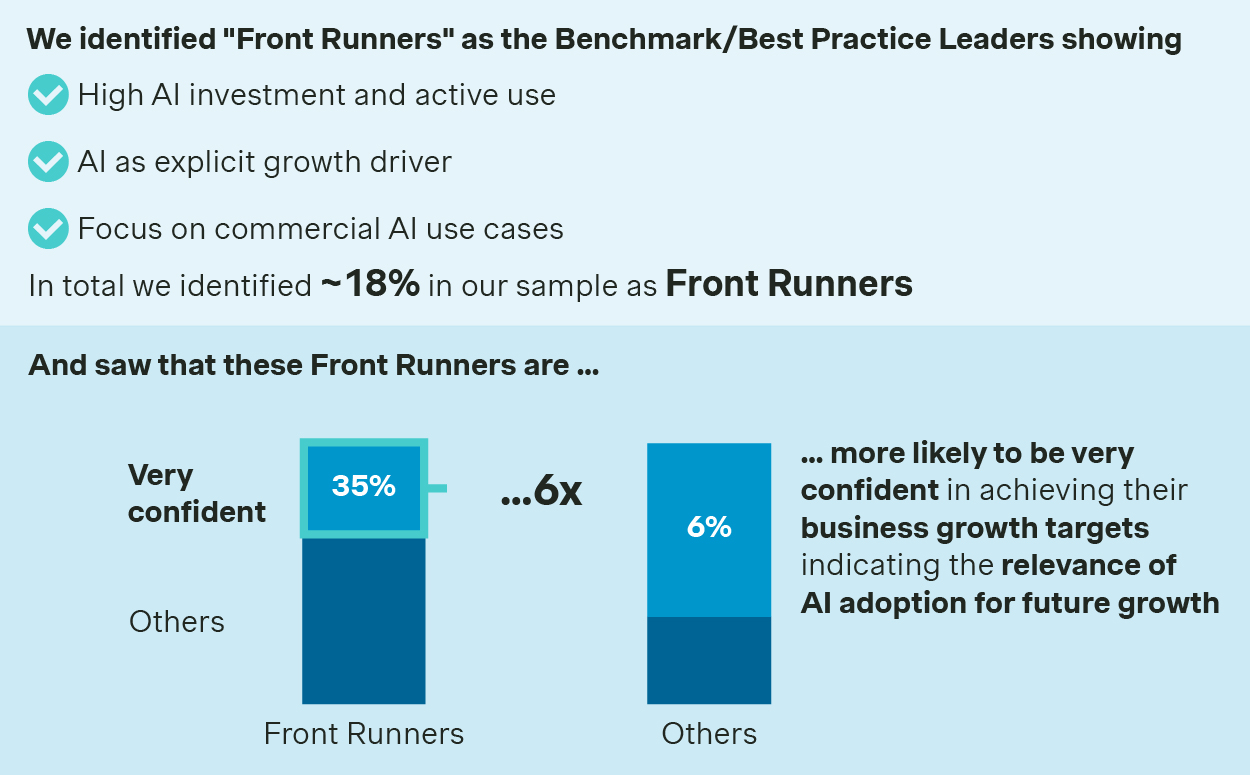
They are deploying specific AI use cases the rest of the market has not yet operationalized, built on a data and integration foundation most firms have not yet put in place.
Three of those use cases stand out: contract intelligence, AI-supported tendering, and back-book contract optimization. This article looks at what they deliver, what they require, and where most firms get stuck between the two.
Contract intelligence: making the back-office commercial
Most Business Services firms manage thousands of contracts. Few have transparency over what is in them. Pricing logic sits in framework agreements. Renewal mechanics live in annexes. SLA commitments hide in side letters. Indexation clauses are scattered across legacy schedules. The data is there, but it is not accessible in any way that supports commercial decision-making.
Contract intelligence is what changes that. AI-powered contract review extracts key commercial and operational terms from contracts, order forms, annexes, and side letters, then structures them into a single layer that the business can actually work with. Pricing terms become searchable. Renewal mechanics become trackable. Compliance risks become visible. What used to be a manual review effort across legal and commercial teams becomes a data extraction problem that AI solves in hours.
Effective contract management isn't just administrative work – it's a strategic lever for cost saving, risk reduction, and smarter growth. Tap into the potential today.
10% increase in annual profitability with effective contract management | 20% faster decision-making is enabled with real-time contract analytics | 10-15% cost savings identified using insights from contracts and RFQs through renegotiations |
Simon-Kucher's Lexicon is one example of how this works in practice. The platform ingests unstructured contracts from multiple sources, extracts key terms with high accuracy across multiple languages, and benchmarks them against business rules and standard terms.
A leading healthcare services company, for example, used Lexicon to analyze 20,000 multi-year contracts for an upcoming price increase campaign. The result was 625 FTE days saved, 60% more contracts analyzed than under the previous approach, and 36% more contracts identified as eligible for repricing.
That last number matters most. Contract intelligence is not primarily an efficiency tool. It is a commercial value lever. The firms that have deployed it are finding revenue and margin that was always in the contracts – they just could not see it before.
AI-supported tendering: where speed and quality compound
Tendering is one of the most expensive commercial processes in Business Services. RFQs, RFPs, and tender responses consume senior expert time, often with low conversion rates and slow turnaround. The work is high-stakes, repetitive in structure, and unevenly distributed across the sales team.
AI-supported tendering changes the economics. By combining prior responses, standard response libraries, service descriptions, solution architectures, staffing assumptions, and pricing patterns, AI can produce draft responses in hours rather than days. Bid teams move from generating content to refining it. Win rates improve not just because turnaround is faster, but because consistency and quality rise across the bid portfolio.
The commercial impact compounds. A firm that responds to twice as many qualified tenders at higher quality – without expanding its bid team – fundamentally changes its growth trajectory. This is the difference between using AI to do the same work faster and using AI to do more work better.
Front Runners have understood this. They are not deploying tendering AI as a back-office productivity tool. They are deploying it as a commercial scaling lever.
Back-book optimization: the value already sitting in your portfolio
The third use case is the most underappreciated. Most Business Services firms have an installed contract base that has accumulated quietly over years – framework agreements with negotiated concessions, local addenda with non-standard rates, indexation clauses that were never enforced, side letters that override standard pricing. That portfolio carries embedded value that the original commercial team never recovered.
AI-based back-book optimization makes that value visible. By analyzing the installed contract base systematically, AI identifies price uplift potential, expired concessions, unenforced indexation, inconsistent service rates, and structural margin leakage. What follows is not a new sales motion. It is a structured repricing program across existing accounts, executed with data to support each conversation.
The numbers can be substantial. Firms that run a structured back-book review typically find low-single-digit to low-double-digit percentage margin improvements in the affected portfolio, with most of the gain captured within 12 months. The investment is modest. The return profile is unusually attractive – particularly compared with new AI initiatives that require years to mature.
While firms spend significant budgets on new AI projects, many are leaving meaningful margin in contracts they have already signed. Back-book optimization closes that gap.
What these three use cases have in common
The three use cases look different, but they share the same operational reality.
Each depends on the firm being able to access, structure, and act on commercial information that is currently locked inside fragmented systems and unstructured documents.
- Contract intelligence cannot extract clauses that no one can find
- AI-supported tendering cannot reuse responses that sit in incompatible formats across regional drives
- Back-book optimization cannot identify margin leakage in pricing data that never made it into a structured repository.
This is where most Business Services firms stall. The use cases are clear. The commercial value is real. Technology often also exists. What is missing is the data and integration architecture that turns these capabilities from impressive pilots into operational businesses. And in Business Services, that architecture is rarely in place.
What separates a pilot from a deployment
The data reality in Business Services is well known but rarely confronted. Contracts sit in PDFs across shared drives, often in multiple languages and formats. Pricing logic lives in spreadsheets maintained by individuals. Side letters and annexes override standard terms in ways that are not systematically captured. Service descriptions, statements of work, and proposal libraries are scattered across regional repositories. The systems that should hold this information – CRM, ERP, CPQ, contract management platforms – are typically disconnected, with each holding a partial view of the commercial relationship.
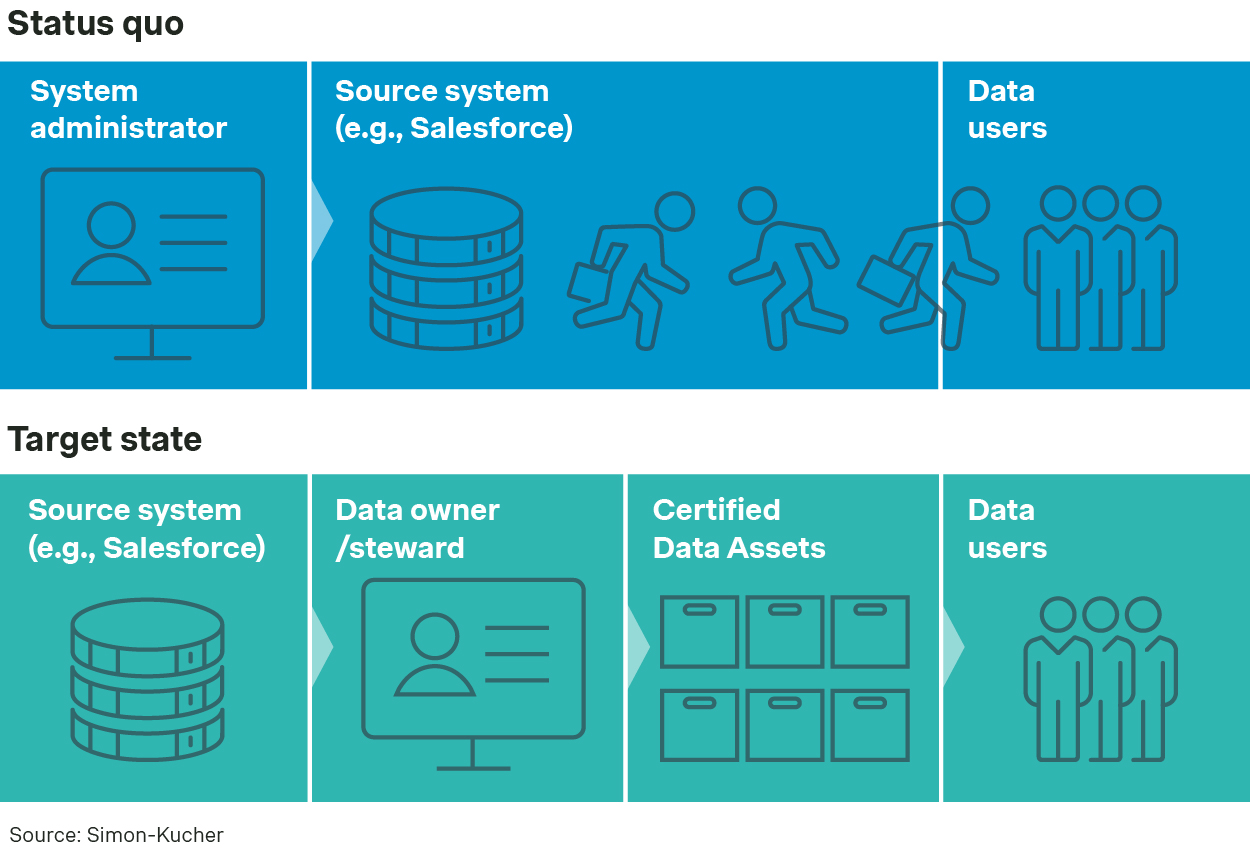
Closing this gap is not an IT cleanup project. It requires data architecture designed around specific commercial use cases, integration logic that connects systems where commercial value actually flows, and governance that makes AI outputs trustworthy enough to drive client-facing decisions. The firms that have built this foundation are not just running more pilots. They are running fewer pilots that scale into operational capabilities. Their contracts become searchable. Their pricing data becomes actionable. Their proposal libraries become a competitive asset.
This is the work Simon-Kucher Elevate is built for: combining commercial expertise with data and integration architecture, designed to turn AI use cases from isolated experiments into commercial capabilities that compound across the portfolio.
How to get started
For firms that want to deploy these capabilities, the path forward has three steps – none of which can be skipped.
Pick a use case with clear commercial value and acceptable data quality. Contract intelligence is often the fastest path to demonstrable return, because the data is dense and the value is measurable. Back-book optimization is often the most undervalued, because the data is already in place. Tendering automation typically requires a slightly more structured starting point but delivers compounding returns over time.
Treat the data foundation as a commercial investment. Cleaning up contract repositories, integrating key systems, and structuring unstructured information are not IT housekeeping tasks. They are the precondition for AI to deliver commercial returns. Funding them through commercial budgets rather than IT budgets typically accelerates progress.
Start with an honest data assessment. The use cases above succeed or fail based on whether the underlying commercial data is accessible, integrated, and trustworthy. Most firms underestimate the gap between what they have and what they need. A data and architecture diagnostic – before the first pilot launches – determines whether the deployment becomes a reference case or a stalled experiment.
From part one to part two
Part one of this series argued that AI is creating value in Business Services faster than firms capture it. Part two has looked at what value capture actually requires in practice: not abstract AI strategy, but specific applications, built on the right data and integration foundation, deployed with commercial intent. The Front Runner advantage is real on both sides of that equation. The firms pulling ahead are the ones building the commercial logic and the technical capability in parallel.
The window is the same. The next 24 months will determine which firms shape the Services-as-Software era and which firms inherit it.
Want to know more? To discuss how data and architecture diagnostic, contract intelligence, tendering automation, or back-book optimization could apply to your firm, reach out to our Simon-Kucher experts.
We would like to thank Tim Wisniewsky for his contribution to this article.