
As AI agents mature from simple assistants into autonomous contributors, pricing decisions become much more important, and much more complex. Leaders consistently tell us the same thing: they want to capture value, protect margins, and provide customers with predictability, but they are unsure where to begin.
Part of the challenge is that AI agents blur boundaries. At times they behave like software, at others like services, and increasingly like digital employees. Traditional SaaS pricing models, designed around user access or feature tiers, struggle to capture this nuance.
In Part 1 of this series, we explored why those legacy structures break down. In Part 2, we offer a practical framework to help SaaS leaders determine the pricing model that best fits how their agents create value.
The challenge: Too many pricing options, too little clarity
Most AI teams can articulate several potential price metrics: usage, seats, credits, outputs, outcomes. Yet they struggle to select one with confidence. The question is not “What could we charge for?” but “What reflects value, supports adoption, and protects margins as we scale?”
Across engagements, three dimensions consistently determine which price models work in practice. They are intuitive, leadership-friendly, and map cleanly to how AI agents mature over time
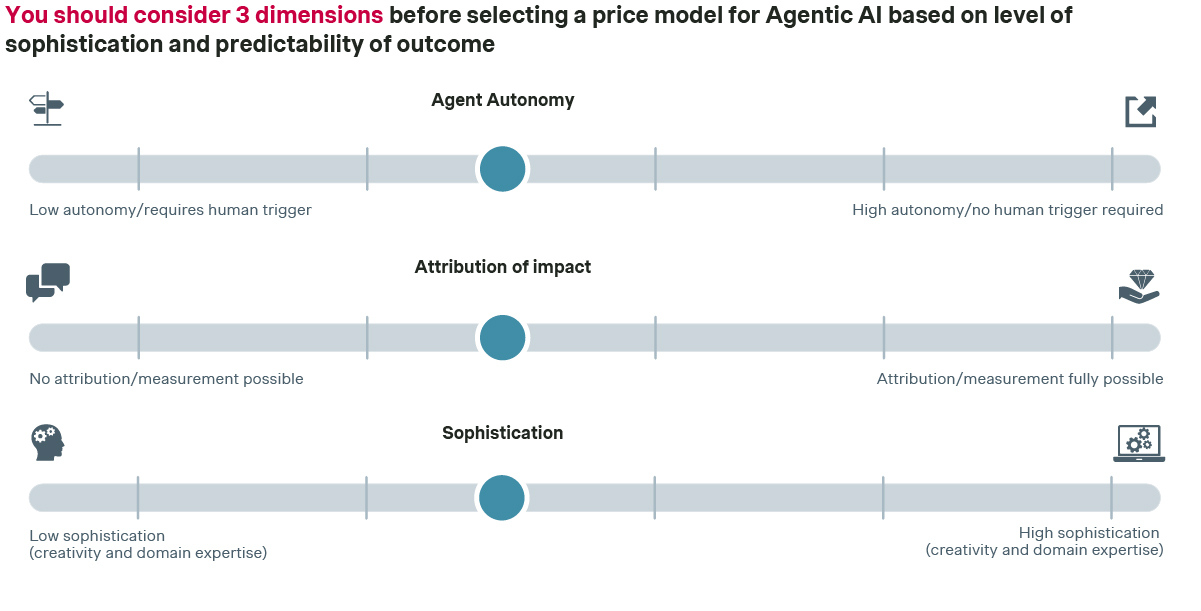
1. Autonomy: How independently does the agent operate?
Autonomy shapes value, cost, and customer expectations. We typically see three levels of autonomy emerge as AI agents mature:
| Executor | Manager | Leader |
|---|---|---|
| Responds to prompts; supports human-led tasks, e.g. drafting an email, summarizing a ticket. | Orchestrates multi-step workflows; adapts execution based on feedback, e.g. triaging support requests and routing them. | Plans and completes tasks end-to-end with minimal human input, e.g. resolving a customer issue without agent supervision. |
Higher autonomy typically supports pricing models that are closer to value-based pricing, because the agent is delivering meaningful, measurable outcomes.
2. Value attribution: How clearly can the business impact be measured?
Attribution determines what you can monetize, not just what you would like to. Output- or outcome-based pricing becomes viable when impact can be measured consistently across customers, for example through:
- Resolved inquiries
- Completed workflows
- Verified tasks
- Hours saved
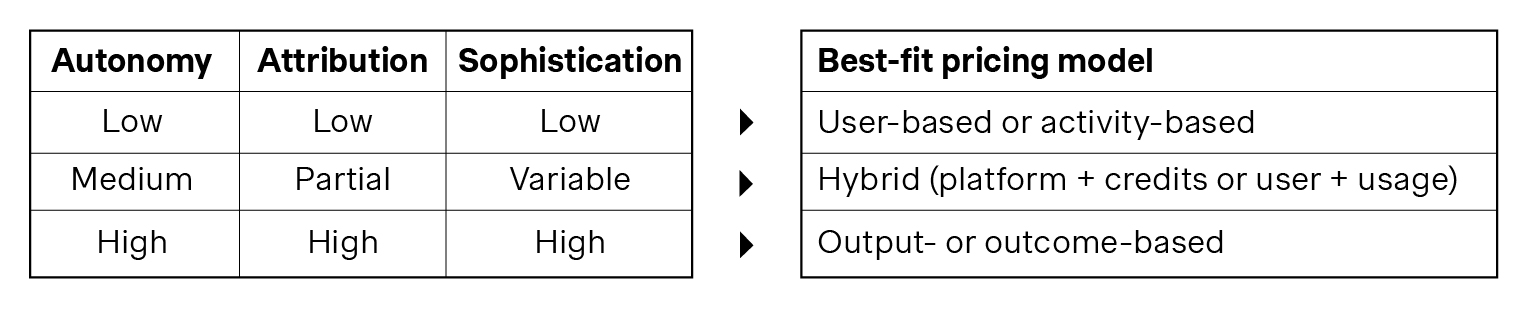
If attribution is partial or customer use cases vary widely, hybrid models are often the safest path, blending predictability with value capture. For example:
- Platform fee + usage credits
- User fee + output fee
- Base agent fee + performance fee
This approach aligns strongly with buyers’ preferences: 86% prefer usage- or outcome-based models for AI solutions, compared with traditional seat-based structures.
3. Sophistication: Is the agent a commodity or a specialist?
Sophistication influences willingness-to-pay and pricing power:
- Generalist agents: Useful across many tasks, but easy for competitors to replicate. Better suited to consumption or access-based pricing.
- Specialized agents: Trained for legal, financial, compliance, or deeply contextual tasks. Can command premium pricing, particularly when risk reduction or accuracy is central to value.
Across the market, specialization is emerging as one of the strongest levers for differentiating AI agent offerings and justifying higher tiers.
Putting the framework together
When we combine the three dimensions, patterns emerge that make the pricing decision far clearer:
This is not about theory. It’s about commercial predictability. Pricing works when it reflects how value is created and recognized.
This is not about theory. It’s about commercial predictability. Pricing works when it reflects how value is created and recognized.
The AI price metric spectrum
Across industries, AI pricing follows a predictable progression: from cost-oriented metrics to those that reflect business outcomes more directly.
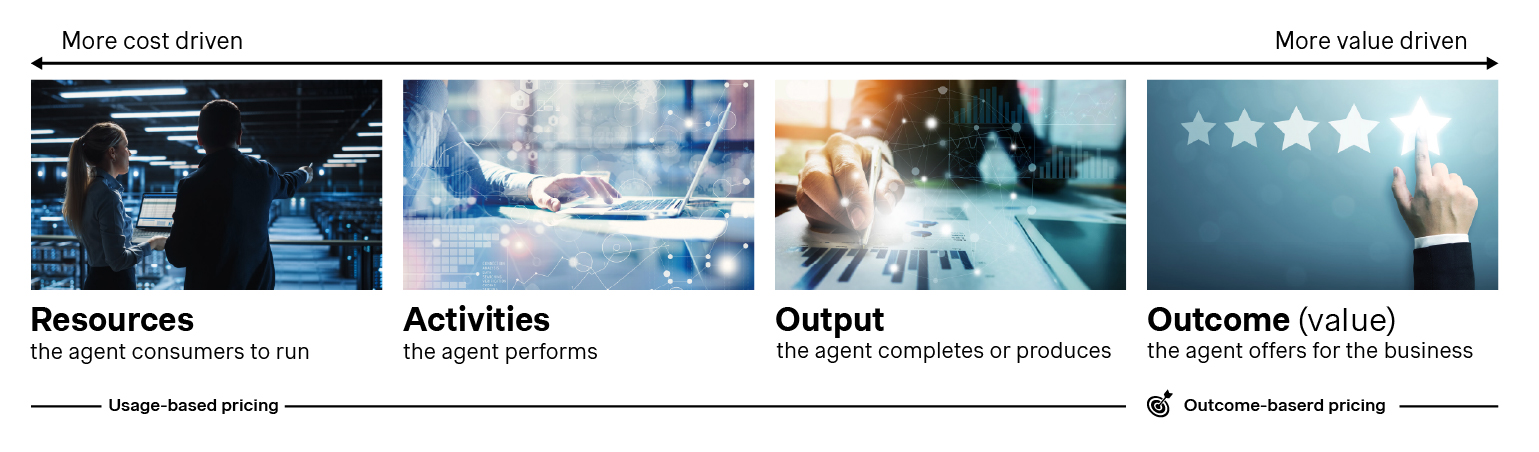
Each step moves closer to business value:
- Resources (compute, tokens): Easy to measure, but abstract for buyers
- Activities (emails drafted, documents analyzed, call minutes): More understandable, but still variable in value
- Outputs (conversations completed, workflows executed): Clearer link to outcomes
- Outcomes (cases resolved, revenue generated, cost saved): Strongest commercial logic
Companies rarely start with outcome pricing, but they often evolve toward it as attribution improves. This mirrors how human performance is measured: the more responsibility someone holds, the more their compensation reflects outcomes, not activity.
Outcome-based pricing will not be the end-game solution for every agent though, either because attribution may become more complex in a multi-agent world, or because some clients ultimately will prioritize predictability.
Why hybrid models are becoming the default
In our recent Global Software Study, 45% of companies said they plan to use two or more pricing metrics for their AI offerings.
Hybrid structures give customers predictability while allowing providers to capture value more closely in line with usage and outcomes. These models also help smooth cost-to-serve volatility, which is critical for AI workloads where compute demand can spike.
How leaders can apply this framework immediately
Three actions help teams move from uncertainty to clarity:
- Assess where your agent sits today, and where it is heading. Most agents progress along the autonomy spectrum. Pricing should evolve with them.
- Test models in controlled environments. Pilot new pricing with guardrails to gather clean signals before scaling. Short, well-designed tests outperform broad rollouts every time.
- Align your operating model early. Pricing decisions affect sales motions, forecasting, billing architecture, and customer success.
This alignment separates companies that scale seamlessly from those that face commercial friction later.
Conclusion
Choosing the right pricing model for AI agents is not about finding perfection on day one. It’s about designing a structure that reflects how your agent creates value today, and how it will evolve.
In Part 3 of this series, we explore how packaging can make these pricing decisions tangible for customers, using autonomy, expertise, and trust as the foundation.
Need support choosing the right pricing model for your AI agents? Our experts help software companies design pricing approaches that align with value, scale predictably, and enable sustainable growth.