
Most medtech and diagnostics companies know omnichannel is a priority but only some know how to execute it successfully. This second article in our two-part series on omnichannel transformation moves from diagnosis to action. Here, we examine the key practical initiatives that separate transformations that deliver from those that never gain traction.
In our first article, we explored why omnichannel engagement has become a strategic priority for medtech and diagnostics companies – and what common challenges companies are facing.
Six challenges appear repeatedly in omnichannel transformation efforts:
- Only opportunistic use of e-commerce and inside sales teams
- No data-based sales enablement support for sales reps
- Inconsistent messaging for engagement across channels
- Low sales compliance to CRM, resulting in poor data quality
- Tech strategy lacking end-to-end vision and integration
- Limited team experience and skills for omnichannel engagement
This article examines the practical initiatives that tackle them and turn omnichannel ambition into execution that delivers results.
Opportunity 1: Engagement model and alternative sales channels to overcome only opportunistic use of e-commerce and inside sales teams
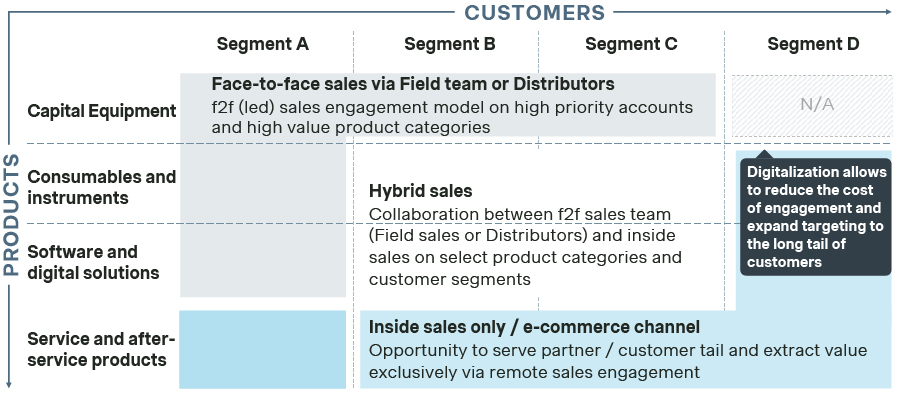
For most medtech and diagnostics companies, face-to-face selling remains the backbone of the commercial model. While digital channels and inside sales teams have been introduced, they often remain underutilized because their role within the broader commercial model is not clearly defined.
A successful omnichannel strategy requires a deliberate orchestration of channels. Not every customer or product warrants the same engagement model. High-value capital equipment demands close, in-person engagement between customers and field sales representatives. At the same time, other segments may be better served through remote sales or digital platforms.
Source: Simon-Kucher insights
Once channel roles are defined, companies must build the capabilities required to support them. This includes understanding FTE implications, defining new job profiles, and equipping teams with the right toolkits and processes. For example, sales reps in field sales vs. inside sales, or in capital equipment vs. software, show strong differences in terms of capabilities required, workflows, and incentivization needed. Only then can e-commerce and remote sales teams truly help boost growth and efficiency while reducing the cost of engagement.
To boost growth and efficiency via e-commerce and remote sales teams, best practice is to:
- Identify optimal channels per product category
- Assess internal capabilities and processes for each relevant channel and identify gaps
- Initiate measures to close capability and processes gaps
In one of our recent project examples, one company lowered SG&A costs by around 15% and increased EBIT margin by about 4% points at the same revenue level through efficient e-commerce and remote sales teams.
Opportunity 2: AI-supported sales to address the lack of no data-based sales enablement support for sales reps
Many sales teams still operate without sufficient data-driven support, resulting in reactive rather than proactive engagement.
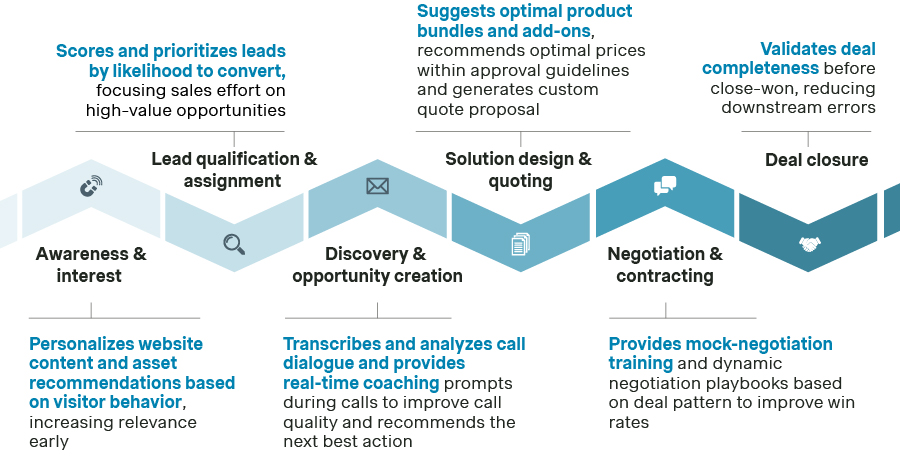
The opportunity lies in integrating digital tools (i.e., CRM, CPQ, etc.) and AI capabilities directly into the sales process - from awareness creation to deal closure - to increase both efficiency and effectiveness. Rather than deploying isolated tools, companies should review the process end-to-end and identify where AI-enabled support can improve decision-making, prioritization, and execution.
Source: Simon-Kucher insights
To improve sales productivity through AI-supported sales enablement, best practice is to:
- Map the end-to-end sales process and identify the highest-value AI use cases (e.g., lead prioritization, next-best actions, quoting support)
- Carefully evaluate the best implementation approach for AI : i) using AI features in existing tools like the CRM; ii) working with specialized AI companies; or iii) building custom AI solutions to leverage proprietary expertise and data
- Integrate AI recommendations directly into CRM and sales workflows to maximize adoption
- Ensure dedicated change management and enablement efforts to bring sales teams along
- Measure usage and commercial impact continuously and refine AI models based on sales outcomes
Companies can significantly reduce sales preparation time and increase conversion rates through AI-enabled lead prioritization and next-best-action recommendations. That’s why, instead of buying costly software licenses, we increasingly see medtech companies investing in AI agents to replace, for example, software for CPQ.
For a deeper perspective, our webinar “Digital, AI, and agentic selling: The future of sales in medtech and diagnostics” explores how AI can reshape commercial engagement across the industry.
Opportunity 3: Content management platforms for cross-channel engagement to avoid inconsistent messaging across channels
Integrating digital tools and AI capabilities alone is not enough. If the messaging flowing through these tools is inconsistent, the problem simply moves upstream – customers end up receiving different value propositions depending on whether they interact with marketing campaigns, digital platforms, or sales representatives. Additionally, engagement models have to consider that target groups are increasingly using AI to inform themselves about products.
Content management platforms address this by centralizing and standardizing engagement materials like product one-pagers, sales presentations, and email templates. They translate inputs - such as customer segmentation, unmet needs, therapeutic areas, or technology adoption - into structured sales enablement toolkits.
These toolkits typically include:
- Ready-to-use messages
- Recommended value propositions
- Cross-sell and up-sell suggestions
- Next-best-action guidance
AI capabilities can also support this by creating content, such as text, visuals, and videos, that is customized by target group, but aligned across channels.
Critically, these platforms create feedback loops between sales and marketing. By capturing analytics on content usage, customer interactions, and field-level responses, they enable marketing teams to continuously refine messaging, sharpen engagement strategies. This ensures that customers experience a consistent and credible value proposition across all channels.
To ensure consistent customer engagement across all channels, best practice is to:
- Develop a centralized content library with standardized messaging and value propositions – ideally leveraging AI to do so
- Define governance for content creation, approval, and updates across marketing and sales
- Track content usage and customer engagement to continuously optimize messaging
Companies can reduce content creation effort by approximately 40% while significantly improving message consistency across field sales, inside sales, and digital channels through a centralized content management platform.
Opportunity 4: CRM gamification to overcome low sales compliance with CRM and improve data quality
Despite significant investment, CRM systems in most medtech companies remain underutilized – leaving data incomplete, outdated, and unreliable.
In many cases, this is not primarily a technology issue, but a behavioral one. Sales representatives are typically incentivized to generate revenue, not to maintain high-quality data in CRM systems.
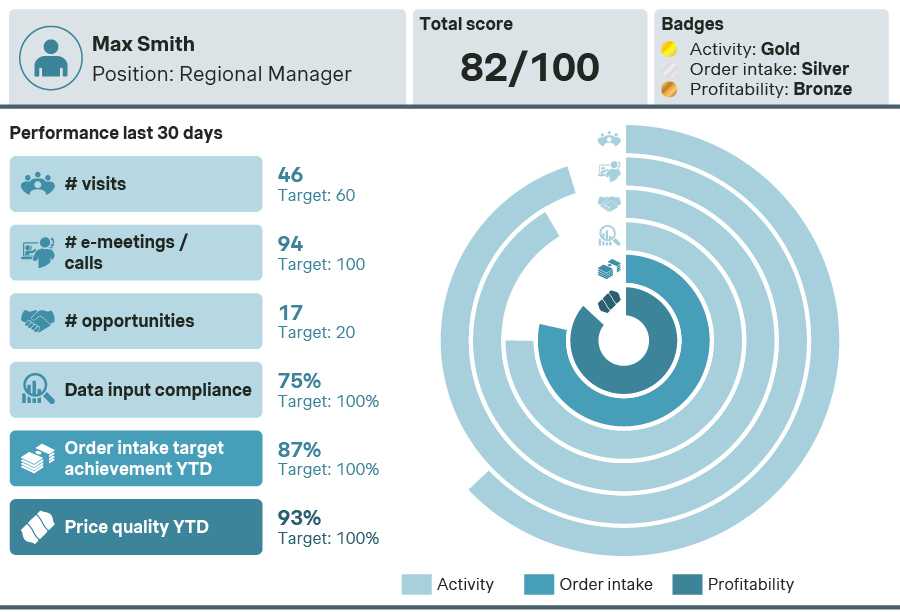
There's more to gain from shaping user behavior rather than forcing change. One increasingly effective approach is CRM gamification. By introducing dashboards, performance scores, badges, and leaderboards, companies can encourage sales teams to use CRM systems more actively.
Source: Simon-Kucher insights
These mechanisms help transform CRM usage from a compliance exercise into a performance management tool. When designed effectively, gamification significantly improves data quality while also increasing motivation and engagement among sales teams.
At the same time, AI is reducing the effort required to keep CRM data up to date. AI assistants can automatically capture customer interactions by transcribing sales calls, extracting key information from emails and meeting notes, and suggesting CRM updates for review. By reducing manual data entry, these capabilities improve data completeness while allowing sales representatives to spend more time engaging customers.
To improve CRM adoption and data quality, best practice is to:
- Define a small set of CRM behaviors that directly support commercial performance
- Introduce gamification mechanisms, such as scorecards, badges, and leaderboards, linked to these behaviors
- Review adoption metrics regularly and reinforce desired behaviors through coaching and incentives
Companies can increase CRM data completeness to more than 90% and substantially improve pipeline visibility after introducing a gamified CRM performance dashboard.
For a deeper perspective, our webinar “Digital, AI, and agentic selling: The future of sales in medtech and diagnostics” also explores how leading companies are building commercially driven CRM setups and leveraging AI to support high-impact commercial use cases.
Opportunity 5: End-to-end data and technology stack to avoid tech strategy lacking end-to-end vision and integration
Behind most omnichannel failures lies a broader problem: a fragmented technology landscape where different systems manage customer data, marketing activities, and sales processes across business units.
To deliver a consistent experience, companies need an integrated architecture that connects all customer touchpoints. Best-in-class companies structure their technology architecture as a layered model:
- The experience layer includes all customer interactions, such as field visits, websites, online shops, social media, events, and service platforms, with the objective of creating “one customer, one experience”.
- The system layer incorporates core business platforms such as CRM, ERP, Price management, marketing automation, e-commerce, and service systems.
- The data and AI layer integrates customer data, behavioral insights, and analytics and AI capabilities that enable personalization and continuous improvement.
Together, these components enable organizations to deliver consistent and personalized experiences across all channels.
To establish an integrated omnichannel technology ecosystem, best practice is to:
- Define a target architecture spanning customer experience, business systems, and data and AI layers, and derive initiatives to get there
- Build a central and harmonized data foundation integrating customer data across CRM, ERP, pricing, marketing automation, e-commerce, and service platforms
- Establish governance for data ownership, quality, and interoperability across functions
Companies that consolidate multiple disconnected commercial systems into a unified architecture enable a single customer view and reduce manual reporting effort by up to 50%.
Opportunity 6: Organizational and skill requirements to address limited team experience and skills in omnichannel engagement
Finally, omnichannel transformation requires new capabilities across the organization.
Medtech and diagnostics companies often have limited experience with omnichannel engagement, which creates a significant skills gap across teams. For example, sales representatives must combine traditional selling capabilities with digital and analytical skills.
Key capabilities include:
- Data interpretation and insight generation
- Customer-centric thinking and consultative selling
- Digital fluency with CRM and virtual engagement tools
- Cross-functional collaboration with marketing and digital teams
- Agility in adapting to evolving customer needs
- Ability to interact with technical stakeholders on the client side as digital/AI solutions increase in relevance
To build the organizational capabilities required for omnichannel success, best practice is to:
- Define future role profiles and capability requirements across commercial functions
- Assess current skills and identify capability gaps at individual and team level
- Implement targeted training, coaching, and change management to accelerate adoption of new ways of working
By redesigning commercial roles and delivering a targeted capability-building program, companies can increase digital engagement adoption by more than 50% within the first year.
From initiatives to full transformation
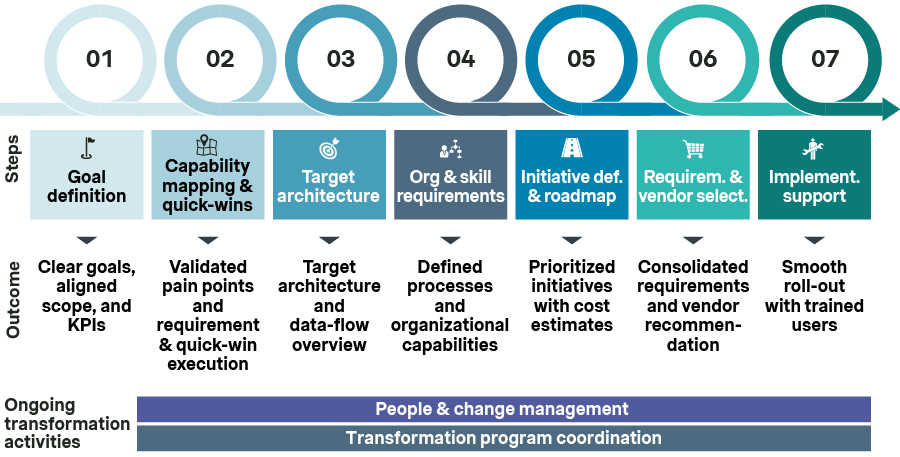
Each of these initiatives can deliver results on its own. However, the long-term structural impact comes from combining them into a transformation roadmap that demands coordinated changes across strategy, processes, technology, and people.
This means starting with clear goals, mapping customer journeys and capabilities, and identifying where early action delivers visible results. Companies then define their target architecture and organizational requirements before prioritizing initiatives and moving into vendor selection and implementation.
Source: Simon-Kucher insights
Ultimately, success in omnichannel is not defined by the number of channels deployed but by how effectively they are orchestrated to deliver a consistent and valuable customer experience.
Companies that take such a structured approach will be best positioned to win in the hybrid future of healthcare commercial engagement.
Please reach out to discuss how we can tailor this approach to your company.