
With limited resources and significant evidence gaps, how can biotech leaders ensure they invest in the real-world evidence that matters? Explore two critical pillars that show where RWE can reduce uncertainty and protect asset value, and what capabilities are needed to generate credible evidence that informs regulatory and market access decisions.
Breakthrough science alone is not enough to create a successful asset. For a clinical-stage biotech, clinical trials are the foundation of evidence generation, but they cannot answer every question that could influence an asset's value.
A holistic evidence strategy can help fill those gaps. Pre-launch real-world evidence (RWE) can characterize natural history, unmet need, and treatment patterns; help contextualize trial results; and address anticipated questions from regulators, health technology assessment (HTA) bodies, payers, clinicians, and potential commercial partners. Post-launch RWE informs longer-term effectiveness and safety in routine practice, addresses ongoing evidence requirements, and supports competitive differentiation.
For biotechs developing treatments for complex, under-researched diseases, evidence gaps are often substantial and resources are constrained. The biggest risk is generating the wrong evidence: spending scarce capital on studies that answer interesting questions while failing to address the uncertainty most relevant to regulatory approval, market access, or asset value.
The challenge is to decide where to play and how to win. First identify where additional evidence can reduce uncertainty, influence consequential decisions, or protect asset value. Then, build an engine to deploy that evidence credibly.
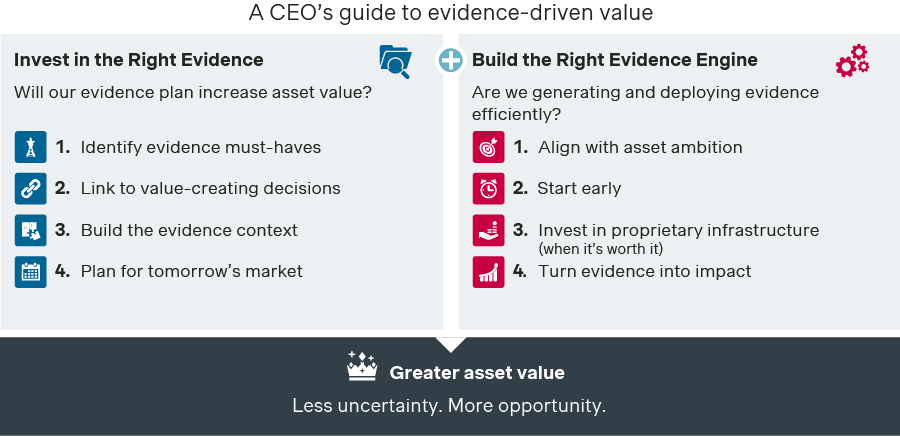
That requires discipline around two principles: the right evidence and the right engine. Used well, additional evidence will complement the clinical program, answering decision-relevant questions it was not designed to resolve, and increase asset value.
Source: Simon-Kucher insights
Pillar 1: The right evidence
1. What is our must-have evidence?
The first discipline is to identify which gaps the clinical development program will leave unanswered and which of those would limit value capture
Critical evidence needs could jeopardize regulatory approvals, desired label strategy, or market access timelines. Ideally, these questions should be considered before pivotal decisions are finalized. After Reata Pharmaceuticals’ pivotal trial of SKYCLARYS for Friedreich’s ataxia, the FDA initially indicated that a second pivotal study could be required. Given the challenges of conducting another trial in a small population with a slowly progressing rare disease, Reata supplemented its existing trial results with additional evidence, including a propensity-matched comparison between patients in its open-label extension and those in a natural history study. The FDA ultimately accepted that evidence as part of the basis for approval.
Leadership should understand the value gaps in the clinical program in order to effectively allocate resources. This is especially important in rare diseases where small patient populations may limit opportunities to collect additional data later.
2. How will this evidence add value?
RWE investment is particularly susceptible to the “because we can” mindset: pursuing studies simply because a dataset becomes available, a registry exists, or an analysis is feasible. None is sufficient reason to spend scarce capital.
It’s important to understand the role evidence will play in stakeholder decision-making. The FDA's decision to expand palbociclib's breast cancer indications to include men, for example, was supported by RWE from electronic health records (EHRs) and insurance claims, addressing a defined regulatory question about an underrepresented population.
Biotech companies developing products for global markets may also need to undergo the EU’s Joint Clinical Assessment (JCA), in which their products will be evaluated against local standards of care and treatment practices across EU member states. If the evidence package does not address the relevant population, intervention, comparator, and outcome (PICO) requirements, it could jeopardize the success of pricing and market access discussions across Europe. RWE can play a role both in predicting which PICOs will be a part of the assessment and in generating acceptable evidence without the burden of additional clinical trials.
A technically interesting analysis that changes no meaningful decision is less valuable than a simple study that closes a critical evidence gap. Therefore, every investment should begin with three questions: What business decision does this evidence support? Who needs to be convinced? How does it increase or protect enterprise value?
3. Have we established the context needed to demonstrate value?
For many pre-commercial biotechs, some of the highest-value RWE comes before the product is used in practice.
Stakeholders need to understand the disease, affected patients, and outcomes under current care to judge the relevance of an asset’s benefits.
BioMarin’s VOXZOGO program illustrates pre-launch RWE. Several years before European approval, BioMarin sponsored LIAISE, an observational study across six European countries examining clinical burden, quality of life, healthcare resource use, and socioeconomic and psychosocial impact in achondroplasia. It helped establish the real-world baseline against which a new treatment could be understood.
This is particularly important in rare or under-researched diseases, where natural history is poorly characterized or care pathways are fragmented. The RWE strategy must be able to provide stakeholders with the context to understand the product’s value.
4. Have we planned for the future as the standard of care evolves?
Clinical development programs are difficult, expensive, and slow to redirect. The market around them is not. New therapies can change the standard of care, while treatment sequencing, prescribing patterns, and stakeholder expectations shift during development.
A notable example is Blueprint Medicines’ avapritinib evidence strategy. While avapritinib’s single-arm program was underway, midostaurin became the first broadly applicable approved treatment for advanced systemic mastocytosis. Blueprint subsequently developed a retrospective real-world external-control study comparing avapritinib with best-available therapies. The resulting RWE helped address the comparative-evidence gap in regulatory and HTA assessments and subsequently supported a positive NICE recommendation.
RWE provides a flexible way to track such changes through analyses of treatment patterns, comparator use, patient populations, and outcomes. The evidence plan must be revisited as the competitive environment and standard of care evolve.
Pillar 2: The right engine
Knowing what evidence matters is only half the challenge. Biotechs also need an operating model capable of generating credible evidence at the right time, in the right markets, and in a form stakeholders will trust.
1. Is our evidence plan aligned with our launch ambition?
The RWE strategy must align with the commercial strategy and vision, clearly supporting launch footprint, brand positioning, and aspirational value story, with foundations laid early on.
One example of this is argenx’s MyRealWorld MG study, which collected longitudinal patient-reported data across Europe, Japan, North America, and the UK before VYVGART’s launch. This overlaps with markets where argenx later built its own commercial presence.
Leadership should decide where the company needs to develop its own RWE narrative and where a future commercial partner can reasonably build it. Investment should reflect not only where the asset is developed, but where – and by whom – its value will be captured.
2. Are we starting evidence generation planning early enough?
RWE is often associated with post-launch use, but some high-value applications require years of lead time. Natural-history cohorts require follow-up, registries need infrastructure, and outcomes may need to align with clinical development.
Ascendis Pharma's ACHieve natural-history study began years before navepegritide reached the market. The study subsequently provided longitudinal data on pre-treatment growth and disease history for patients entering the pivotal ApproaCH program.
Teams should work backward from decisions across development, regulatory engagement, access, partnering, and launch. By the time a pivotal readout exposes an evidence gap, the best opportunity to address it may have passed.
3. When does investment in proprietary evidence infrastructure make sense?
Not every RWE question warrants a bespoke dataset or long-term study. Existing claims, EHRs, registries, and partnerships may answer many questions faster.
Proprietary infrastructure becomes more compelling when required evidence cannot be obtained elsewhere, or when one longitudinal asset can answer multiple high-value questions. Ultragenyx’s Disease Monitoring Programs illustrate that logic in rare disease, supporting natural-history, treatment-outcome, regulatory, and research questions from a reusable evidence platform.
The objective is not to own every dataset, but to decide what to build, what to buy, and where proprietary data can create differentiated strategic value.
4. Do we have the right capabilities to turn evidence into impact?
A growing biotech does not need a large RWE organization, but it does need clear ownership. Someone must identify the right business questions and then translate these into decision-grade studies, and ensure the outputs reach the targeted decision-maker effectively. Here, cross-functional collaboration is crucial: without coordination, functions can commission overlapping analyses, use inconsistent definitions, or answer one stakeholder’s question while overlooking another’s.
Emerging biotechs can turn lean teams into an advantage by aligning functions around a shared understanding of key evidence gaps. This allows teams to prioritize questions collectively and identify where one investment can support several strategic objectives.
Generating RWE and turning it into stakeholder impact are distinct capabilities. Both need an accountable owner. This becomes particularly important when work is outsourced. External partners can provide data, methodological expertise, and execution capacity, but the company remains accountable for defining the strategic question and ensuring that the answer reaches the right stakeholder at the right time.
Finally, RWE should rarely be communicated in isolation. Findings need to be positioned within the broader evidence base, with their strengths and limitations clearly communicated. The goal is not simply to produce a publication; it is to ensure credible evidence informs the decisions it was generated to support.
Making evidence count where it matters
The most impactful RWE program is not necessarily the largest, the most technically sophisticated, or the most investment heavy. It is one that is strategically curated and thoughtfully designed, with the decision-maker’s question in mind at every step. It is a product of seamless collaboration and effective communication. This requires clear vision setting by leadership, along with fostering internal collaboration and breaking down any silos that could result in redundancies.
- Start with the decision, not the dataset. Prioritize RWE only where reducing uncertainty could materially change development, access, partnering, commercial, or investment decisions.
- Generate the right evidence early enough to matter. Identify must-have gaps before pivotal choices are locked in, especially where patient populations are small or data collection opportunities are difficult to recreate.
- Treat evidence generation as an enterprise capability. Clear ownership, cross-functional alignment, fit-for-purpose data, and a plan for how findings will be used are as important as the study itself.
Biotech leaders should know where RWE can materially change a consequential decision, ensure it is generated before the opportunity is lost, and build the capabilities needed to turn it into impact.
Are you asking the right questions, developing the right strategies, and building the right capabilities? Contact our experts to discuss how we can help.