
Commercial success in emerging markets starts with a series of deliberate choices. Here, we examine how biotechs can assess access potential, choose the right route to market, structure partnerships, and build an operating model that matches each therapy’s ambitions, resources, and path to value.
Emerging markets present an opportunity to rethink standard commercialization playbooks for biotechs. For decades, biotech commercialization has followed a familiar path: launch first in the US, Europe, and Japan, then consider emerging markets once major markets are established. That sequence reflected the realities of the time, with emerging economies possessing limited reimbursement, fragmented specialist infrastructure, and fewer viable access pathways that constrained opportunity.
The narrative is now changing. Investment growth in specialist care, the rise of diagnostic capability, and maturing reimbursement pathways and regulatory frameworks are making an increasing number of emerging markets commercially relevant towards biotechs much earlier in their lifecycle.
Today, emerging markets account for more than 18% of global medicine spending, and biotech partnering has evolved from opportunistic licensing into a strategic source of value creation. Publicly disclosed deals and partnerships by biotechs in emerging markets (ex-China) have exceeded US$1.2 billion in cumulative value across more than 20 deals in the last two years, illustrating the growing importance of emerging markets in creating commercial value for biotechs.
Biotechs that continue to rely solely on the developed-market playbook risk failing to leverage the opportunity in emerging markets that are now beginning to flourish. The question is how to capture this opportunity effectively, without compromising speed, control or long-term value creation.
Why biotech go-to-market is different
Emerging market commercialization is not a scaled-down version of large pharmaceutical commercialization. It follows a different set of commercial economics. Large pharmaceutical companies optimize their portfolios, while biotech companies optimize individual therapies. That distinction fundamentally changes how commercialization decisions are made.
Most biotechs cannot fund a broad country-by-country buildout, wait years for reimbursement, or absorb unsuccessful launches. In today’s tight funding market, where biotechs are reducing pipelines and facing harder fundraising conditions, every commercialization choice must either extend runway, accelerate value inflection, or improve the asset’s partnering narrative.
That changes how emerging markets should be viewed. Rather than representing a late-stage expansion opportunity, selected emerging markets can become an earlier source of value creation through upfront licensing, partner-funded development, local evidence generation, and earlier patient access, allowing another avenue for biotechs to commercialize and generate upfront value for their investors.
Recent partnerships between biotechs and partner firms, such as Agenus–Zydus (where Agenus outlicensed its oncology asset for commercialization in India and Sri Lanka, along with selling its US manufacturing sites, to expand Zydus’ global manufacturing network) and Biophytis–Blanver (where Biophytis outlicensed their muscle-wastage asset for manufacturing and clinical development support with Blanver in LATAM markets), illustrate this evolution. In both cases, emerging market partnerships provided substantial capital and extended beyond commercial rights to include clinical development, manufacturing, and regulatory collaboration, demonstrating how regional partnerships can create value well before full asset commercialization.
For biotech companies looking to commercialize in emerging markets, the primary question should thus be, "which commercialization model creates the greatest value for this therapy at its current stage of development?"
At Simon-Kucher, we believe the answer lies in understanding three key questions:
- Where should the biotech compete?
- What should the commercialization model look like?
- Which capabilities should it build, partner for, or retain in-house?
Prioritizing markets by access feasibility
Understanding where to compete is key for a biotech; choosing the wrong market can divert scarce resources away from opportunities with a clearer path to value. Traditional market assessments, however, are often designed with a large pharma lens. They are focused on broad market sizing, established payer systems, and scalable commercial infrastructure. For biotechs, these inputs need to be adapted to reflect more constrained resources, higher uncertainty, and the need for focused execution.
Commercial success for a biotech often hinges on whether a small, targeted commercial footprint can effectively activate the full patient journey, from identifying often rare or underdiagnosed patients to navigating referral networks, securing partners, and delivering treatments. A large market offers limited value if diagnosis rates are low or concentrated in a handful of institutions that are difficult to access. Strong partner interest cannot compensate for the absence of clear treatment pathways or the ability to actually reach patients in need.
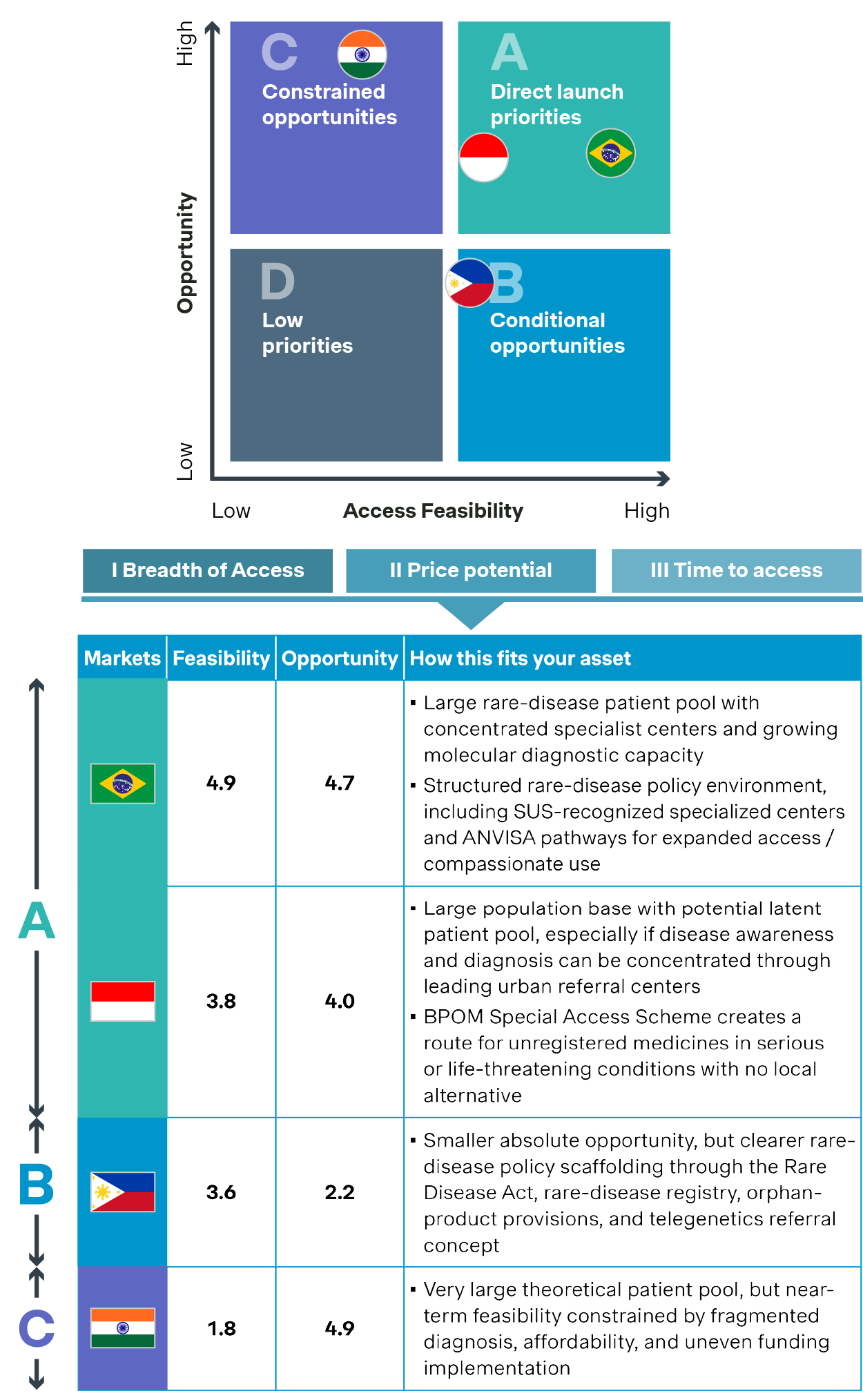
A practical prioritization framework should focus on three dimensions:
Breadth of access. Can patients move successfully from diagnosis to treatment? For innovative therapies, patient pathway maturity often matters more than market size.
Price potential. Is there a credible route from price to payment through public reimbursement, private insurance, or alternative funding mechanisms?
- Time-to-access. How quickly can patients realistically receive treatment? Early-access and named-patient pathways may generate value before conventional reimbursement.
Source: Simon-Kucher insights
This framework provides companies with an insight across the opportunity available in the market and the feasibility of realizing this opportunity. By leveraging this framework, biotechs can prioritize key markets and effectively allocate resources to further commercialization efforts.
Choosing the right commercialization model
Once priority markets are defined, commercialization strategy will have to be tailored to each market to capture maximum value for the biotech.
Commercialization decisions should be made in two sequential steps: commercial ambition and organizational execution. Separating these decisions avoids the common mistake of jumping straight to organizational questions before defining the company's long-term ambition.
Step 1. Define the commercialization model and the biotech’s role
The first decision focuses on understanding where the biotech should sit on the commercialization spectrum, balancing profit potential against the level of investment, control, and execution risk.
On one end, a biotech might fully out-license rights where local partners can create more value than investing in direct commercialization efforts. On the other hand, it may consider going direct and building local affiliates in markets where opportunities, access, and strategic control justify the additional investment.
Between these points lies a continuum of hybrid approaches, allowing companies to calibrate how much they invest, control, and rely on partners. These can range from lighter-touch distributor arrangements to deeper co-commercialization or development partnerships, each offering a different balance between speed, risk-sharing, and long-term value capture.
To ensure effective resourcing, biotechs should adopt tailored approaches rather than a single commercialization model, calibrating their level of control and investment by market.
When out-licensing assets, partnerships should be viewed as more than a straightforward transfer of commercial rights. Regional partners are now contributing to clinical development, regulatory expertise, manufacturing support, and non-dilutive capital alongside commercialization. To illustrate, Karyopharm's has partnered with Antengene, where Karyopharm leveraged Antengene’s local clinical development expertise to advance multiple drug candidates towards market registration alongside upfront licensing revenues.
Partner selection should reflect the therapy’s strategic priorities, including alignment on the indication and access to relevant clinical and commercial networks. Genor’s breast cancer expertise and established development network in Asia has helped generate upfront value, accelerate clinical development, and support NMPA approval for G1’s breast cancer asset.
Step 2. Design the operating model for commercialization
If the decision is to commercialize directly, the next step is determining how commercialization should be organized and executed locally.
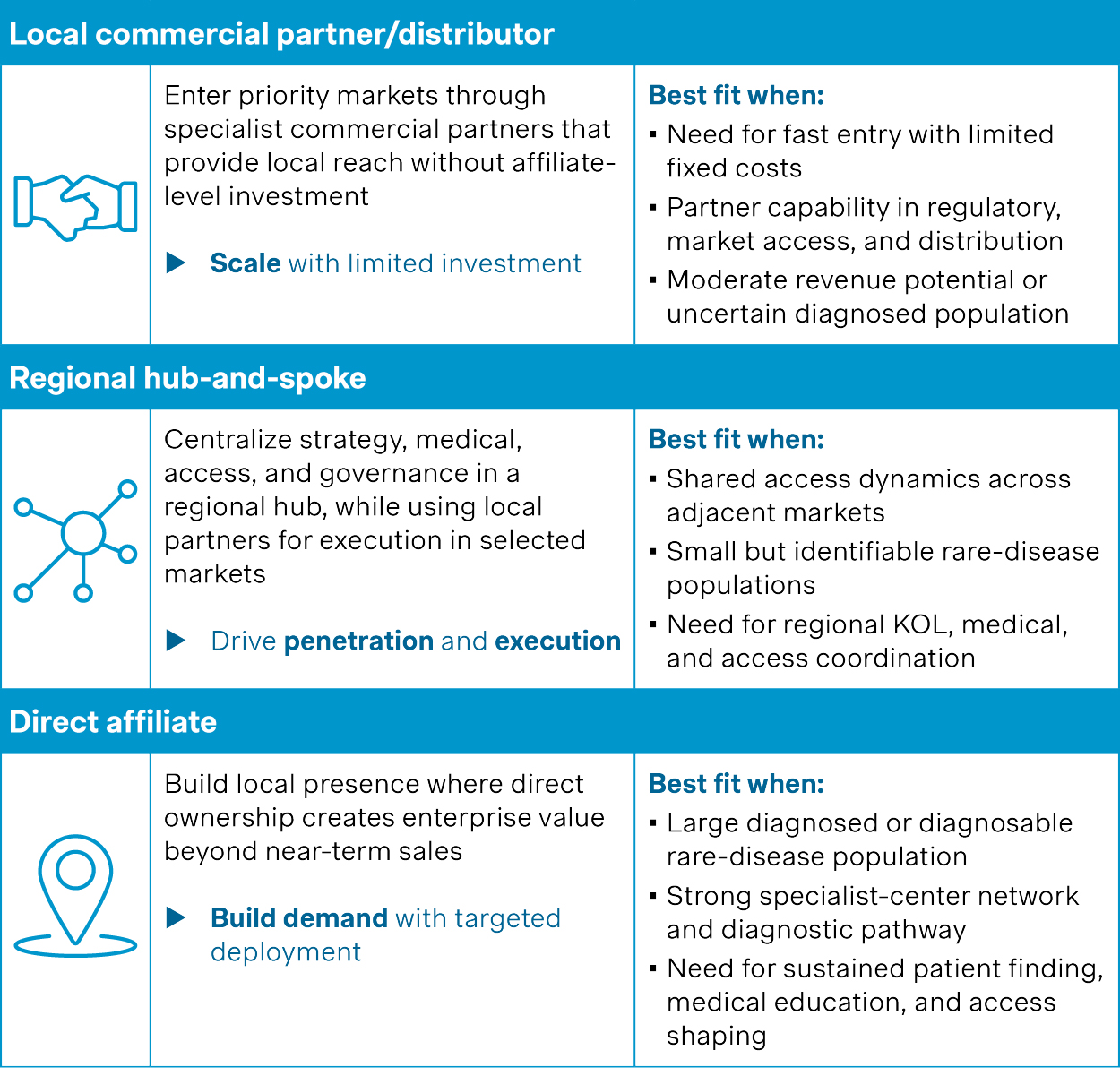
The appropriate operating model depends on the balance the biotech wants to strike between investment, control, and execution speed. Most emerging-market strategies rely on one or a combination of three operating archetypes: direct affiliate, local commercial partner or distributor, or regional hub-and-spoke.
Local commercial partners are often the most practical starting point when market potential does not justify building an affiliate. BridgeBio's commercialization partnerships for acoramidis, their pioneering cardiomyopathy treatment, with regional powerhouses such as DKSH show how biotechs can leverage established regulatory, market-access, and commercial capabilities to enter new markets with limited upfront investment.
Direct affiliates and regional hub-and-spoke models become more attractive when long-term value depends on capabilities that are hard to outsource. Ultragenyx’s Latin American expansion shows how initiating and sustaining local ownership can pay off. Their consistent engagement in a high-need market helped make Mexico the only country where all its products are commercially approved.
Source: Simon-Kucher insights
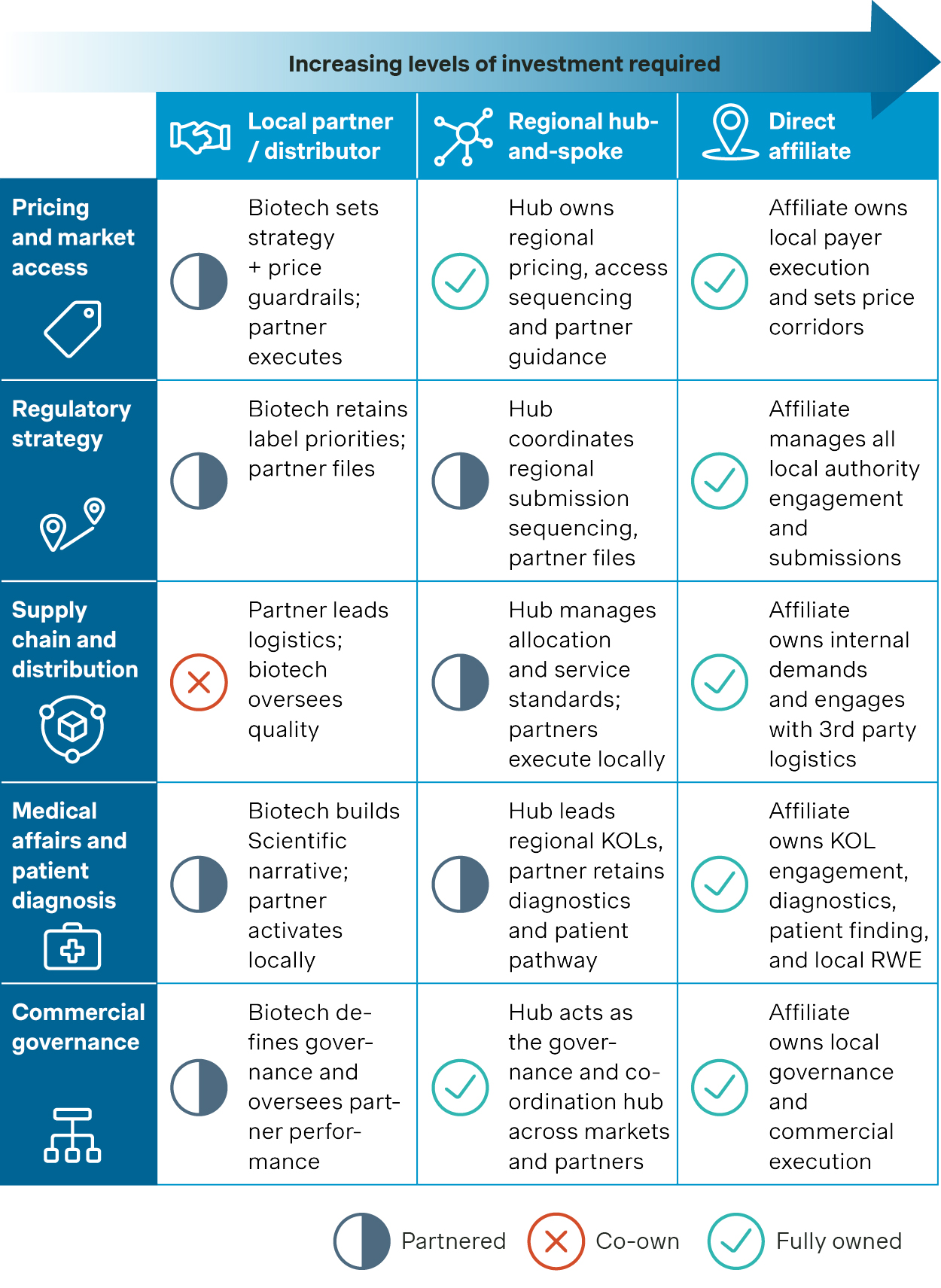
Selecting the operating model is only one part of launch readiness. Companies must also ensure that pricing, regulatory, supply chain, medical and governance capabilities are in place, retaining ownership only where those capabilities create competitive advantage.
Source: Simon-Kucher insights
In our experience, companies that design these capabilities alongside the operating model execute more consistently and effectively than those treating them as separate workstreams.
A notable GtM model suitable for certain biotech companies involves partnering with local manufacturing partners or governmental agencies to solve specific local health concerns, usually revolving around infectious diseases or vaccine-based products. This model was particularly evident during the Covid-19 pandemic, where multiple biotechs developing vaccines signed localization agreements with nations around the world to develop and manufacture vaccines for their local populations, such as Novavax partnering with Serum Institute of India and Gavi/COVAX to scale access to its Covid-19 vaccine for LMICs, and Arcturus partnering with VinBioCare, part of Vietnam’s Vingroup, to establish local drug-product manufacturing for its investigational self-amplifying mRNA Covid-19 vaccine, with VinBioCare sponsoring a large Vietnam-based clinical program.
Beyond Covid-19, this model is increasingly relevant for biotech companies developing vaccines and infectious-disease products for endemic or outbreak-prone markets. Valneva, for example, partnered with CEPI, the EU, and Brazil’s Instituto Butantan to support access to its chikungunya vaccine (IXCHIQ) in low- and middle-income countries, including local clinical development, regulatory approval, and local manufacturing in Brazil. ANVISA granted IXCHIQ marketing authorization in 2025, and later authorized Instituto Butantan’s local manufacturing in 2026, creating a pathway for potential integration into Brazil’s public health system. BioNTech offers a broader platform-localization model. Through its Kigali BioNTainer facility in Rwanda, supported by CEPI and later by blended European Commission and EIB financing, the company is building local mRNA R&D and manufacturing capacity intended to support vaccines for malaria, tuberculosis, HIV, mpox, and future epidemic threats.
The model links biotech-owned platform technology with regional public-health priorities and pandemic preparedness goals.
A framework for commercialization decisions
In summary, there is no one-size-fits-all commercialization model for emerging markets. The right approach depends on the specific therapy, the market opportunity, and the company's strategic priorities.
Before entering a new market, biotech leaders should answer four questions:
- What are the strategic priorities for the company and the therapy?
- Which markets offer the strongest combination of access feasibility, price potential, and speed-to-access?
- Which commercialization model provides the right balance of investment, control, and long-term value creation?
- Which capabilities should remain under direct ownership, and which can be delivered through trusted partners?
For biotechs, success depends on turning scarce resources into focused impact. To succeed in emerging markets, biotechs must make deliberate commercialization decisions, prioritize the right markets, select the appropriate commercial and operating model, and selectively invest in key capabilities that create differentiated value. When executed well, this approach enables biotechs to unlock the full value of emerging markets, accelerate time-to-revenue, and build a scalable foundation for future launches.
At Simon-Kucher, we combine deep emerging-market expertise with extensive experience supporting biotech launches to help companies unlock growth beyond traditional markets. Contact us to explore how we can support your biotech’s commercial success.
Thanks to contributions from Irene Garcia Martin and Cheng Kai Lim!