
Marketing in financial services is shifting from manual execution to intelligent orchestration. Discover how an AI-first operating model combines AI agents, real-time contextualization, and dynamic budget optimization with human strategy and creativity to drive commercial growth.
Marketing teams have spent years becoming more digital. The next shift is different.
AI does more than write copy, produce campaign variants, or generate reports. It changes how marketing work gets planned, executed, measured, and improved. What began as support for content creation is becoming an operating model: AI agents run tasks, customer interactions adapt in real time, and budgets move toward the channels that create the highest return.
For financial services leaders, this raises a concrete question: How do you redesign marketing when execution is largely automated, customer journeys increasingly start inside AI interfaces, and performance can be optimized continuously rather than reviewed after the fact?
The answer is not to add more disconnected AI tools. It is to build an AI-first marketing model in which automation, data, governance, and human judgment come together as one commercial system.
Why AI-first marketing requires a new operating model
Most marketing organizations still operate around channels, campaigns, and periodic planning cycles. Teams define segments, create messages, allocate budgets, launch campaigns, and then review performance. This model can work, but it is too slow for an environment where customer signals, media costs, competitor actions, and AI-generated recommendations change continuously.
Our analysis identifies five shifts that define AI-driven marketing in financial services:
- AI takes over core marketing tasks, not just content creation.
- AI agents become the interface between customers and brands.
- Real-time contextualization replaces traditional personalization.
- Smarter marketing delivers greater impact with smaller budgets.
- The future of creativity combines AI-driven insights with human storytelling.
These are not separate technology trends. Together, they point to a different role for marketing: less manual execution, more intelligent orchestration.
That shift changes how teams work, how they organize, and how they manage performance. Marketing teams will still need strategy, brand judgment, creative taste, and commercial accountability. But teams will do more of that work through AI-enabled workflows that generate content, prioritize audiences, adjust budgets, and test alternatives faster than any manual process.
1. Move from campaign execution to agent orchestration
AI agents are beginning to take over tasks that used to require large execution teams: keyword selection, content generation, segmentation, budget allocation, performance review, and optimization.
Marketers do not become irrelevant. Their value simply moves.
In an AI-first model, marketers define the commercial objective, provide strategic input, set boundaries, review quality, and steer performance. AI agents then execute the workflow, learn from results, and improve with each iteration. The organization moves from doing every step by hand to orchestrating a system that runs continuously.
The commercial upside is clear: lower manual workload, faster time to market, and more campaign volume without scaling headcount at the same pace. But the risk is equally clear. Without governance, AI-led execution can lead to inconsistent messaging, poor-quality output, unmanaged spending, or customer experiences that feel automated in the wrong way.
The management task is therefore not just to automate, but to automate under control.
2. Prepare for the shift from search to AI-mediated discovery
Customers are already using AI tools to research, compare, and decide. In that environment, brands no longer influence demand only through websites, apps, search ads, and direct journeys. They must also influence the AI systems that now sit between the customer and the brand.
This changes the logic of acquisition.
Traditional SEO is still important, but it is no longer enough. Marketing teams need to make their content discoverable, structured, consistent, and trustworthy enough for AI assistants to use. The new requirement: make sure that LLMs (large language models) can find your brand, trust it, and recommend it – through well-structured content and credible authority signals.
This is especially relevant in financial services, where trust, clarity, and comparison matter. If an AI assistant recommends banking or insurance options, the brand's visibility depends on more than ranking on a search results page. It depends on whether the brand has proof points, reviews, third-party mentions, and structured product information that AI systems can interpret and reuse.
For leaders, the practical question becomes: are we optimizing only for human visitors, or also for the AI systems that may guide those visitors before they ever reach us?
3. Replace static segmentation with real-time contextualization
Personalization has often meant assigning customers to predefined segments and targeting them with the next-best campaign. AI makes this more dynamic.
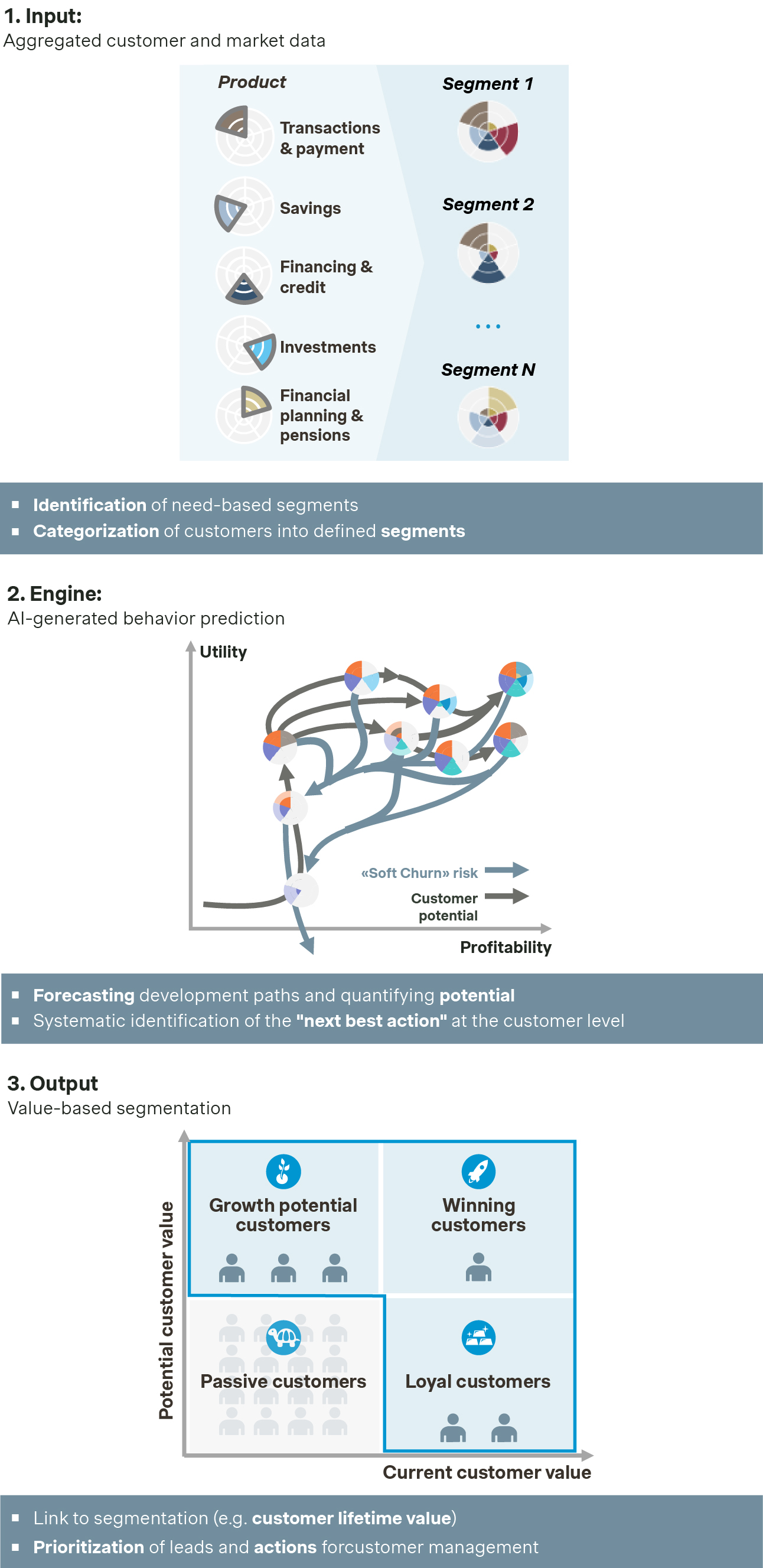
With the right data foundation, marketing can move toward real-time contextualization: offers and messages adapt to live customer behavior, next-best actions are recalculated with each interaction, and each customer’s value potential is assessed continuously.
This matters because financial services needs relevance, not just reach. A customer landing in a new country, changing employment status, opening an investment account, or showing signs of churn does not need a generic segment journey. They need a timely, useful, and commercially sensible interaction.
The customer value example below shows the logic: aggregated customer and market data feed an AI-generated behavior prediction engine, which segments customers by value and ranks the next-best action.
Source: Simon-Kucher
The point is not segmentation for its own sake, but better decisions at the customer level: who to contact, when, with what offer, and through which channel.
This is where AI-first marketing connects directly to revenue growth, retention, and customer lifetime value.
4. Optimize budgets continuously, not periodically
Marketing budget decisions are often too static. Teams allocate spend across channels, observe results, and adjust after performance reviews. AI-driven marketing mix models make this process more responsive.
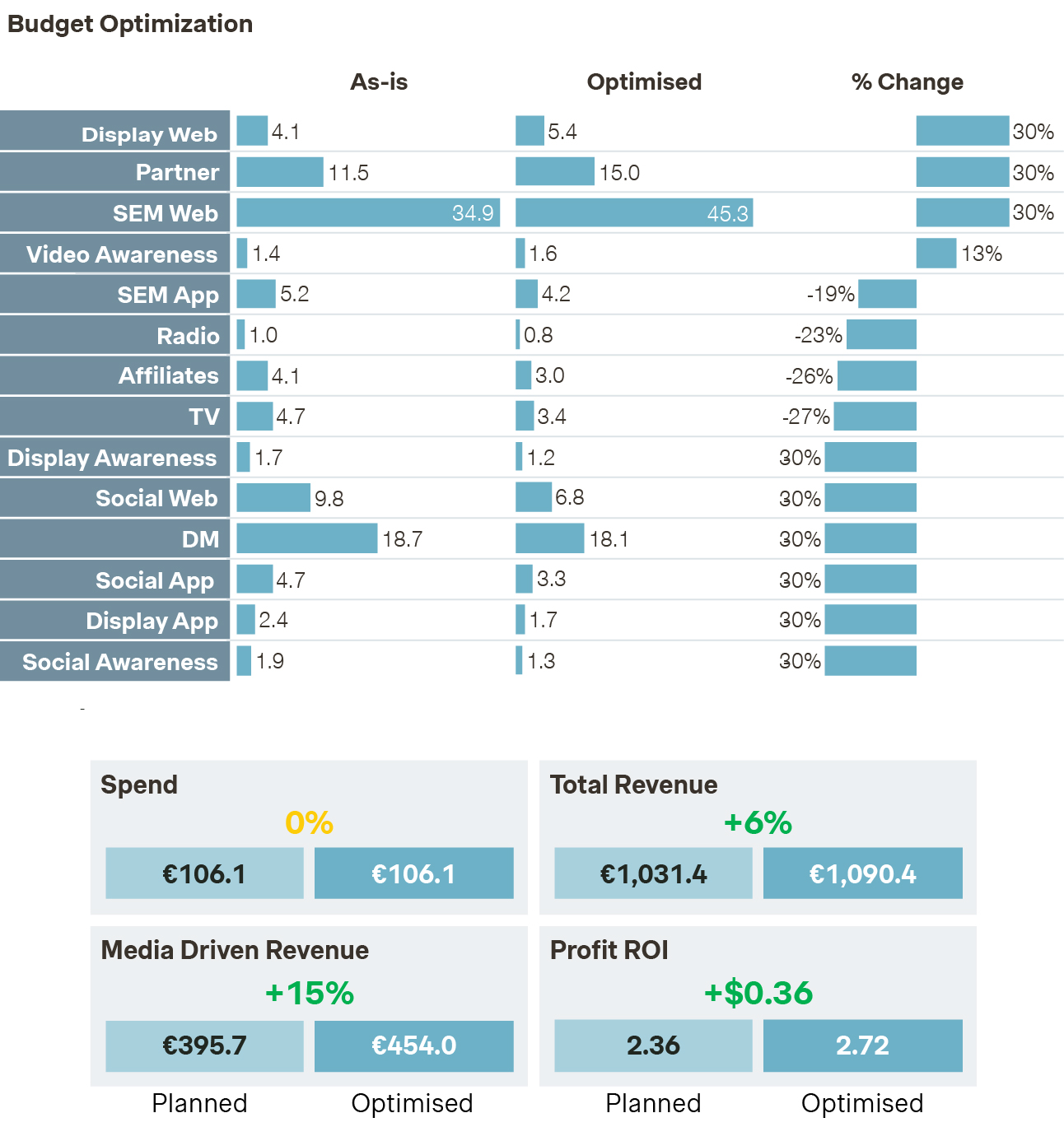
One banking case shows how it works: an AI-driven marketing optimization model delivered a 15 percent uplift in ROAS without increasing total spend. Media-driven revenue rose by 15 percent, total revenue by 6 percent, and profit ROI improved from 2.36 to 2.72.
Source: Simon-Kucher
The lesson is not to copy the exact channel allocation, but that managing marketing performance can become far more dynamic. Underperforming channels come down faster, high-performing channels scale earlier, and budget decisions are tied to forecast revenue and return more closely.
For CFOs and CMOs, this is one of the most tangible entry points for AI in marketing because it links the technology directly to measurable commercial outcomes.
5. Keep human creativity in the loop
The strongest AI-first marketing models do not remove human creativity – they simply change how it is used.
AI can generate variants, predict engagement, personalize assets, and test creative options at scale. Human teams still decide which ideas are on brand, emotionally credible, ethically acceptable, and strategically differentiated.
This distinction matters. If companies rely on AI only to produce more content, they risk creating more noise. If they combine AI-driven insight with human judgment, they get faster campaign cycles, better targeting, and more relevant creative work.
The operating principle should be simple: let AI expand the options and accelerate testing; let humans make the decisions that require taste, trust, and commercial judgment.
How leaders can get started
AI-first marketing does not need a full transformation program to begin. It should start with a few high-impact use cases that can be validated quickly and scaled deliberately.
The practical path has two phases.
First, define a strategy around high-value applications. Assess GenAI readiness, identify and prioritize use cases, and select the three to five opportunities with the highest near-term commercial impact. This should take weeks, not months.
Second, validate and iterate. Design the pilot, build the workflow, launch it, measure performance against commercial and functional criteria, and then decide what should be industrialized.
Three enablers are essential:
- People: new skills and ways of working, including prompt design, AI orchestration, LLM optimization, and performance management.
- Processes: governance, quality control, approval flows, and clear ownership.
- Technical infrastructure: data, integrations, model access, usage tracking, and controls for tokens, agents, and SaaS subscriptions.
Without these enablers, AI remains a set of experiments. With them, it becomes an operating capability.
Conclusion
AI-first marketing is not about replacing the marketing function. It is about redesigning it around a new division of labor.
AI can execute, test, optimize, and personalize at scale. Human teams set the commercial direction, protect the brand, interpret results, and decide where growth should come from next.
The companies that move early will not just produce more content or run cheaper campaigns. They will build marketing systems that learn faster, respond more precisely, and connect activity more directly to business value.
Our Simon-Kucher Elevate experts help companies turn this shift into practical commercial impact: from prioritizing use cases and designing AI marketing operating models to running pilots, setting up governance, and scaling what works.
Ready to redesign your marketing operating model? Talk to our Simon-Kucher experts about where to start.