
In 2026, two of the world's most aggressive digital challenger banks Nubank and Revolut received conditional approval to become fully chartered US banks. Both are on track to operate as standalone banks and accept FDIC-insured deposits in the first half of 2027.
However, Nubank is not waiting for 2027 to start the race. In early September, the Latin American digital banking giant partnered with Lead Bank to launch a full suite of bank products including high-yield savings, fee-free wire transfers, and cashback credit cards.
Nubank’s accelerated US launch suggests the push to disrupt the largest and most fragmented banking market in the world is moving faster than expected. US incumbents should treat Nubank and Revolut’s arrival as a credible competitive threat.
Nubank serves 131 million customers and generated $2.9 billion of net income in FY2025, Revolut serves more than 80 million customers and generated $6 billion of revenue and $2.3 billion of profit before tax in 2025. These are not early-stage fintechs arriving in search of product-market fit. They are scaled, profitable financial institutions that have already built broad consumer franchises outside the United States.
Three factors make this entry different from earlier foreign fintech attempts: Nubank and Revolut bring bank-scale economics, they have repeatedly shown that they can land with a focused proposition and expand, and they are entering a US market where customer primacy is becoming more fluid.
Three reasons this entry is different
They arrive with scale - and economics to use it
Scale matters because it changes the economics of market entry. Nubank's monthly cost to serve has remained below $1 per active customer, while its customer base and revenue per active customer have continued to grow. Revolut, meanwhile, has developed a diversified model spanning subscriptions, card payments, foreign exchange, wealth, lending, and business banking; in 2025, 11 separate product lines each generated more than roughly $135 million of revenue.
That creates strategic room that many earlier challengers did not have. Both can invest in acquisition while funding their US expansion from profitable businesses elsewhere. Their operating leverage also gives them more freedom to use pricing as a structural tool: lower fees, sharper foreign-exchange economics, attractive rates, or more generous product bundles can be sustained for longer when the underlying cost base is lower and monetization is diversified.
For incumbents, the issue is not whether they can match a single promotional rate. Large US banks can respond aggressively when they choose. The harder question is whether they can defend the same customer economics across segments while carrying branches, legacy infrastructure, and more complex operating models. For US fintechs, the bar also rises. They may increasingly compete with challengers that combine fintech product velocity with the funding, balance sheet, and multi-product economics of a world-class bank.
They have already proven the land-and-expand playbook
Neither company built its franchise by launching every product at once. Nubank repeatedly entered markets with a focused proposition, originally centered on the credit card, and then expanded into accounts, lending, investments, insurance, payments, and other financial services as customer engagement deepened. The sequence differed by market, but the commercial logic was consistent: win a clear job, build trust and data, then earn the right to capture more of the relationship.
Revolut followed a different route but a similar logic. Its original wedge was international money movement and foreign exchange. From there it expanded into everyday banking, premium subscriptions, wealth, credit, rewards, and business services across dozens of markets. The result is a broad platform that can monetize the same customer through multiple financial needs.
This matters because the US entry does not require either company to win the whole banking relationship on day one. A narrow foothold can be enough. If that foothold creates frequent engagement, useful data, and a reason to trust the brand, the product set can expand behind it.
The US customer relationship is becoming more contestable
The US has historically been a difficult market for foreign digital challengers. Consumers are already banked, major incumbents have strong digital propositions, and financial needs are served by a dense ecosystem of banks, card issuers, brokerages, wallets, lenders, and payments platforms. But that same fragmentation is weakening the idea that one institution must own the full relationship.
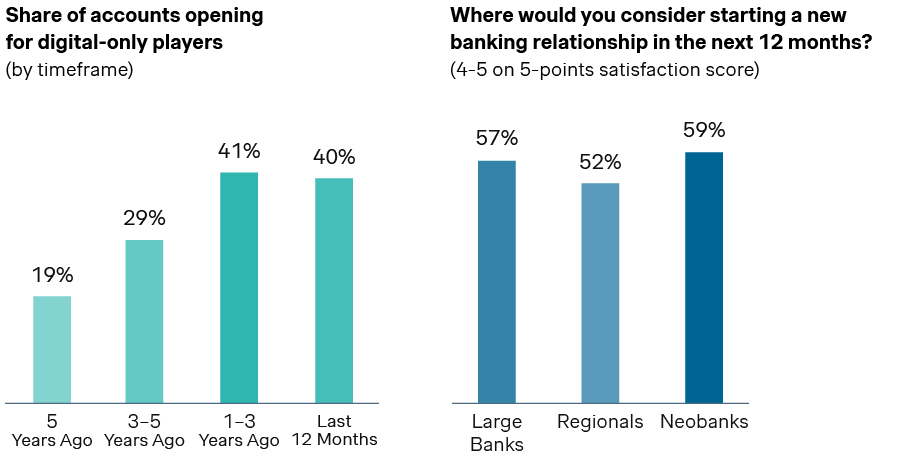
Simon-Kucher's 2026 Global Neobanking Study shows that digital-only banks captured 40% of US accounts opened in the previous 12 months. In the same research, 59%of US consumers said they would consider starting a new relationship with a neobank, slightly ahead of large banks. The primary bank is still important, but it is no longer a moat.
Source: Simon-Kucher Global Neobanking Study 2026
Younger, digitally native consumers reinforce that shift because they are already accustomed to splitting financial activity across apps. AI could accelerate it further. As product discovery moves from a bank's own channels toward assistants that compare rates, fees, rewards, cross-border options, or credit products, the next financial decision becomes easier to reroute. Strong brands, transparent propositions, and attractive economics become more visible at the moment of choice.
That creates a potentially powerful acquisition funnel for Nubank and Revolut. Their advantage in an AI-mediated discovery environment would not come from AI alone. It would come from being able to show up with a recognizable digital brand, a simple proposition, and pricing that their unit economics can support.
The proven US fintech GTM playbook: Win one job, then expand
The first generation of successful US fintechs started with a narrow job-to-be-done where the incumbent experience was weak or expensive, built habitual engagement around it, and expanded from there. Chime built relevance around paycheck access and fee-free everyday banking; Robinhood around simple, low-cost access to investing; and SoFi around student-loan refinancing. All three now compete across a much broader set of financial needs than their original wedge.
That makes cross-border customers a plausible US foothold for both Nubank and Revolut. Expatriates, immigrants, frequent travelers, and households whose financial lives span countries face specific frictions around foreign exchange, remittances, payments, and managing money across markets. Revolut's original proposition was built around precisely these needs, making the segment a natural extension of a playbook it has already used internationally.
Nubank has already started. Roughly 4-5 million customers from Brazil, Mexico, and Colombia regularly use the app and make purchases in the US. For Nubank, the initial GTM challenge may therefore be less about creating awareness from zero and more about extending an existing relationship across the border.
If either player can solve that job materially better - through lower fees, better foreign-exchange economics, simpler cross-border money movement, or a more tailored digital experience - the value of the wedge goes beyond the first transaction. It creates engagement, data, trust, and a lower-cost path into checking, cards, credit, savings, and wealth. Cross-border banking can therefore be the landing point: a US version of the same land-and-expand logic already proven by domestic fintechs and by Nubank and Revolut in other markets.
What incumbents should worry about, and do now
In the short term, the exposure is concentrated but real. Banks and fintechs serving expatriates, internationally mobile customers, remittance and foreign-exchange use cases, or highly price-sensitive consumers are the most obvious targets. These customers have a clear reason to try a new provider, and Nubank and Revolut have the scale and unit economics to compete aggressively on the attributes that matter most: price, convenience, and cross-border functionality.
The longer-term threat is more consequential. If the initial wedge works, both entrants can broaden into deposits, cards, lending, savings, investments, rewards, and other everyday financial services. They do not need customers to abandon their primary bank on day one. They need to own one meaningful financial job, then use that relationship to win the next one. That is how a narrow segment can become a broader challenge to customer primacy.
Incumbents should not wait for Nubank or Revolut to become mainstream US banks before responding. By then, the more important battle may already have been lost: the initial relationship and the data, engagement, and permission to expand behind it. Nubank and Revolut arrive with mass scale, proven profitability, and repeatable land-and-expand models. The near-term threat may begin with cross-border customers; the strategic threat is what they can build from that staging point.