
Within any Revenue Growth Management (RGM) framework, Portfolio Price Architecture (PPA) is a foundational strategy that helps consumer brands structure their pricing, products, and packs. PPA ensures that each product in your portfolio has a defined role and price point, serving different needs and shopper segments. Active Mix Management builds on this by helping brands continuously steer the right assortment across channels, retailers, and customers.
As consumer behaviors evolve and channel dynamics become more complex, traditional PPA is no longer enough to fully capture market potential. Brands need to both design the right portfolio and actively manage how that portfolio is deployed in the market.
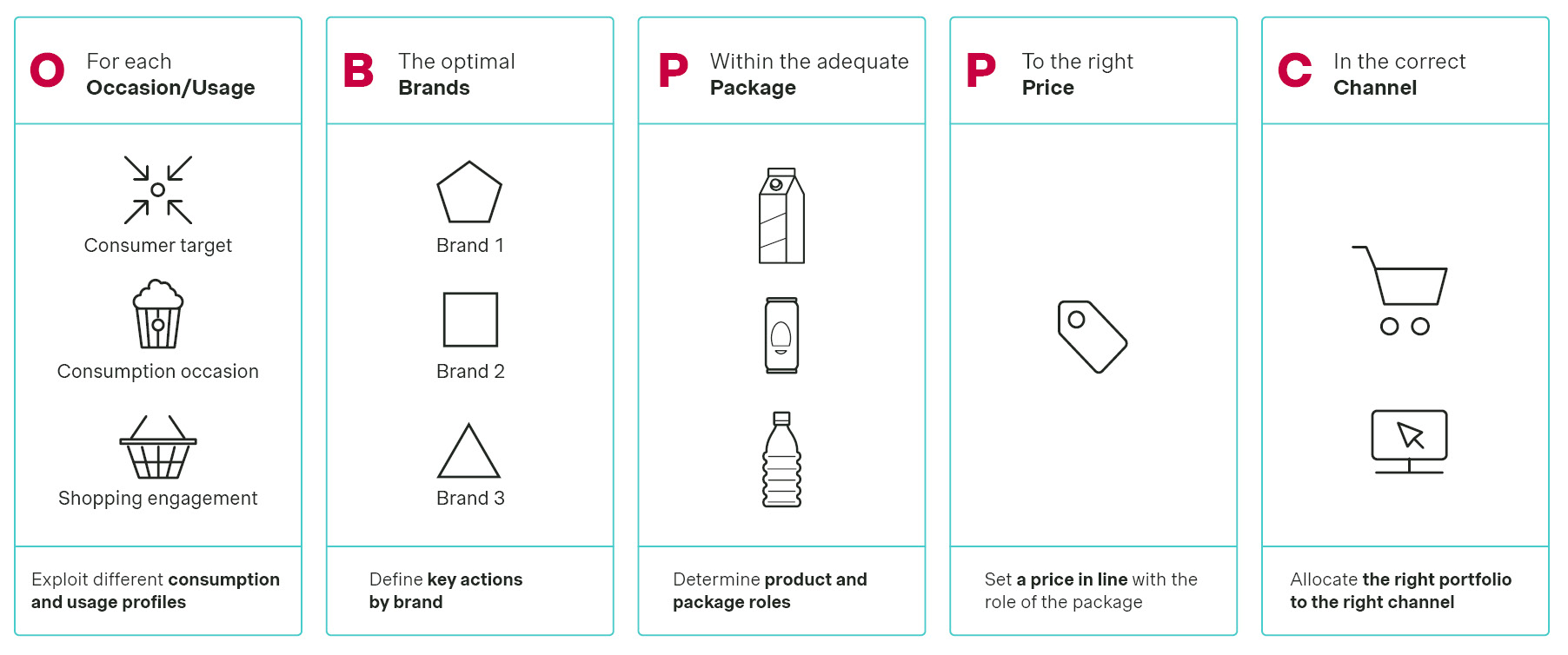
That’s where OBPPC (Optimized Brand, Price, Pack, and Channel) and Active Mix Management come in.
Source: Simon Kucher
OBPPC takes PPA to the next level by integrating deeper consumer insights, consumption occasions, and shopper missions into your pricing and product strategies. Combined with Active Mix Management, it provides a more holistic approach by connecting product formats, price points, channel strategies, and assortment decisions. This ensures you not only meet demand but also actively steer your mix to drive category growth and profitability.
Many CPG companies manage multiple brands within their portfolio, each serving a different need or consumption occasion. An integrated PPA and Active Mix Management approach ensures you are serving more consumers, more often, with the right products, pack sizes, and price points in the right channels. This blend of consumer needs, product architecture, channel differentiation, and active assortment management drives both frequency of purchase and basket size.
By linking PPA and Active Mix Management with the broader RGM framework, brands can unlock higher value, improve portfolio productivity and profitability, and stay competitive across channels. In this article, we explore how this approach can optimize your portfolio and deliver lasting growth.
The consumer-first approach
Traditional PPA focuses on the product alone, but a successful OBPPC and Active Mix Management strategy requires putting the consumer and shopper first. Too often, manufacturers launch products without considering how they fit into the broader brand and product hierarchy. This fragmented approach leads to overlapping products that confuse consumers and dilute your brand’s overall value proposition.
In contrast, OBPPC is not just about launching new products. It’s about doing so profitably and ensuring the resulting portfolio continues to perform. It involves considering the entire portfolio, from brand positioning down to specific pack sizes, through the consumer and shopper lens. Active Mix Management then helps translate this architecture into the right assortment for different channels, customers, and shopping missions.
The consumer is the end user, the one who will actually consume your product. The shopper is the person making the purchase decision in-store or online. As the consumer and shopper can be two different people, this approach helps you meet the needs of both.
You want your new products to grow the category, not compete with your own offerings or push consumers to lower-margin items. PPA and Active Mix Management help avoid pitfalls like cannibalization or trading down within your portfolio. They also ensure you’re not oversaturating the market with too many products that fulfill the same need, streamlining your assortment while maximizing its relevance and productivity.
What does PPA and Active Mix Management with Simon-Kucher look like?
When we help brands develop their PPA and Active Mix Management strategy, we begin by deeply understanding your business, your shoppers, your consumers, and your market. Our approach is tailored, structured, and grounded in consumer insights, market data, and profitability. Here’s what working with us looks like:
Understanding shopper missions and channel dynamics
We start by analyzing the different shopper missions across each of your sales channels. Is the mission about bulk shopping for the week, a quick top-up, or an on-the-go purchase? Each mission demands a different product-pack-price strategy. For example, a stock-up mission in a hypermarket might call for larger pack sizes, while a top-up mission in a convenience store would require smaller, single-serve packs. We map these shopper missions to your channel strategy to ensure your offerings align with consumer behavior.
Defining product roles
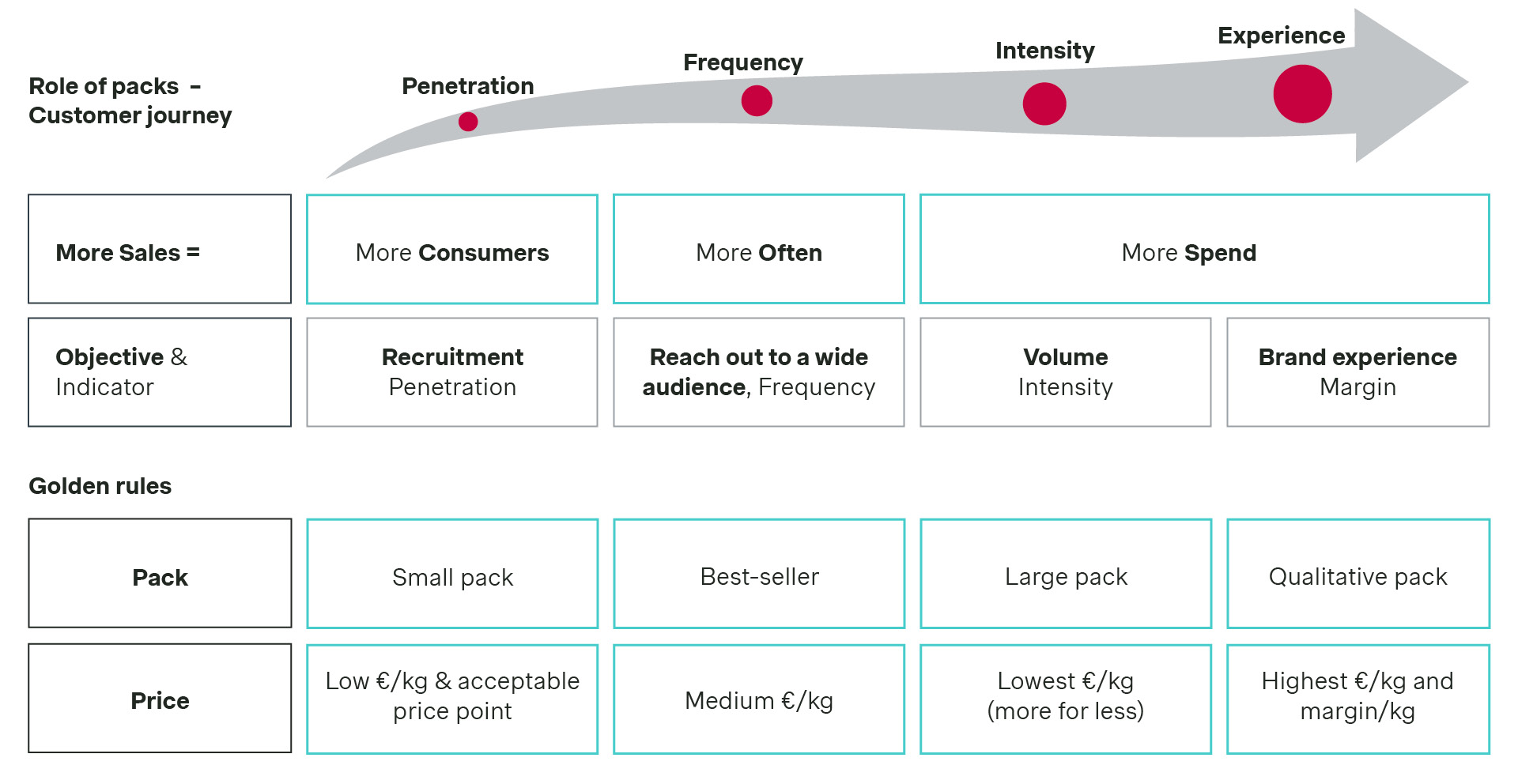
Once we understand the shopper missions, we help you define the role of each product in your assortment. Different products serve different purposes, and it's crucial to get this right for growth:
Penetration products: These are your entry-level products, often priced at a compelling price point to recruit new consumers. The goal here is to increase penetration, bringing new customers into the category.
Frequency products: These products target repeat purchases, often in slightly larger sizes, encouraging your existing consumers to buy more frequently.
Upsize products: Here, we focus on increasing the average transaction value by offering larger pack sizes or premium formats, encouraging consumers to spend more.
Experience products: These offerings deliver a premium or differentiated experience, often at a higher price point. The goal is to attract consumers less sensitive to price per unit and more focused on quality or uniqueness. Characteristics include special packaging formats, higher-quality ingredients, or limited editions that command a price premium..
![Role of packs - customer journey]() Source: Simon Kucher
Source: Simon Kucher
 Source: Simon Kucher
- Tailoring packs and pricing to consumption occasions
A key pillar of OBPPC is matching your product offering to the right consumption occasion. Whether your product is consumed individually, in groups, with meals, or on the go, the pack size and price should fit the moment. For example, a soft drink for an individual at lunch may come in a smaller pack size compared to a larger, family-oriented option consumed at a gathering.
How the product is presented, whether it’s a sleek aluminum bottle, an eco-friendly package, or a bulk pack, also plays a critical role in shaping consumer perceptions and driving purchase decisions. We analyze consumption occasions across channels and regions to ensure your pack formats are optimized for each scenario.
Market and competitive analysis
To stay ahead, it’s critical to know your market and competitors, as well as how your own portfolio is performing. We analyze the market landscape alongside performance across channels, retailers, and SKUs.
For example, if you’re competing in the soft drink category, we look at the entire range of cans, bottles, and multi-packs offered in your market. We assess competitor price points, pack sizes, and formats and compare them with your own.
By understanding where volume and profit growth are happening and identifying gaps, or white spots, in your current offering, we help you make data-driven decisions about where to focus your efforts. This can include introducing a new pack or price point, differentiating assortments by channel, or reallocating focus toward the SKUs and categories with the greatest potential.
Aligning product and pack strategy with consumer segments
We also help you define the consumption occasions and consumer segments that matter most to your brand. For example, are you targeting kids who need small-sized beverages for breakfast, or families who need a larger pack for dinner? We map your product offering to each segment and occasion, ensuring you’re covering all important use cases with the right pack size and format.
This also helps determine where differentiated assortments make sense across channels and customers, rather than applying the same portfolio everywhere.
Consumer testing and validation
Once we’ve defined the optimal product and pack architecture, we put it to the test. Through consumer surveys and shelf simulations, we gather direct feedback on your products. For example, we create a virtual supermarket shelf with your and competitor products, asking consumers which one they would choose. This helps us understand preferences around pack size, price, and format, as well as how consumers react to new products or packaging.
Optimizing price architecture and margins
When setting your final prices, we ensure your price per unit makes sense across pack sizes. We shape the price architecture so that consumers feel they’re getting a better deal as they trade up to larger sizes, which is crucial for encouraging up-trading and maximizing profitability. Additionally, we’ll guide you on how to leverage premium products for higher margins without alienating your core consumers.
Building a three-year growth plan
PPA and Active Mix Management are not short-term fixes. They provide a strategic approach to delivering sustainable growth over the long term. Once we’ve analyzed the market, defined your product roles, and validated your assortment, we work with you to build a growth plan that spans one to three years.
This plan factors in supply chain considerations, ensuring you have the production capacity to meet demand, and aligns your promotional strategy across channels and retailers. We also recommend which products to phase out, where to launch new offerings, and how to manage the transition smoothly without disrupting sales or distribution.
This is exactly the combination we at Simon-Kucher value: consumer insight, market data, and profitability.
Ready to strengthen your portfolio through PPA and Active Mix Management? Let’s work together to identify the right product, pack, price, and channel for every consumption occasion. Reach out to our experts today.