
AI is creating growth for software companies while changing how customers buy, use, and pay for their products. Our Global Software Study 2026 reveals where commercial models are falling behind and what leaders should do next.
Software companies have spent years asking how quickly they can bring AI into their products. Now comes a harder question: How much of the value they create can they truly capture?
Based on surveys of 492 software executives and 200 software buyers, our Global Software Study 2026 finds that 79% of executives say AI is already increasing revenue. Yet, 62% see at least a moderate risk of AI displacing their core products within two years.
Our study exposes an AI commercialization gap: AI is already driving software revenue growth, but the commercial models needed to capture that value profitably are not keeping pace. Customers are investing and finding value, while vendors are still refining how they prove value, charge for AI, and manage delivery costs.
For software leaders, that raises an uncomfortable prospect. An AI offering can win customers and grow revenue without strengthening the underlying business. Here is where the gaps are appearing, and how to close them.
Bigger AI budgets, tougher questions for incumbent software
Buyers are putting money behind AI. 86% expect AI-related software budgets to increase by at least 10% over the next two years, compared with 43% anticipating equivalent growth in traditional software spending. Conventional software budgets remain resilient, suggesting AI can create additional demand rather than simply replace existing purchases.
That does not mean today's vendors will automatically capture it.
Predictions of a widespread SaaS collapse (SaaSpocalypse) have made headlines, but our findings point to a more measured shift. Only 7% of buyers have already replaced a traditional software solution with an AI substitute. However, 36% have built or piloted alternatives, and another 27% are exploring them. The threat is more visible in experimentation than in completed replacement.
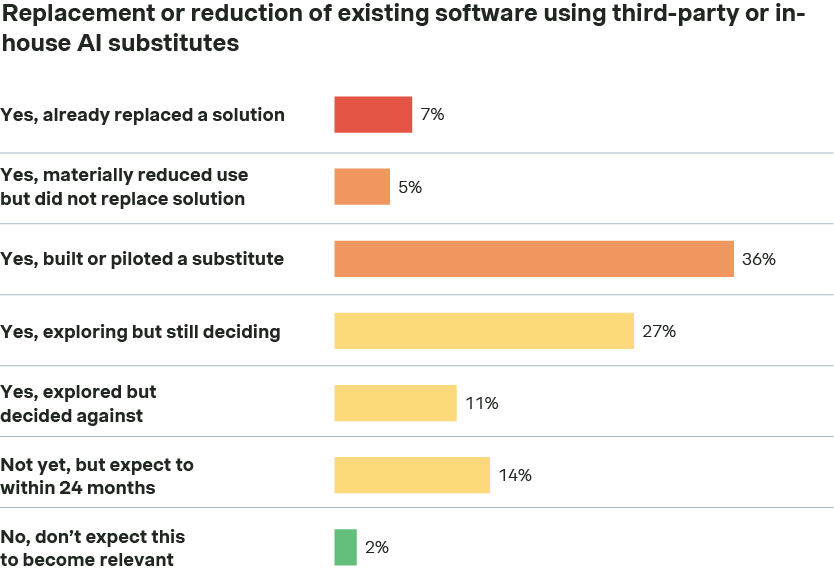
Source: Simon-Kucher: AI-Driven Replacement
Exposure also varies. Buyers consider customer service (53%), productivity software (43%), and analytics and business intelligence (42%) the categories most likely to face replacement or material usage reductions. Deeply embedded systems appear harder to dislodge.
Software executives know differentiation matters. They rank domain expertise and trust (59%), product capabilities (57%), and embedded customer workflows (56%) as stronger defenses than cost advantage. Adding AI features alone is unlikely to protect a product that customers can easily substitute.
There is an offensive opportunity, too.
81% of buyers expect at least 5% of external-services spending to shift toward software and AI over the next two years. Vendors can pursue work currently funded through service providers, provided they demonstrate the economic benefit of automating it. While 72% of buyers would initially fund such tools from software budgets, 52% would also consider reallocating external-services or labour budgets. That gives vendors a practical route into spending that has historically sat outside IT.
The next best move is to choose where to reinforce the existing portfolio and where to pursue new workflows before competitors do.
The widening gap between AI value and financial proof
One of the study's sharpest contradictions sits with buyers. 98% say AI capabilities have met or exceeded their expectations for meaningful value as promised by the software vendor, yet only 4% measure AI's business impact across the enterprise.
Positive experiences are not automatically becoming investment-ready business cases. While 58% report AI deployment across selected teams or functions, only 17% say it is broadly embedded.
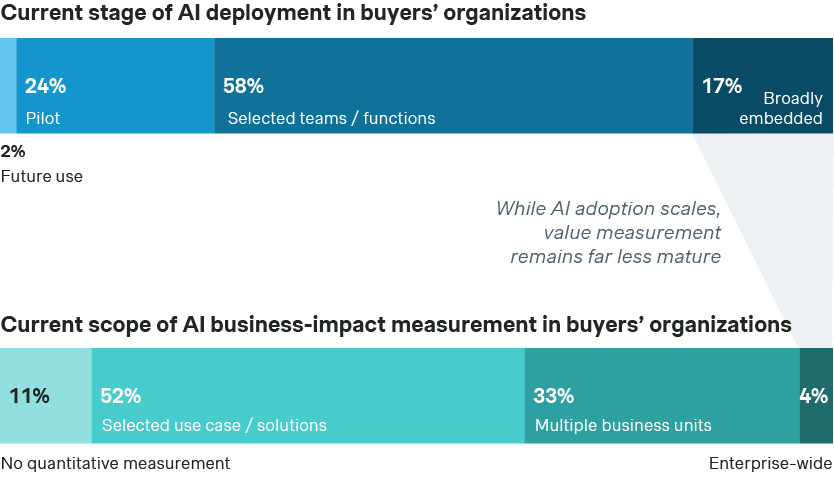
Source: Simon-Kucher: AI Value is broadly real, but measurement still trails adoption
For buyers without broad deployment, the leading barriers are security, privacy, or compliance (50%), systems integration (34%), and cost predictability (33%). Only 15% cite insufficient value or ROI.
Getting AI approved and operational across the enterprise is proving harder than demonstrating its potential.
That approval comes with a demanding burden of proof. 66% require quantified financial benefits or ROI, 61% require CFO or finance approval, and 55% expect payback within 12 months.
Consider an AI-enabled customer service product. A demonstration of faster responses helps, but finance needs to know how much handling time decreases, what that saves, and when the investment pays back. Security needs confidence in how data is handled.
Vendors must establish a baseline before deployment and agree on measurable outcomes. If the business case depends on adoption, the payback calculation should use realistic uptake rather than assume every user changes their behavior immediately. Those results should inform expansion and renewal conversations, rather than forcing teams to resell the original promise each time.
AI pricing is entering a new era of experimentation
Willingness to pay is encouraging. 73% of buyers would accept purchasing premium software tiers to access AI capabilities.
The harder question is how to capture that willingness consistently.
Only 40% of software executives describe their AI monetization models as mostly established or mature and scalable. Meanwhile, 94% have changed or plan to change their approach, and 59% expect revisions to become more frequent over the next two years.
Pricing has become a moving target because the way AI creates value keeps changing.
The share of surveyed vendors using pay-as-you-go consumption is expected to rise from 42% today to 61% within two years. Pre-committed consumption is projected to rise from 30% to 60%, and per-agent or machine-user pricing from 24% to 62%.
These are not mutually exclusive approaches. A subscription may suit software that assists employees, while consumption or transaction charges may better reflect automated work. Most vendors will need more than one option across their portfolios.
Buyers, however, still need budget certainty. 51% favor proactive spending alerts and 48% want hard spending limits to make variable pricing more acceptable.
The commercial task is to select charging units that reflect customer value, then make spending understandable. Clear allowances, commitments, and transparent overage rates can help buyers accept variable pricing without fearing their next invoice. Complexity belongs in the vendor's pricing design, not on the customer's bill.
AI profitability: Rising costs, stronger margin expectations
AI also changes the delivery-cost equation. Model inference and supporting infrastructure create expenses that increase with usage. The software leaders we surveyed expect a median 20% increase in ongoing AI cost-to-serve over the next two years.
Yet confidence in AI's profitability potential remains high. 86% of software executives expect AI to improve gross margins over the same period. Rising delivery costs and improving margins are not necessarily at odds, provided vendors manage their costs and monetization effectively.
The challenge is having enough visibility to do so. Only 23% currently measure AI cost-to-serve at the individual-account or workflow, action, or API level. This can obscure significant differences in profitability. Two customers paying the same subscription fee, for example, may generate very different margins depending on how extensively they use AI.
Software companies are already taking action. Our Global Software Study 2026 shows that 74% are optimizing model and infrastructure costs, 69% are differentiating pricing and packaging, and 60% charge for incremental AI usage to protect margins.
The priority now is to connect usage, customer value, price realization, and cost-to-serve at a meaningful level of detail. Instead of adopting cost-plus pricing for AI, companies must understand where AI can generate profitable growth and where adjustments to pricing, packaging, or delivery costs can improve the economics further.
What happens to software pricing when the user is an AI agent?
Imagine a customer requesting a refund. An AI agent checks the support policy, retrieves the order, initiates payment, and records the outcome across several applications. The underlying software remains essential, but the employee may never open it.
This is no longer a distant scenario. 93% of buyers use, pilot, or plan to use AI tools or agents to access third-party software. 25% already use them, 46% are piloting, and 22% are planning to. Yet only 23% of vendors currently monetize machine or agent usage independently of a human seat.
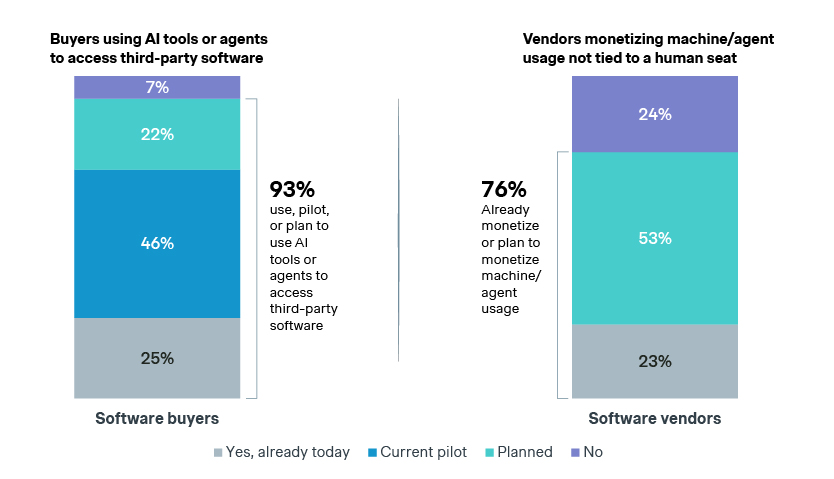
Source: Simon-Kucher: Machine access; Buyer adoption is outpacing monetization as agent access becomes a standard software interface.
The implications reach beyond revenue. Agents can change who controls the customer interface while generating activity and infrastructure costs that seat-based contracts were not designed to capture.
Our findings show that software providers are setting boundaries. 72% say governed agent access is their default policy. But pricing remains unsettled. When considering separately charged agent access, 43% of buyers prefer it bundled into specified product tiers. Only 6% favor per-agent fees.
Simply adding an agent license may therefore miss what customers value. Vendors should first define what machines may access and do. Then, they must measure activity and cost and determine which actions or outcomes warrant a charge.
As AI agents become a new route into software, it’s important to consider which part of the workflow the vendor still owns and how that contribution earns revenue.
A tougher buying committee: Proving value after the sale
Enterprise purchasing is gaining more approval gates. Compared with two years ago, 61% of buyers report greater involvement from information security or risk management, 55% from CFOs, and 50% from data, analytics, or AI governance teams.
A persuasive business case must now work for people asking very different questions. Finance wants a credible return while security seeks controlled access and data protection. Business owners are focused on operational results.
Vendors are investing in the people needed to make that case. 63% have increased spending on Account Executives, 60% on Customer Success Managers, and 50% on Solution Engineers over the past year.
More people will not help much if they tell different stories. The approval case should be developed early, not assembled in response to objections late in procurement. Sales and technical teams need a shared value case that Customer Success can carry through implementation.
The responsibility does not end at the contract.
Among vendors surveyed about Customer Success under usage-based models, 46% say the function owns adoption or usage growth, while 42% say it co-owns expansion or upselling.
When revenue depends on consumption, adoption and realized value become commercial responsibilities. Clear handoffs and shared customer data matter as much as the initial sale.
Closing the AI commercialization gap: Four commercial priorities
Our 2026 study points to four strategic areas for software leaders to focus on.
1. Defend the core and pursue new value pools.
Identify vulnerable, task-based products and deepen the workflow integration, trust, and domain expertise that make them harder to replace. Pursue AI use cases that can automate work funded through labor or external-services budgets.
2. Prove customer value and manage profitability.
Baseline the customer's economics before deployment and quantify realized outcomes afterward. Then, measure AI usage and cost-to-serve at account or use-case level. Customer value and vendor margin need to be visible together.
3. Keep refining AI monetization.
Match charging units to value created through access, consumption, actions, or outcomes. Combine predictable commitments with variable charges where appropriate and give buyers meaningful spending controls.
4. Adapt commercial execution and govern machine access.
Define agent entitlements and monitoring rules. Equip Sales, Solution Engineering, and Customer Success to satisfy finance, security, and business stakeholders, with clear ownership beyond the initial purchase.
At Simon-Kucher, we see these disciplines coming together in an AI Commercialization Control Tower, a recurring management process that connects value proof, pricing, machine access, go-to-market execution, and unit economics. Product, Finance, Pricing, Sales, and Customer Success need a common view of outcomes, usage, margins, and clear decisions on when to scale or redesign an offer. This enables management to identify where existing pricing models leave AI value uncaptured, which customer segments or use cases require pricing or cost adjustments to become profitable, and which AI offerings are ready to scale versus those that need redesign.
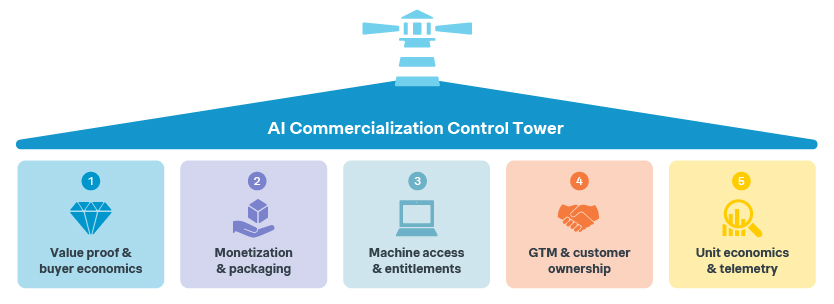
Source: Simon-Kucher: AI Commercialization Control Tower
AI has demonstrated that it can create software revenue. Your next discussion should examine how that revenue is earned and how defensible it will remain.
To explore the complete data set and craft a strategy based on these insights, download the full Simon-Kucher 2026 Global Software Study.
About the Study
Simon-Kucher's Global Software Study 2026 draws on surveys of 492 software executives involved in commercial strategy and 200 software buyers responsible for budgeting, vendor selection, and purchasing. Both surveys were conducted in August 2026 across multiple regions, company sizes, and AI maturity levels. Results reflect respondents' experiences and expectations; question-level sample sizes vary.
Form placeholder. This will only show within the editor